Best Band Saws for Resawing Wide Walnut Boards
What's inside
As an Amazon Associate I earn from qualifying purchases. This post may contain affiliate links at no extra cost to you.
Resawing a wide walnut board is one of the hardest jobs for a band saw. The cut is tall, the blade is under continuous load, and walnut exposes every weakness in setup. A saw that handles ordinary curves and 3/4-inch boards may struggle badly when asked to split a 10-inch-wide, 2-inch-thick board into two bookmatched panels.
The best choice is usually a 14-inch or larger stationary band saw with at least 12 inches of resaw capacity, a rigid upper guide assembly, and enough power to maintain speed in dense hardwood. Wheel size matters, but frame stiffness, guide adjustment, blade quality, and a reliable fence matter just as much.
As an Amazon Associate we earn from qualifying purchases at no extra cost to you.

Contents
What Makes a Band Saw Good for Resawing
Start with resaw capacity. This is the maximum distance between the table and the upper blade guide. For walnut furniture work, 12 inches is a practical minimum. A 14-inch capacity gives you more flexibility for wide boards and lets you resaw a board without running the guide assembly at its absolute limit.
Motor power is useful, but published horsepower figures are not always comparable. A saw with a genuine 1-1/2 to 2 horsepower motor is a sensible target for regular walnut resawing. A 1 horsepower saw can work with sharp blades, modest feed rates, and boards under roughly 8 inches. It becomes frustrating when the cut is tall, the walnut is dry and dense, or the blade is dull.
Frame rigidity prevents the blade from wandering. A heavy cast-iron or welded-steel frame generally holds alignment better than a lightweight benchtop design. Look for a substantial table, a stable trunnion, and a fence that cannot flex when you push a board against it.
The Best Band Saw Types for Wide Walnut
| Band saw type | Typical resaw capacity | Best use | Main compromise |
|---|---|---|---|
| 14-inch floor-standing saw | 10–14 inches | Most furniture shops and serious hobbyists | May need a riser block or upgraded motor for very wide stock |
| 17-inch floor-standing saw | 12–16 inches | Frequent resawing and thick hardwood | Higher cost, larger footprint, and more power requirements |
| Benchtop band saw | 4–6 inches | Small parts and occasional thin resawing | Not suitable for wide walnut boards |
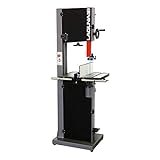
A quality 14-inch floor-standing machine is the value choice for most shops. Many accept a riser block that increases capacity, but a riser does not automatically increase power or stiffness. A 14-inch saw with a riser may cut a 12-inch board, yet it can be less comfortable and more prone to blade deflection than a larger 17-inch machine.
If you routinely resaw boards 10 to 12 inches wide, compare 14-inch floor-standing band saws with at least 1-1/2 horsepower and a 12-inch capacity. For regular production work, a 17-inch resaw band saw is easier to live with because it leaves more room above the table and usually has a heavier frame.
Blade and Fence Requirements
The blade is often more important than the saw. Use a 1/2-inch or 3/4-inch-wide blade designed for resawing, with about 2 to 3 teeth per inch. A hook or skip-tooth pattern clears walnut chips better than a fine scroll-cutting blade. A thin blade may cut with less waste, but it is more likely to deflect in a tall cut.
For a 1-inch-wide board, a 1/2-inch blade is usually easier to tension and steer. For boards 8 inches or wider, a 3/4-inch blade can track more accurately if the saw accepts it and the guides support it correctly. Keep a spare blade available. Continuing with a dull blade creates heat, burns the walnut, and encourages you to force the stock, which makes drift and wandering worse.
The fence should be tall enough to support the board and adjustable for drift. A straight fence set perfectly parallel to the miter slot may still produce a curved cut because many blades naturally track at an angle. Make a short test cut, observe the blade’s actual path, and angle the fence slightly if needed. A tall band saw resaw fence is a worthwhile upgrade if the included fence is short or flexible.
How to Resaw Walnut Safely
Flatten one face and joint one edge before resawing. The jointed edge must ride firmly against the fence; a rough or bowed edge can push the board away from the blade halfway through the cut. Remove metal, dirt, and loose bark before the board reaches the saw.
Mark the intended cut on both ends and along the top face. Set the upper guide roughly 1/4 inch above the board. Feed at a steady rate rather than stopping repeatedly. If the motor slows noticeably, reduce the feed rate. Do not solve a slow cut by pushing harder.
Common failure modes include blade drift, burning, wandering cuts, and pinching. Burning usually means a dull blade, too many teeth per inch, insufficient blade tension, or a feed rate that is too slow. A cut that curves toward the fence often indicates drift or a crowned board. If the kerf closes behind the blade, stop and inspect the board for internal stress; forcing the cut can trap the blade.
Use push sticks or a dedicated resaw push block when your hands would approach the blade. Keep the blade guard in place, wear eye protection, and provide dust collection. Walnut dust is irritating, and resawing produces a large volume of fine material.
When a Cheaper Saw Is Enough
A cheaper 14-inch saw is fine if you resaw only occasionally, limit boards to about 6 to 8 inches, and are willing to tune the guides and replace the stock blade. Spending the difference on a quality resaw blade, a taller fence, and a mobile base can produce better results than buying a larger saw with poor setup.
Choose the larger machine when wide walnut is a regular part of your work, when you need repeatable bookmatched panels, or when you cannot tolerate slow feed rates. The extra capacity and stiffness reduce wrestling, but they do not eliminate the need for a flat board, proper tension, and a sharp blade.