Best Band Saws for Resawing Rough Lumber into Thin Boards
What's inside
As an Amazon Associate I earn from qualifying purchases. This post may contain affiliate links at no extra cost to you.
Contents
Choosing a Band Saw for Resawing Rough Lumber
Resawing means cutting a board through its thickness to produce thinner boards or veneer. Rough lumber makes the job harder than resawing straight, kiln-dried stock because it may be wide, twisted, damp, or carrying hidden tension. The best band saw is not simply the one with the largest throat capacity. It needs enough resaw height, a rigid frame, a reliable fence, a flat table, and enough blade control to keep a wide blade tracking straight.
For most serious home workshops, a 14-inch stationary band saw with at least 12 inches of resaw capacity is the sensible starting point. A 1-1/2 to 2 horsepower motor gives useful reserve when cutting hardwoods 6 to 10 inches thick. A smaller 10-inch saw can be perfectly adequate for occasional work, but it is less forgiving when the board is wide, rough, or slightly bowed.
As an Amazon Associate we earn from qualifying purchases at no extra cost to you.
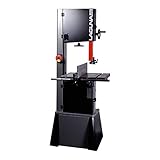
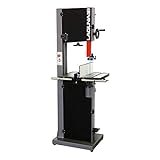

If you routinely cut slabs or stock thicker than 10 or 12 inches, look at a 14-inch band saw with high resaw capacity. Capacity is only useful if the saw can hold the blade under load, however. A tall upper guide post and a large throat opening do not compensate for a flexible frame or an underpowered motor.
Specifications That Matter
| Feature | Good target for resawing | Why it matters |
|---|---|---|
| Resaw capacity | 10 to 14 inches | Determines the maximum board thickness you can split |
| Motor | 1-1/2 to 2 HP | Maintains speed in dense hardwood and wide cuts |
| Blade width | 3/4 to 1 inch | Wide blades resist twisting and track more accurately |
| Throat depth | 13 to 16 inches | Provides room between the blade and frame for wide boards |
| Table size | At least 16 by 20 inches | Supports heavy, unstable rough lumber |
| Fence | Tall, rigid, adjustable | Keeps the board at a consistent angle through the cut |
Do not choose a saw based on horsepower alone. Manufacturers use different motor ratings, and some quote peak horsepower rather than continuous output. Frame rigidity, wheel diameter, guide adjustment, and blade tensioning are often more important in actual use.
A 14-inch saw with 1 HP can resaw modest-width pine and thinner hardwood boards if the blade is sharp and the feed rate is controlled. It becomes frustrating on 8-inch maple or dense exotic wood. A 2 HP saw gives a more comfortable margin, but it still will not cut safely through a twisted board that is pressing sideways into the blade.
Blade and Guide Setup
Use a dedicated resaw blade rather than the general-purpose blade supplied with many saws. For most boards, a 3/4-inch blade with three teeth per inch is a practical choice. A 1-inch blade can track better on a large saw, but it requires adequate wheel width and tension. Check the saw’s manual before fitting one.
Skip-tooth blades clear wet or resinous sawdust well. Hook-tooth blades generally cut more aggressively in dry hardwood, but they need careful feeding. A blade with too many teeth per inch packs sawdust into the gullets, heats up, and begins wandering. A dull blade often shows its problem as a burned edge, a cut that curves away from the fence, or a need to force the stock through the saw.
Set the side guides and thrust bearing close to the blade without touching it while the blade is free. The guides should support the blade just behind the teeth, not bear against the tooth set. Apply enough tension to keep the blade stable, then check tracking by turning the wheels by hand. Excessive tension can damage a saw; insufficient tension produces flutter and wandering.
A tall resaw fence is worth having, particularly when cutting boards 6 inches or more in height. The fence should be adjustable for drift. If the blade naturally wants to travel at a slight angle, aligning the fence with that path is safer and more accurate than forcing the board straight into the blade.
Which Type of Band Saw Makes Sense?
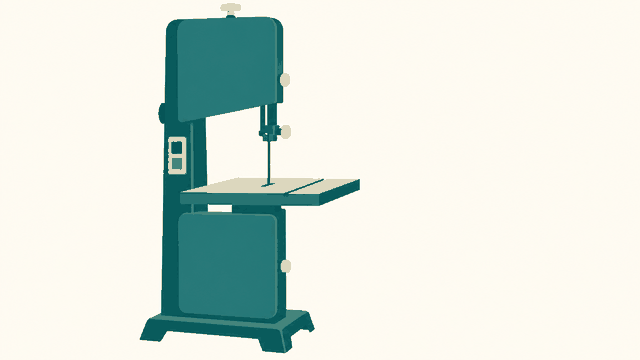
A 14-inch woodworking band saw with a resaw fence is the best all-around choice for a home shop that processes furniture lumber. It offers enough capacity for most boards without requiring the floor space, electrical service, or cost of an industrial machine. Look for a cast-iron or heavy steel table and a frame that does not flex when you press firmly against it.
A 10-inch benchtop saw is the cheaper option, and it is fine for thin stock, small parts, and occasional resawing under about 4 inches. It is usually easier to store and cheaper to equip. The trade-off is a smaller table, less blade tension, narrower blades, and limited capacity. Rough 8-inch boards can overwhelm these saws even if the published specifications appear acceptable.
Floor-standing 18-inch saws are appropriate when resawing is a regular production task. Their larger wheels support wider blades, and their frames usually handle tall stock more confidently. They cost considerably more and may require a 240-volt circuit. For a few boards each month, that expense is difficult to justify.
How to Resaw Rough Lumber Successfully
Flatten one face and one edge before resawing. A jointer, planer sled, or carefully built shop jig can provide a reference surface. If both faces are curved, the board can rock on the table, pinch the blade, and produce a tapered cut. Do not expect the band saw to correct badly bowed stock.
Mark the cut line on both ends and along the face. Leave approximately 1/8 inch of extra material if the pieces will be jointed or planed afterward. Support long boards with an infeed and outfeed table or roller stands. A heavy board that drops off the table can twist into the blade near the end of the cut.
Start the saw before bringing the wood to the blade. Keep your hands well away from the blade path and use push blocks when the remaining stock becomes narrow. Feed steadily without stopping halfway through a cut. Pausing can create a visible step or burn mark, while pushing too hard bends the blade and produces a concave or wandering cut.
Common Problems and Their Causes
If the cut wanders, first replace or sharpen the blade. Then check tension, tracking, guide adjustment, and fence drift. A fence that is square to the table is not necessarily aligned with the blade’s actual path.
Burning usually means a dull blade, an overly slow feed, clogged gullets, or insufficient dust removal. A cut that starts straight and gradually curves often indicates blade fatigue or excessive feed pressure. If the board pinches behind the blade, stop immediately and use a splitter-like relief cut or wedges to keep the kerf open.
Dust collection matters more than many buyers expect. Fine sawdust can clog the blade gullets and obscure the cut line. Choose a saw with a usable lower dust port and connect it to a collector capable of moving roughly 500 to 800 CFM at the machine. Even then, wear eye protection and a respirator when cutting dry or unknown rough lumber.
What to Buy
For most woodworkers, buy the heaviest 2 HP 14-inch stationary band saw that fits the budget and electrical supply, then budget for a quality resaw blade and a tall fence. If your work is limited to occasional thin boards, a 10-inch saw is reasonable and the savings can be put toward a planer or jointer. The cheapest saw is only a bargain if its capacity matches the lumber you actually handle.