How to Plane Long Boards with Proper Infeed and Outfeed Support
What's inside
As an Amazon Associate I earn from qualifying purchases. This post may contain affiliate links at no extra cost to you.
Contents
Why long boards need support
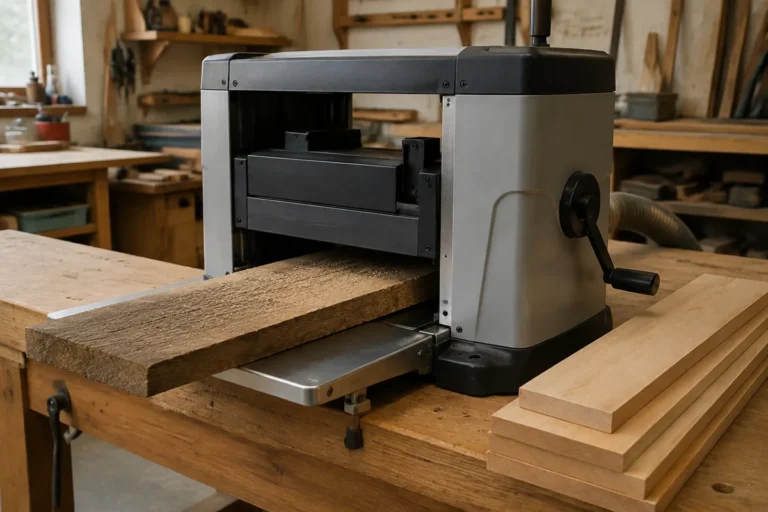
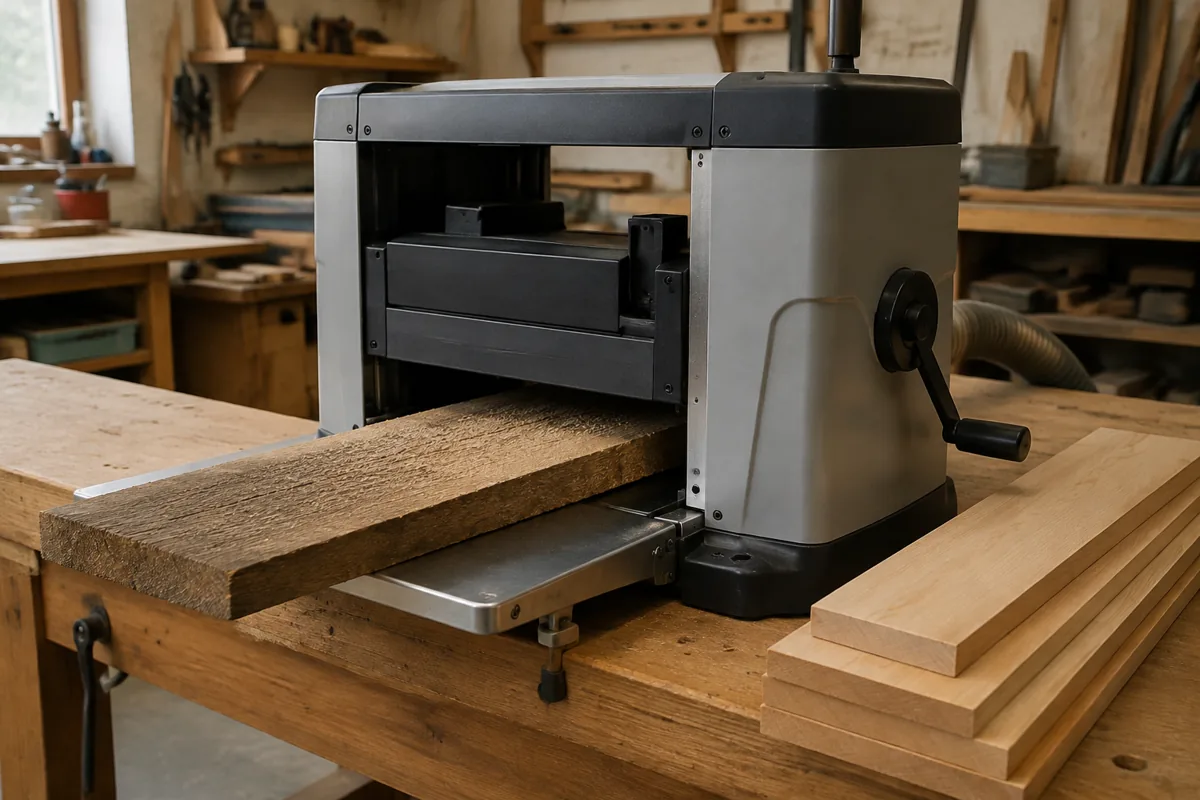
A thickness planer feeds stock through powered rollers and cuts the face that rides on its bed. With a long board, the unsupported end can sag, lift, or catch as it enters or leaves the machine. That movement may cause snipe—deeper cuts near the board’s ends—or make the board harder to control. Support helps keep the stock moving level; it does not replace safe handling or a stable planer stand.
Set up support before switching on the planer. Measure the board, then make sure there is clear space for its full length on both sides of the machine. For a 10-foot board, for example, plan for roughly 10 feet of unobstructed approach and exit space, plus room for you to stand and guide it. Never pull a board through a planer by standing in line with its path.
Choose a support that suits the job
Roller stands are a common, inexpensive choice for occasional work. They are easy to reposition, but a narrow roller can let a board drift sideways, and an uneven stand can lift or drop the stock. A sturdy, broad-top stand is less fussy for wide boards. A long, level table is often the steadiest option for repeated work, but it takes up more floor space and must be aligned carefully.
If you need portable support, compare adjustable roller stands. For a more stable surface, a folding outfeed support stand may suit occasional use. Check the stated load rating and working height; capacity alone does not tell you whether a stand will resist wobbling under a long, awkward board.
| Support type | Best use | Main trade-off |
|---|---|---|
| Single roller stand | Occasional, narrower stock | Quick to set up; stock can wander sideways |
| Wide-top support | Wide or uneven boards | More stable contact, but may be bulky |
| Long infeed/outfeed table | Frequent long-board planing | Steadiest arrangement when aligned; costs space and setup time |
Set the height and alignment
Place supports close enough to the planer that the board cannot sag significantly in the gap, while keeping them clear of the infeed and outfeed openings. Adjust each support so its contact surface is level with the planer bed or just a fraction lower. A support that is too high can lever the board upward; one that is too low lets the end dip. As a starting point, aim for flush alignment, then check how the board travels with the machine off.
Use a straightedge across the planer bed and support surface to spot a step. Lock the stand’s height and make sure its feet cannot slide. For roller stands, set the roller parallel to the feed direction, not across it. Test the setup by moving the board slowly through the machine by hand, with the planer unplugged. It should stay flat and feed without catching or being pushed sideways.
For long stock, one stand at each end is often better than a single support far away. Add a second stand where a board bows or feels heavy; a long, flexible board may need more than one support on the infeed or outfeed side. Keep the support tops in the same plane rather than creating a ramp.
Prepare the board and planer
Inspect the board for loose knots, embedded metal, splits, and severe twist. Remove dirt and grit that could mark the knives. A thickness planer does not reliably flatten a twisted board: one face should be jointed flat first, or the stock should be secured to a flat sled. If the board rocks on the planer bed, it can come out thinner in places or shift during a cut.
Check the planer’s manual for maximum stock width, thickness, and length guidance, and follow its feed-direction and anti-kickback instructions. Set a light first cut, especially on bowed stock or a board close to the machine’s width limit. Take several shallow passes rather than forcing a heavy cut. Do not plane a board that is too short for the manufacturer’s minimum length or that cannot be controlled safely.
Feed the board without fighting it
Stand to one side of the board’s path. Support its leading end as it enters, but do not push down hard; the infeed rollers should take over. Walk alongside the board and keep it centered, using light guidance rather than steering against the feed. As the trailing end approaches, move to the outfeed side only when there is room to do so safely. Let the rollers carry the stock—never reach into the opening or pull against the feed.
Watch the board’s height at both supports. If the end drops as it leaves the planer, raise or move the outfeed support closer. If the board climbs onto a roller or bumps at the entrance, lower the support slightly or correct its alignment. Stop the machine if the stock stalls, chatters, shifts sharply, or begins to feed unevenly. Do not try to hold down a board that is bucking or caught.
Reduce snipe and avoid common mistakes
Snipe often happens when only one set of rollers is gripping the board. Keeping the board level through the cut can reduce it, but stand height is not the only factor: roller pressure, bed condition, knife setup, and the planer’s design also matter. Follow the manual’s advice about lifting the board ends, if any; do not improvise a large tilt that makes the stock unstable. Leave a little extra length and trim the ends afterward when the finished dimensions allow.
Common setup failures are easy to miss: a support placed too far away, a stand that rocks, a roller angled across the feed, or a board being pushed down so hard that it changes how the rollers grip. Recheck height after moving a stand, since telescoping supports can settle or slip. If you plane long boards often, a fixed extension table or a dedicated outfeed arrangement is worth the space. If this is an occasional task, a properly adjusted roller stand and a careful test pass may be enough.