Best Table Saws with Rigid Rip Fences for Long Boards
What's inside
As an Amazon Associate I earn from qualifying purchases. This post may contain affiliate links at no extra cost to you.
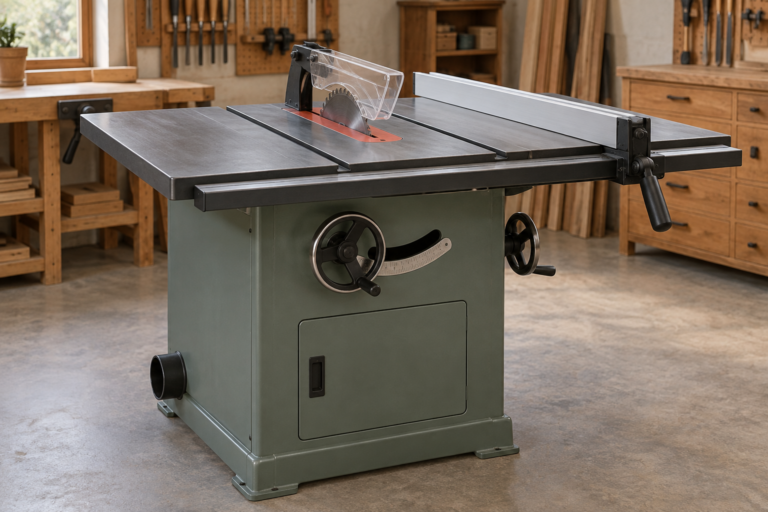
Long boards expose every weakness in a table saw’s rip fence. A fence that flexes, drifts, or binds can turn a straight rip into a tapered edge, especially when the board extends several feet past the table. For this work, the best choice is usually a stationary saw with a heavy T-square fence, a rigid front rail, and enough table support to keep the stock from levering against the fence.
As an Amazon Associate we earn from qualifying purchases at no extra cost to you.


Contents
What Makes a Rip Fence Rigid
A rigid fence needs more than a thick aluminum extrusion. The front rail and locking mechanism do most of the work. A good T-square fence clamps at the front of the table and registers against the rear rail or table edge. When locked, it should resist sideways pressure without shifting at the far end.
For long boards, look for a fence with at least a 2- to 3-inch-high face and a straight, replaceable face surface. A tall face gives wider boards more support, while a replaceable melamine or plywood face lets you close the gap around the blade for narrow cuts. The fence should lock with one smooth motion, without needing to lift or force the handle.
Check the fence with a simple test: lock it near the middle of the table, then push sideways at the far end with firm hand pressure. A small amount of movement is normal, but visible deflection means the fence can change alignment during a long rip. Also measure parallelism at both the front and rear of the blade. A fence that is only 1/32 inch out of parallel can cause burning, wandering, or kickback.
Best Saw Types for Long Stock
| Saw type | Fence and support | Best use | Main compromise |
|---|---|---|---|
| Cabinet saw | Heavy T-square fence, cast-iron table, strong rails | Frequent ripping of hardwood and sheet goods | High price, weight, and installation effort |
| Hybrid saw | Usually rigid enough, with lighter rails | Small shops and serious hobby work | Less mass and often less table depth |
| Contractor-style stationary saw | Can be good if upgraded with a quality fence | Budget-conscious shop use | More vibration and variable stock fence hardware |
| Jobsite saw | Compact rack-and-pinion or folding fence | Occasional work and transport | Least stable choice for long, heavy boards |
Best Cabinet Saws
A cabinet saw is the safest bet when long-board ripping is routine. The heavy base reduces vibration, the cast-iron top stays flat, and the fence rails are less likely to flex under pressure. Models in this class commonly use a 3-horsepower motor and a 10-inch blade, though many shops can do excellent work with a 1-3/4- to 2-horsepower saw on a 240-volt circuit.
Look at cabinet table saws with T-square rip fences if you routinely rip 8-foot boards, dense hardwood, or wide glue-up parts. A SawStop cabinet saw is attractive if built-in flesh detection is a priority. Delta Unisaw and Powermatic cabinet saws are also established choices, but compare the actual fence, rail length, motor voltage, and included dust collection features rather than relying on the brand name.
The downside is installation. A cabinet saw can weigh 400 to 600 pounds, and it needs a flat floor. If the saw is twisted during setup, the table may not align correctly with the blade. Plan on checking the blade-to-miter-slot alignment, fence parallelism, riving knife position, and rail squareness before making precision cuts.
Best Hybrid Saws for Smaller Shops
Hybrid saws make sense when you want a stationary machine but do not rip thick hardwood every day. They generally have enclosed or partially enclosed bases, cast-iron tables, and fences that are much more stable than the thin fences supplied with many portable saws. Their 1-1/2- to 2-horsepower motors are adequate for typical 3/4-inch hardwood and sheet goods.
Choose a hybrid table saw with a heavy-duty rip fence when space, wiring, or budget rules out a cabinet saw. The cheaper option is fine if your longest workpieces are occasional 1x or 2x boards and you are willing to add outfeed and side support. It is not fine if you expect to push 8/4 maple through all day; the lighter motor and rails will make the work slower and can encourage forcing the cut.
Fence capacity matters more than a large number printed on the rail. A 30-inch rip capacity is enough for most furniture work. A 50-inch setup is useful for breaking down plywood, but it takes more floor space and can make the fence harder to support. Extra capacity is not a substitute for a straight, stable feed path.
Support the Board, Not Just the Fence
Even the best fence cannot control a board that is sagging off the table. A 96-inch board hanging unsupported can pivot downward and press its edge into the fence. That pressure may close the kerf, burn the wood, or push the rear of the board into the blade.
Set the infeed and outfeed surfaces level with the saw table, within about 1/16 inch. For wide rips, use a side table or roller support on the fence side. Ball-bearing rollers are convenient, but a flat auxiliary table is usually better because a roller can rotate the board or let it drift sideways. Support stands should be positioned so they do not interfere with your hands or the board’s travel.
For long stock, a second person is helpful, but they should support the board without pulling or pushing it sideways. If solo work is common, use an outfeed table and a side extension rather than trying to steer a heavy board through the cut.
Setup and Safety Checks
Use a sharp blade suited to the material, and keep the riving knife aligned with the blade. The fence should be parallel to the miter slot and either parallel to the blade or opened slightly at the rear, typically no more than 1/64 inch. Too much toe-out leaves a poor cut; toe-in can trap the work against the blade.
Never reach over the blade to retrieve a falling offcut. Keep the push stick available for the last 12 inches of a narrow rip, and stand slightly to the side of the blade’s kickback line. If the board bows, pinches, or requires unusual force, stop the saw and correct the support or fence alignment. A rigid fence improves control, but it does not compensate for warped stock, poor support, or a dull blade.