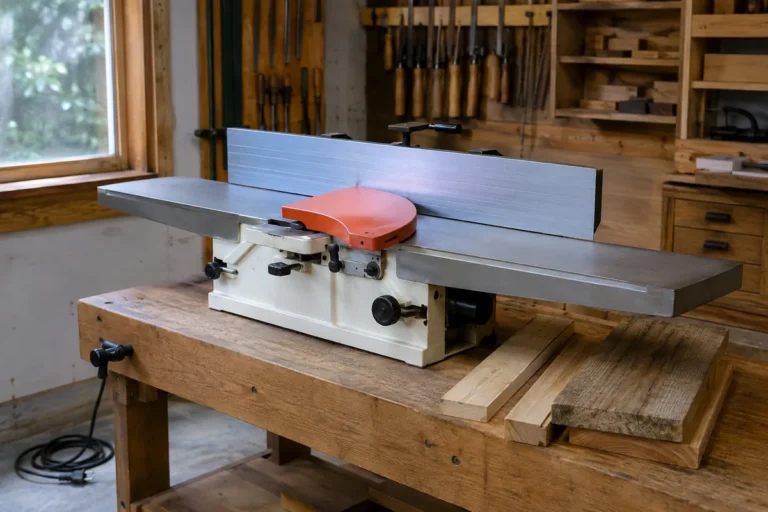
Best Jointers for Milling Rough Oak and Ash Boards
What's inside
As an Amazon Associate I earn from qualifying purchases. This post may contain affiliate links at no extra cost to you.
Rough oak and ash are demanding stock for a jointer. Both are hard, heavy, and often sold with twist, cup, torn grain, or milling marks from the sawmill. A small benchtop jointer can flatten an occasional short board, but it becomes frustrating when working with 6- to 8-foot boards or stock wider than 6 inches. For serious furniture work, an 8-inch stationary jointer is the practical starting point.
As an Amazon Associate we earn from qualifying purchases at no extra cost to you.


Contents
What Makes a Jointer Suitable for Hardwood?
Look first at table length, cutterhead design, fence rigidity, and dust collection. Cutterhead width matters, but it is not the only specification that determines whether a machine can flatten rough lumber accurately.
A long bed supports more of the board and makes it easier to remove twist without creating a hollow in the middle. For oak and ash, aim for at least 60 inches of combined table length. Longer infeed and outfeed tables are especially useful when jointing boards longer than 6 feet.
The fence should be stiff enough that it does not move when you press a heavy board against it. A fence that shifts only 1/32 inch can create a visible angle error along a cabinet panel. A reliable 90-degree stop and a usable bevel adjustment are more important than an elaborate scale that is difficult to read.
For a general-purpose shop, compare 8-inch helical-head jointers with traditional straight-knife machines. Helical heads usually cost more, but their staggered carbide inserts reduce tear-out and make damaged knives easier to deal with. You can rotate an individual insert instead of replacing and aligning an entire knife set.
Jointer Types Compared
| Jointer type | Best use | Main limitation | Typical hardwood advice |
|---|---|---|---|
| Benchtop, 6-inch | Short boards and occasional projects | Short tables and limited width | Fine for boards under about 4 to 5 feet; use shallow cuts |
| Floor-standing, 6-inch | Small furniture shops | Cannot flatten boards wider than 6 inches | Good value when most stock is narrow |
| Floor-standing, 8-inch | Furniture, doors, and general hardwood milling | Higher cost and greater footprint | Best balance for most serious home shops |
| 12-inch or wider | Wide panels and production work | Expensive, heavy, and demanding on power and space | Useful when resawing or edge-gluing wide boards frequently |
A cheaper 6-inch floor-standing jointer is not automatically a bad purchase. If your rough boards are 5-1/2 inches wide or less, and you can flatten wide stock with a planer sled or router sled, it may be the sensible choice. The extra capacity of an 8-inch machine is valuable, but it does not make warped lumber disappear.
Helical Versus Straight Knives
Straight knives can produce an excellent surface when they are sharp and correctly aligned. They are also usually cheaper and faster to sharpen or replace. On figured oak and ash, however, straight knives are more likely to leave tear-out when the grain reverses. Lowering the depth of cut and feeding the board in the correct direction helps, but does not eliminate the risk.
Helical or spiral cutterheads are more forgiving. They typically leave shorter, less conspicuous marks and handle difficult grain better. The trade-off is cost, replacement insert expense, and a slightly different surface texture that may need sanding before finish. Do not assume every cutterhead marketed as “spiral” has the same geometry; check whether it uses carbide inserts arranged in a true shearing pattern or merely staggered straight knives.
For mostly plain-sawn construction oak, straight knives are fine if the machine has a solid table and you are willing to maintain the knives. For expensive figured ash, reclaimed oak, or mixed species, carbide inserts are easier to live with.
Capacity and Power
An 8-inch jointer generally needs a motor in the roughly 2 to 3 horsepower range, depending on whether the rating is honest running horsepower or an inflated peak figure. A 6-inch machine can work with less power, but hard, wet, or heavily cupped boards can still bog it down.
Power is not a substitute for correct technique. Taking 1/16-inch passes from a severely twisted oak board can overload the motor, stall the cutterhead, and leave ridges. Start with cuts around 1/32 inch. Increase only when the board is stable and the machine is not slowing. A final pass of 1/64 inch or less often produces a cleaner reference face.
Check the electrical requirement before buying. Many larger jointers use 240 volts, while smaller machines may run on 120 volts. A 240-volt machine can deliver consistent power under load, but installing a circuit may add meaningful cost. Also verify that the dust port matches your collector; hard oak and ash produce substantial chips, and a shop vacuum is often inadequate for a large floor-standing jointer.
How to Mill Rough Oak and Ash
Inspect every board for nails, screws, grit, and loose bark before it reaches the cutterhead. A metal detector is worthwhile for reclaimed stock. Remove obvious cup first by placing the concave face down on the infeed table. Joint only enough to establish one flat reference face, then plane the opposite face parallel.
Keep the board firmly against the fence and use push blocks once your hands approach the cutterhead. On long stock, support the board before and after the machine so its weight does not lift the leading or trailing end. If the board rocks on the infeed table, mark the high corners with chalk and take light passes until the rocking stops.
A common failure mode is jointing the edges before flattening one face. The edge may then be square to a twisted reference surface, producing a tapered or uneven panel joint. Establish the face first, plane the opposite face, and only then joint the edge.
Buying Recommendations
For most furniture shops, an 8-inch stationary jointer with long tables and a rigid fence is the safest all-around purchase. Choose a helical head if you routinely work figured grain or want lower maintenance. Choose straight knives if initial price and simple sharpening matter more.
If space and budget are tight, an 6-inch floor-standing jointer is preferable to a flimsy benchtop unit for long oak and ash boards. A 6-inch benchtop jointer makes sense for short parts, trim, and occasional repairs, but its short tables make twisted 8-foot boards difficult to control.
Before ordering, measure the available footprint, confirm voltage, inspect the fence adjustment, and budget for proper dust collection, push blocks, and replacement knives or inserts. Those details have more effect on usable results than a small difference in advertised motor horsepower.