Best Jointers for Removing Twist from Furniture Lumber
What's inside
As an Amazon Associate I earn from qualifying purchases. This post may contain affiliate links at no extra cost to you.
Contents
What a jointer can fix—and what it cannot
A jointer can remove twist from furniture lumber by flattening one face. It does that by cutting the high spots as you feed the board across the cutterhead. Once one face is flat, you can put it against a planer bed to make the opposite face parallel. The jointer does not make both faces parallel by itself, and it cannot reliably flatten a board that is too long, wide, or heavy for its tables.
Twist is diagonal: the board rocks on opposite corners when you set it on a known-flat surface. Before buying a machine, check whether the lumber actually needs jointing. A board with a small cup but no twist may be manageable with a planer sled; badly twisted stock generally needs a flat reference face first. For furniture parts, the useful question is not just cutter width, but whether the tables can support the length of lumber you use.
As an Amazon Associate we earn from qualifying purchases at no extra cost to you.


Choose capacity for your stock
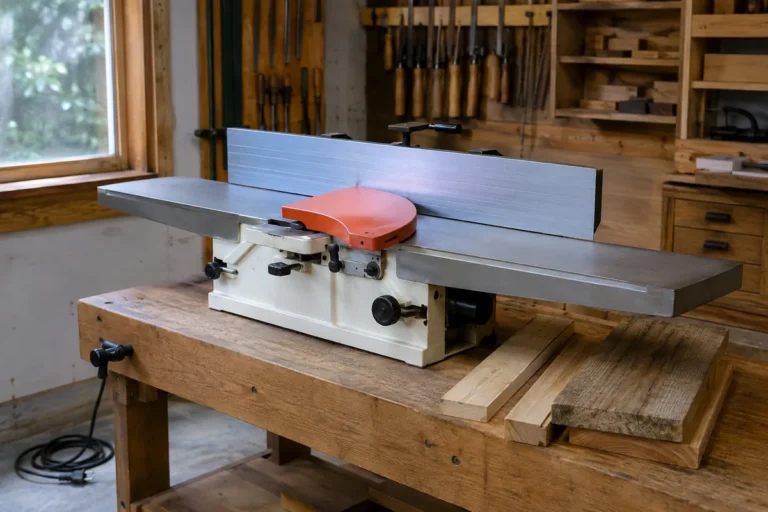
Most benchtop jointers have a 6-inch cutting width and short tables. They are compact and cheaper, but short tables make it harder to control long boards and remove twist without introducing a dip or hump. A 6-inch benchtop machine can be a reasonable choice for short parts, narrow stock, and occasional work. It is less suitable for flattening long furniture rails or wide boards.
A floor-standing 8-inch jointer typically offers wider capacity and longer tables, which help with wider lumber and steadier feeding. It costs more, takes more shop space, and may need a dedicated circuit or careful dust collection planning. For consistently long stock, an infeed and outfeed support setup matters whichever size you buy; supports should be adjusted to the table height, not allowed to lift the board.
For a small shop, compare 6-inch benchtop jointers with 8-inch floor-standing jointers. Check actual table length, cutterhead type, fence adjustment, and whether replacement knives or inserts are readily available. A wide cutterhead is no substitute for tables long enough to support your board.
Jointer types compared
| Type | Best fit | Main limitation |
|---|---|---|
| 6-inch benchtop | Short, narrow parts and limited shop space | Short tables make long boards harder to flatten accurately |
| 8-inch floor-standing | Regular furniture work and wider stock | Higher cost, more floor space, and heavier setup |
| Long-bed jointer | Long boards and frequent flattening | Large footprint and cost; excessive for occasional small parts |
Cutterhead, fence, and setup
Straight-knife cutterheads usually cost less upfront and can produce a good surface when knives are sharp and aligned. Their downsides are more noticeable knife marks, louder cutting, and the need to set knives accurately after replacement. Helical or spiral-style heads use multiple small inserts. They often leave a smoother finish on difficult grain and are quieter, but add purchase cost; damaged inserts can be rotated or replaced individually. Neither head type compensates for a poorly adjusted machine.
Look for a rigid fence that stays square to the table and can be set for bevels without shifting when locked. Check that the infeed table adjusts smoothly and that the guard returns over the cutterhead. On a used machine, inspect for table damage, fence play, and evidence of uneven or improvised knife adjustment. A jointer with tables out of alignment can turn a twisted board into a board with a hollow or crowned face.
How to remove twist safely
Mark the high corners and test the board on a flat surface. Set a shallow cut—about 1/32 inch is a sensible starting point—and keep the board firmly down on the infeed table. Take repeated passes, checking for rocking between them. As the face becomes flatter, use pressure over the infeed table rather than pushing down on the unsupported end; too much pressure on the outfeed side can preserve the twist instead of cutting it away. Avoid trying to remove the whole twist in one deep pass.
Use push blocks, keep hands clear of the cutterhead, and joint with the grain where possible. Reversing direction can reduce tear-out, but do not feed stock backward across the cutterhead. If the board is too short to control safely, too narrow for stable support, or has loose knots and checks, do not force it through. Cross-grain tear-out is a finish problem; a kick or loss of control is a safety problem.
Once one face is flat, mark it and run that face against the planer bed. The planer can then make the opposite face parallel. If you plane first without a flat reference, the board may simply come out thinner while retaining its twist.
When a jointer is not the right purchase
If you flatten only a few short boards a year, a benchtop jointer may be enough, or a planer sled may be the better buy if you already own a planer. A sled holds twisted stock stable while shims prevent rocking; the planer cuts the exposed face flat. It takes setup time and usually requires a second operation to make the other face parallel, but avoids buying a large machine for occasional work.
For long, wide furniture stock, however, short-table capacity is a real constraint, not a minor convenience. Buy for the longest and widest pieces you regularly need to flatten, and leave some margin for safe support. If that points to an 8-inch floor-standing machine but the shop cannot accommodate one, a sled-based workflow or having rough lumber surfaced at a mill is often more practical than expecting a compact jointer to do a job its tables cannot support.