Best Stationary Planers for High-Volume Hardwood Milling
What's inside
As an Amazon Associate I earn from qualifying purchases. This post may contain affiliate links at no extra cost to you.
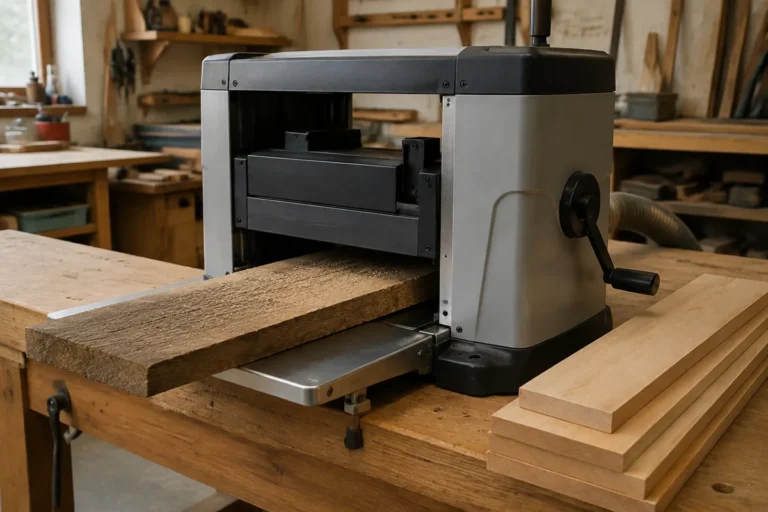
High-volume hardwood milling is where a portable thickness planer’s compromises become expensive. Short beds, small cutterheads, limited dust ports, and light-duty feed systems can turn a straightforward day of milling into repeated snipe removal, knife changes, and stalled cuts. For regular production work, a stationary planer with a rigid bed, strong feed rollers, and a cutterhead suited to hardwood is a better foundation.
As an Amazon Associate we earn from qualifying purchases at no extra cost to you.


Contents
What Makes a Planer Suitable for High-Volume Work
The first specification to check is maximum width. A 15-inch planer handles most furniture stock, while an 18-inch or 20-inch machine gives more flexibility for wide panels and table components. Capacity is not the same as usefulness, however. A planer that can accept a 15-inch board but struggles to maintain feed speed in hard maple is less productive than a well-built machine with a narrower rating.
Look for a cast-iron or heavily braced bed, positive table locking, and adjustable infeed and outfeed tables. The bed should remain stable when you apply pressure to a long board. A moving table can cause uneven thickness, chatter, and inconsistent snipe at the ends of boards.
Feed speed matters as much as motor horsepower. Many stationary planers offer two speeds, commonly around 16 and 30 feet per minute. The slower setting gives the cutter more opportunities to make a clean cut in dense hardwood. The faster setting is useful for softwood or a light finishing pass. A machine with only one aggressive feed rate may remove material quickly but leave more tear-out and require extra sanding.
For a production shop, compare 15-inch stationary thickness planers by bed construction, cutterhead design, and dust collection—not by motor horsepower alone.
Cutterhead Choice: Straight Knife or Helical
Traditional straight-knife cutterheads are still a sensible choice when the purchase price matters. They cut quickly, are easy to understand, and can produce an excellent surface with sharp knives and correct setup. The drawbacks are noise, more noticeable tear-out in figured grain, and a full-width knife change when an edge becomes damaged.
A helical or segmented cutterhead uses many small carbide inserts. Inserts can usually be rotated when one corner is nicked, so a nail or hard mineral streak does not automatically ruin an entire knife set. The smaller cutting edges also tend to reduce tear-out and make machine noise less harsh. The trade-off is higher initial cost, more parts to inspect, and a surface that may show faint cutter marks if the feed system or insert alignment is poor.
For large amounts of ordinary straight-grained lumber, a straight-knife machine can be the cheaper option that does the job. For figured maple, walnut, reclaimed hardwood, or mixed species, a helical head often saves time in knife maintenance and hand sanding. If you mill valuable material, consider helical cutterhead planers before spending extra money on accessories.
Stationary Planer Comparison
| Planer type | Best use | Main strengths | Main limitations |
|---|---|---|---|
| 12-inch benchtop planer | Occasional furniture and small shops | Low cost, compact, easy to move | Shorter bed, more snipe, limited continuous production |
| 15-inch straight-knife stationary planer | General hardwood milling | Good capacity, fast cutting, lower purchase price | Louder, more tear-out risk, knife changes take time |
| 15- to 20-inch helical planer | Frequent hardwood and figured stock | Quieter cutting, carbide inserts, better damaged-edge tolerance | Higher cost and more involved cutterhead maintenance |
| Industrial wide planer | Continuous commercial production | Heavy feed system, long bed, high throughput | Large footprint, higher electrical and dust-collection demands |
Feed System and Snipe Control
Two feed rollers are standard, but their design and pressure adjustment determine how well a planer handles rough boards. Serrated steel infeed rollers grip aggressively, while smooth outfeed rollers reduce marking on finished surfaces. Some machines allow independent pressure adjustment; that is valuable when milling thin stock or boards with uneven faces.
Snipe occurs when the board rises or drops as it enters or leaves the cutterhead. Long tables help, but they do not solve every case. A rigid table lock, correctly aligned extensions, and a cutterhead that stays parallel to the bed matter more. Plan on making a short test cut after installation. Measure the first and last 12 inches of the board; a difference of more than a few thousandths of an inch indicates alignment or pressure problems that should be corrected before production.
For boards longer than about 6 feet, use infeed and outfeed support that stays level with the planer bed. A helper pushing or pulling the board can actually worsen snipe by lifting the stock into the cutterhead.
Dust Collection and Electrical Requirements
Planers produce chips faster than most other stationary machines. A small shop vacuum is usually inadequate for a 15-inch planer, particularly with hardwood. A dust collector moving roughly 800 to 1,200 cubic feet per minute at the machine is a more realistic target, though duct layout and hose diameter affect actual performance. Use the largest dust port and hose the machine supports; reducing a 5-inch outlet to a narrow hose can cause chip buildup and poor surface quality.
Check the electrical requirement before choosing a machine. Some smaller planers run on standard 120-volt circuits, while larger units commonly require 240 volts. A planer that trips a shared circuit will interrupt work and can overheat extension cords or connections. Avoid long, undersized extension cords, especially when the motor is starting under load.
Buying Recommendations
For occasional milling, a 12-inch planer is fine if you can accept more setup, shorter boards, and careful snipe control. It is also the sensible choice when most stock is narrower than 10 inches and the machine will be stored between projects.
For a serious furniture shop, a 15-inch stationary planer is the practical middle ground. Choose a straight-knife version when budget and throughput matter most, and choose a helical version when you routinely mill figured or expensive hardwood. Browse 15-inch woodworking planers with replacement knives or inserts readily available.
Move to an 18-inch or 20-inch machine when wide stock is a regular requirement, not merely because the larger number looks attractive. A wider planer brings higher purchase cost, heavier electrical demand, and a greater need for dust collection. Before ordering, measure the machine’s footprint, doorways, circuit location, and the space needed to safely support boards on both sides.
Finally, budget for spare knives or inserts, a proper dust hose, support stands, and a thickness gauge. Those items do more for daily output than a small horsepower increase. The best planer is the one that holds its settings, feeds hardwood consistently, and can be maintained without putting the shop out of service.