How to Drill Large-Diameter Holes Without Burning the Workpiece
What's inside
As an Amazon Associate I earn from qualifying purchases. This post may contain affiliate links at no extra cost to you.
Large bits create heat quickly. A wide cutting edge rubs against more wood, and chips have farther to travel out of the hole. The usual result is a scorched rim, a smoking bit, or a stalled drill press—not a problem solved by leaning harder on the feed handle.
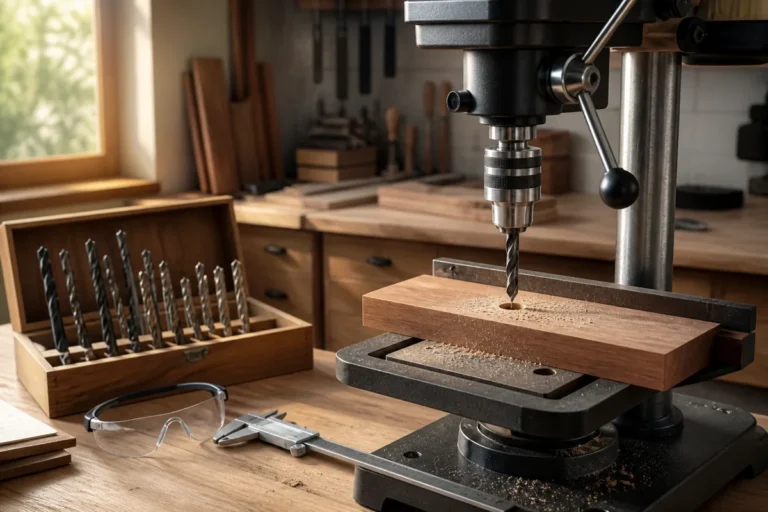
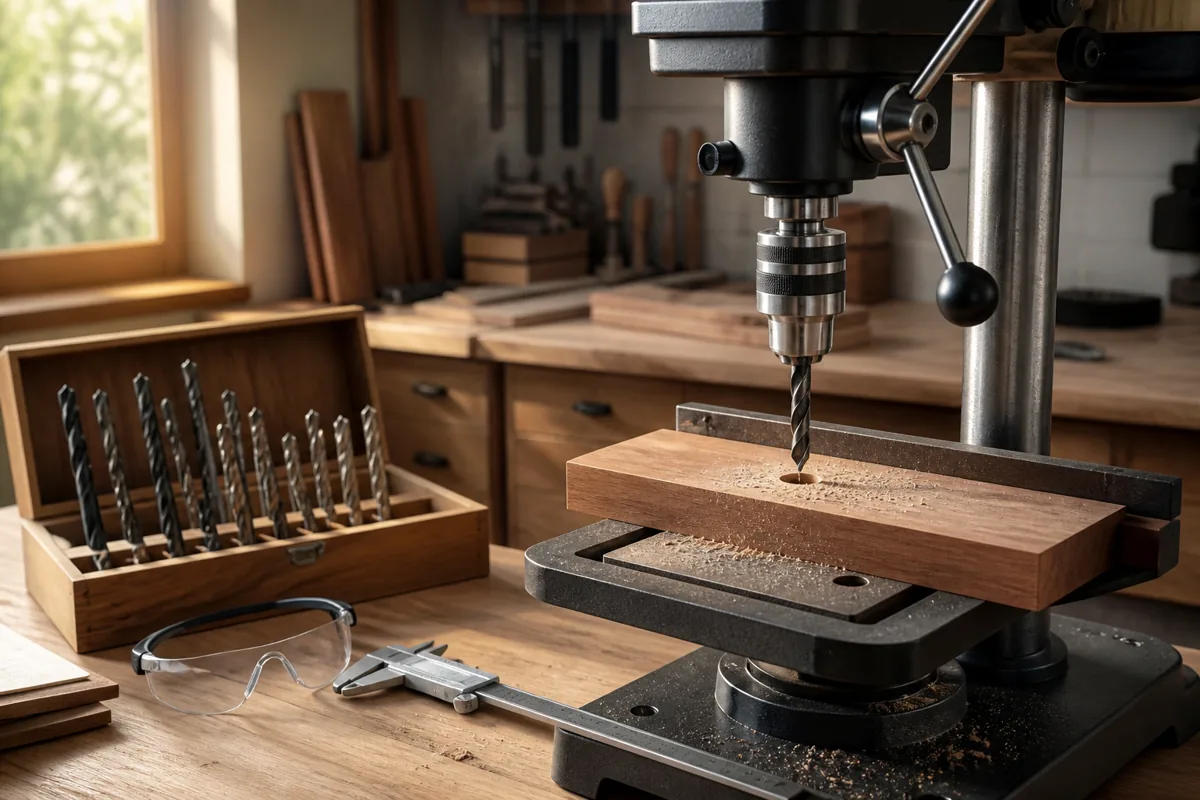
For clean holes, match the bit to the size and depth, set a suitable speed, clear chips often, and support the work securely. The advice below is for a drill press, which gives better control than a handheld drill for large diameters. Check the bit maker’s speed guidance when available; the figures here are practical starting points, not universal limits.
Contents
Choose the right bit for the hole
For holes up to about 1 inch (25 mm), a sharp brad-point bit is a good choice in solid wood when a clean, accurately placed hole matters. For larger holes, a Forstner bit cuts a flat-bottomed hole with a clean edge, but it needs a stable setup and more torque. A hole saw is usually the economical choice for a through-hole, especially in sheet goods or when the center plug is acceptable. A spade bit is inexpensive and fast, but tends to leave a rougher exit and is easier to overheat if you push it too hard.
| Bit type | Best use | Trade-offs |
|---|---|---|
| Forstner bit | Flat-bottomed holes and clean rims, often around 1–2 inches (25–50 mm) | Needs low speed, a rigid setup, and frequent chip clearing; large sizes can demand more drill-press torque than a small machine has |
| Hole saw | Large through-holes in boards and sheet goods | Leaves a core to remove; chips can pack inside the cup and cause burning |
| Spade bit | Low-cost rough holes where speed matters more than a polished edge | More tear-out and vibration; needs controlled feed and a backing board for a cleaner exit |
If you only need one or two rough holes, a basic spade bit may be enough. For repeat work or clean, flat-bottomed recesses, a good-quality Forstner bit is worth considering. Compare options by diameter range and shank size, not just the number of pieces in a set: Forstner bit sets for wood.
Set a sensible speed
Large bits usually need slower speeds than small bits. A 1/4-inch bit might run at 2,000–3,000 RPM in many woods, but that is far too fast for a 2-inch cutter. As a starting point for a sharp bit in ordinary wood, try about 500–800 RPM for a 1-inch Forstner bit and 250–500 RPM for a 2-inch bit. Dense hardwood, a hole saw, or a bit with a long cutting edge may call for a lower setting.
Use the lowest appropriate speed your drill press can manage without stalling, then adjust based on the cut. If the bit squeals, smokes, or darkens the wood, stop and diagnose the cause. On a belt-drive press, change speeds only with the machine unplugged and the spindle fully stopped. Do not run below the manufacturer’s minimum speed, and do not compensate for an underpowered drill press by forcing the feed.
For repeated large holes, check the drill press’s speed range and rated capacity before buying. A press that bottoms out at 600 RPM may be unsuitable for a 2-inch Forstner bit in hardwood. A floor-standing press may offer more speed options and a sturdier table, but a smaller benchtop model can be adequate for occasional holes in softwood.
Clamp and support the work
Large bits can grab suddenly, especially as they break through. Clamp the workpiece to the table; never hold it by hand. A spinning board can injure you or pull fingers into the bit before you can react. Use a drill-press vise, clamps positioned clear of the bit, or a stop block that keeps the work from turning. Make sure the table and column are locked before drilling.
Put a sacrificial backing board beneath through-holes to reduce tear-out at the exit. For a deep hole, check that the quill has enough travel; lowering the table or repositioning the work may be safer than drilling at the limit of the stroke. Keep long stock supported so it cannot tip or lever against the bit.
Feed steadily and clear chips
Start with light pressure until the cutting edges establish the hole. Then feed steadily: enough to make continuous chips, but not so hard that the press slows noticeably. If the drill press bogs down, ease off. Excessive pressure can stall the motor, bend a small shank, or make the bit grab. Too little feed is also a problem: the cutting edges rub rather than cut, building heat and glazing the wood.
For a deep hole, withdraw the bit every few seconds to clear chips from the flutes. With a hole saw, back it out often so packed sawdust can escape from the cup and clear the kerf. A hole saw cutting a thick board may benefit from drilling partway from one side, then finishing from the other using a pilot hole to align the cut. That limits breakout and helps prevent the saw from binding as the core loosens.
Respond to burning before it gets worse
Stop if you see smoke or a dark burn mark. Let the bit stop completely, unplug the press before inspecting it, and clear packed chips. Check for a dull or damaged cutting edge, a loose chuck, excessive runout, or a bit that is unsuitable for the material. Resinous softwood can gum up cutters; hardwood and plywood glue lines can also increase resistance.
Clean pitch from the bit with a product intended for tool cleaning, following its label. Do not touch a rotating bit with a brush or rag. If the bit is sharp and the setup is sound, lower the speed or use a firmer, controlled feed, then test on scrap. For a stubbornly hot bit or repeated holes, a small amount of lubricant is sometimes used on metal, but oil is generally not a fix for burning wood; it can stain the work and mask a speed or chip-clearance problem.
When to buy a different bit
If a hole saw burns repeatedly, a sharper saw with a more suitable tooth pattern may help more than a larger drill press. For clean large holes, a quality hole saw can be a practical middle ground between a cheap spade bit and a large Forstner bit. Check that its arbor fits your chuck and that the saw’s rated speed suits your press. A set is useful for varied diameters, but if you need one size, buying a single saw avoids paying for sizes you will not use: hole saw sets for woodworking.