Best Planers for Reducing Chipout in Spalted Maple
What's inside
As an Amazon Associate I earn from qualifying purchases. This post may contain affiliate links at no extra cost to you.
Spalted maple is attractive, but it is a difficult board for a thickness planer. The dark lines are caused by fungal activity, which often leaves the wood weaker and more prone to breaking out than sound maple. The best planer for reducing chipout is not simply the machine with the largest motor. Cutterhead design, feed consistency, knife sharpness, and the ability to take very light cuts matter more.
Contents
What Makes Spalted Maple Difficult to Plane
Spalted maple can change from solid, hard maple to soft or crumbly material within a few inches. That uneven density makes the fibers more likely to tear when the cutterhead meets reversing grain. Bark inclusions, voids, and small cracks create additional failure points.
Before planing, inspect every face and edge. Reject boards with loose sections unless you can stabilize them with thin epoxy or cyanoacrylate. A planer is not a safe way to remove loose bark or weak chunks. They can be thrown from the machine, damage knives, or leave deep gouges in the board.
Keep the board at room temperature and reasonably dry. For interior furniture, around 6 to 8 percent moisture content is a useful target. Wood that is still moving can cup after planing, making a good surface appear to have been ruined by the machine.
The Best Cutterhead for Reducing Chipout
A helical or true spiral cutterhead is usually the best choice for spalted maple. Its carbide inserts cut with a shearing action instead of presenting a straight knife edge across the full board width. That reduces tearout, lowers cutting shock, and lets the machine handle changing grain more gracefully.
When shopping, compare helical cutterhead thickness planers rather than relying on the word “spiral” alone. Some manufacturers use “spiral” for staggered straight knives, while others mean a cutterhead with angled carbide inserts. Both can work, but individually replaceable, four-sided carbide inserts are easier to maintain and generally better suited to figured or unstable wood.
A helical cutterhead does not eliminate chipout. It reduces it. Deep cuts, dull inserts, feeding against the grain, and unsupported board ends can still produce damage. Inserts also cost more than disposable knives, although a single damaged insert can be rotated instead of replacing an entire knife set.
Planer Features That Matter
| Feature | Why it helps with spalted maple | What to watch for |
|---|---|---|
| Helical or shear-cut cutterhead | Reduces the lifting force that causes torn grain | Replacement inserts and cutterhead availability |
| Variable feed speed | Allows a slower pass for difficult grain and a faster pass for ordinary stock | Slower feed usually means lower production |
| Long infeed and outfeed tables | Reduces end drop and planer snipe | Short machines may need added roller support |
| High dust-collection airflow | Clears chips before they are pressed back into the surface | Fine shavings quickly expose an undersized collector |
| Fine depth adjustment | Makes repeatable 1/64-inch or lighter cuts practical | Loose height mechanisms can change under vibration |
How Much Planer Do You Need?
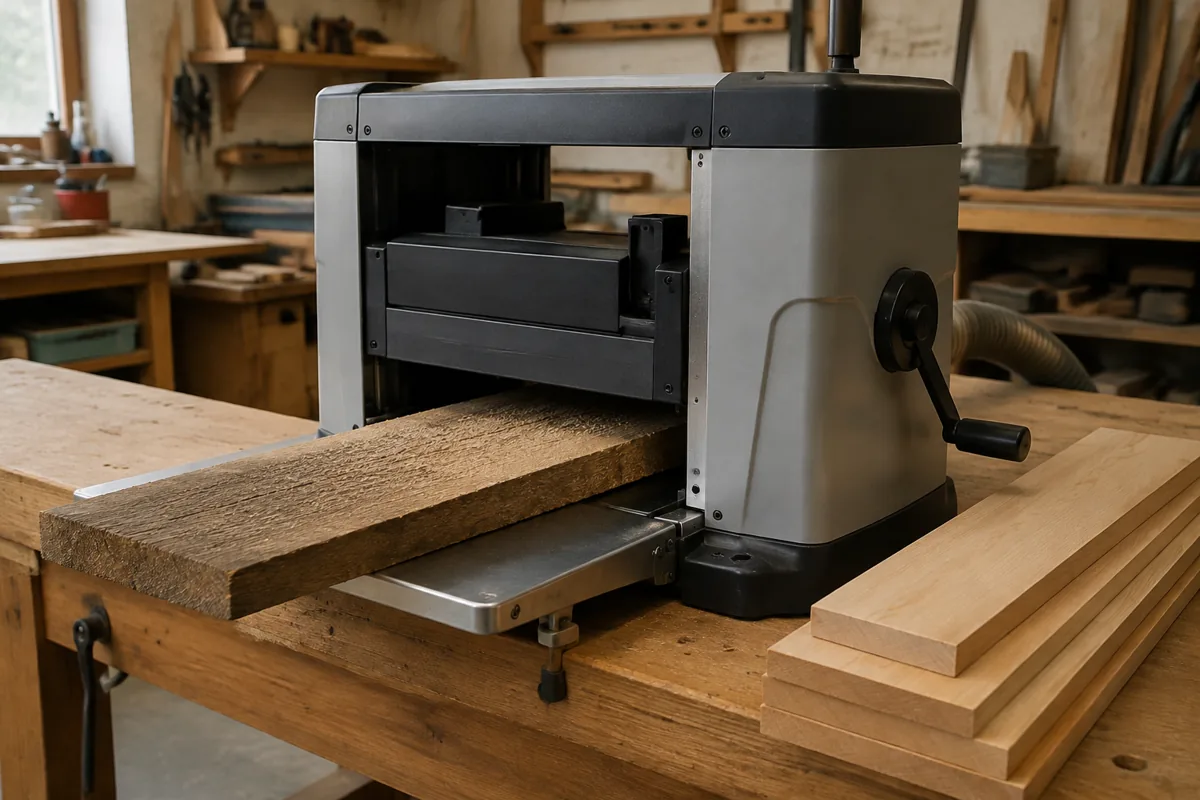
A benchtop planer is sufficient for occasional furniture parts, boxes, and small slabs. A 12- or 13-inch machine is easier to fit in a small shop and usually costs less to maintain. If it accepts a helical cutterhead or can be upgraded to one, it can produce excellent results on spalted maple.
A heavier stationary planer has advantages when working with wide, dense stock. Its longer bed, more rigid frame, stronger feed system, and larger dust hood can make difficult boards easier to control. It is also less likely to move when a board enters the rollers. The trade-off is price, floor space, electrical requirements, and more expensive replacement parts.
For many home shops, a standard 13-inch helical thickness planer is the practical sweet spot. A cheaper straight-knife planer is fine if you mostly plane clear, straight-grained lumber and are willing to take very light finishing cuts. It is also a reasonable buy if you plan to install a compatible aftermarket cutterhead later. Do not buy a low-cost machine assuming an upgrade will always be available; check the exact model and parts support first.
How to Plane Spalted Maple Without Tearing It Out
Flatten one face first with a jointer, sled, or router flattening setup. A planer makes the opposite face parallel; it does not reliably flatten a cupped or twisted board. If the board rocks, the feed rollers can press it flat temporarily and release it with the same warp still present.
Mark the high face with pencil and begin with a cut of about 1/32 inch. On badly figured material, start at 1/64 inch. Once the surface is clean and stable, use a final pass of roughly 1/128 to 1/64 inch. Removing 1/16 inch in one pass is needlessly aggressive on spalted stock and can turn a minor weak spot into a crater.
Feed the board so the cutterhead meets the grain with the grain rather than lifting it. Grain direction can change along a spalted board, so examine the fibers every few inches. If one direction produces torn grain, reverse the board and test again. A short test piece from the same board is worth sacrificing.
Support the board before it contacts the rollers and after it leaves them. Snipe often appears over the first and last 2 to 4 inches, particularly on lightweight benchtop planers. Keep the board level with the planer bed, and do not pull or lift it while the rollers are engaged. If the board is long enough, plane extra length and cut away the affected ends afterward.
Knives, Maintenance, and Safety
Sharp cutters are essential. Dull straight knives rub and pry at weak fibers, while worn carbide inserts can leave isolated lines or patches of torn grain. Rotate inserts when an edge becomes dull, and replace any insert with a chipped corner. Clean pitch and resin from the cutterhead and rollers; buildup can cause uneven feeding and extra snipe.
Use a dust collector with the planer’s full-size hood whenever possible. Spalted material can produce fine, irritating dust, and packed chips increase the chance of a rough surface. Wear eye and hearing protection, keep hands away from the opening, and never plane boards containing nails, screws, or loose foreign material.
For the cleanest possible finish, accept that some spalted maple should be finished with a sharp hand plane, card scraper, or sanding block after thicknessing. The planer’s job is to establish thickness efficiently. A light final cut followed by careful handwork is often faster than repeatedly trying to force a marginal board through an aggressive machine.