
Key takeaways
- Compare the best marking gauges for dovetail joinery, with wheel cutters, dual scales and specs for crisp baselines on pins, tails and drawer parts.
What's inside
As an Amazon Associate I earn from qualifying purchases. This post may contain affiliate links at no extra cost to you.
- Top Pick: iGaging Wheel Marking Gauge
- Runner-up: WoodRiver Wheel Marking Gauge
- Also consider: Clarke Brothers Wheel Marking Gauge Kit
The best marking gauge for dovetail joinery is a wheel gauge with a sharp circular cutter, a fence that registers flat and stays put, and a beam long enough to reach across your widest drawer parts. For most benches, the iGaging Wheel Marking Gauge is the pick to beat: its solid brass head, dual-scale steel rod and secure knurled lock deliver repeatable baselines without drama. Woodworkers who want more heft and a traditional feel step up to the WoodRiver Wheel Marking Gauge, while beginners are well served by the YOSELIN dovetail set, which pairs two cutters with a dovetail guide. Below, we compare five wheel gauges that suit dovetail layout and explain what separates them.
As an Amazon Associate, we earn from qualifying purchases.
Contents
Table of Contents
- Why a Wheel Gauge Earns Its Place in Dovetail Layout
- The 5 Best Marking Gauges for Dovetails
-
- iGaging Wheel Marking Gauge
-
- WoodRiver Wheel Marking Gauge
-
- Clarke Brothers Wheel Marking Gauge Kit
-
- MKC Wheel Marking Gauge Kit
-
- YOSELIN Dovetail Marking Gauge Set
- How to Choose a Marking Gauge for Dovetail Work
- FAQ
- Conclusion
- Product and ASIN Reference
Why a Wheel Gauge Earns Its Place in Dovetail Layout
Every dovetail starts with a baseline: the scribed line, set to the exact thickness of the mating board, that tells your saw and chisel where the pins and tails end. Get that line right and the joint almost assembles itself. Get it wrong and careful sawing cannot rescue the fit.
A wheel gauge is built for exactly this job. Its small circular cutter rolls along the wood and severs fibers instead of tearing them, so the line stays crisp across end grain, where dovetail baselines do most of their work. Because the wheel cuts a shallow groove rather than drawing a surface mark, a chisel edge can drop into the line and register positively when you chop the waste. A pencil line, by contrast, has width and disappears the moment a chisel approaches it.
The second advantage is transfer. You do not measure a baseline; you steal it. Set the gauge directly from the thickness of the mating board, lock it, and scribe. The same setting then marks every pin board and tail board in a drawer or case, so all four corners share one dimension. That repeatability is what separates a gauge from a ruler, and it is why the five tools below are all wheel gauges rather than pin gauges, whose spurs tend to follow grain and wander on cross-grain passes.
The 5 Best Marking Gauges for Dovetails
1. iGaging Wheel Marking Gauge
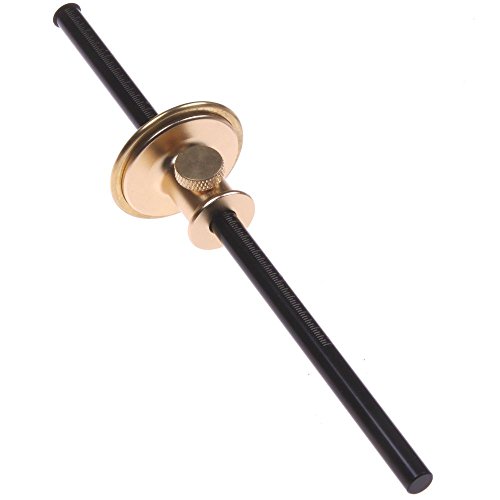
The iGaging is the gauge most dovetail cutters recommend first, because it covers the fundamentals without weak spots. The head is precision machined from solid brass, giving it enough mass to stay registered against a reference face without tipping, and the knurled lock nut tightens by hand and holds the setting through a full round of marking.
Its steel rod runs a full 8 inches and is graduated in both 1 mm and 1/32-inch increments, so you can read a setting straight off the shaft when you do need a number. For dovetails, the more common move is to set the gauge from the mating board itself, and the smooth-sliding rod makes that quick: butt the board against the fence, slide the cutter to the far face, lock, and scribe.
The cutter is a non-rotating, locked wheel, which tracks straight in dense hardwoods like maple and white oak where a free-spinning wheel can skate. The same tool doubles as a depth gauge for checking socket depth on half-blind dovetails, a genuinely useful second job at the bench. In the mid-range tier, nothing else here matches its combination of reach, scales and dual duty.
Specs:
– Cutter type: Non-rotating wheel cutter
– Head material: Solid brass, precision machined
– Beam: 8-inch steel rod
– Scales: 1 mm and 1/32-inch graduations
– Lock: Knurled lock nut, hand tightened
– Weight: About 5 ounces
– Extra function: Doubles as a depth gauge
– Tier: Mid-range
2. WoodRiver Wheel Marking Gauge

The WoodRiver is the premium hand-feel pick. It pairs a solid brass and stainless steel build with bubinga wood accents on the fence, and at roughly 10.4 ounces it is the heaviest gauge in this roundup. That mass gives the cutter momentum through long-grain passes and keeps the fence planted when you scribe baselines around all four faces of a tail board.
The seven-inch steel beam carries engraved imperial and metric scales, so a setting can be recorded and returned to later. The cutting wheel retracts flush with the fence, which protects the edge in the tool roll and lets you set the gauge by standing it directly on the mating board’s end grain, a fast way to capture exact stock thickness for a baseline.
There is no micro-adjuster, so fine changes are made by feel against the lock knob, and the fully round fence can roll if it is set down carelessly. For dovetail work, where you set the gauge once from the mating piece and mark a whole batch of parts, neither point matters much. This is the gauge for woodworkers who value heft, finish and a cutter that arrives sharp.
Specs:
– Cutter type: Retracting wheel cutter
– Fence: Brass and stainless steel with bubinga accents
– Beam: 7-inch steel beam
– Scales: Engraved imperial and metric
– Weight: About 10.4 ounces
– Adjustment: Lock knob, no micro-adjuster
– Tier: Premium
3. Clarke Brothers Wheel Marking Gauge Kit
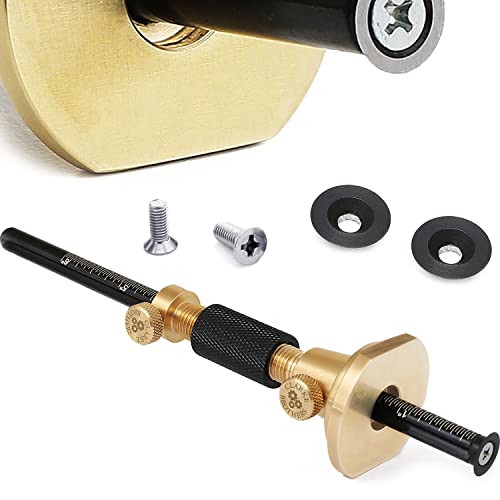
Clarke Brothers builds its gauge entirely from metal: a hardened steel stem and cutter with a solid brass fence. Two flat edges machined into the fence stop the tool rolling off the bench, and the same flats give stable registration when you roll the gauge around a board’s corners while scribing a continuous baseline.
Inch and metric graduations run to 6 inches and 150 mm along the stem, more reach than dovetail layout ever asks for, since baselines sit within an inch or so of a board’s end. The round cutter is locked in place with a screw rather than free-spinning, so it can be driven with firm pressure through hard, dry stock without skating sideways, exactly the behavior you want when the baseline crosses end grain on a pin board.
The kit includes two spare hardened steel cutters, which matters more than it sounds: a wheel gauge is only as good as its edge, and swapping in a fresh cutter takes seconds compared with honing the installed one mid-project. Large thumbscrews give a secure grip for locking, even with dusty hands. It sits in the mid-range tier and is the durability-first choice here.
Specs:
– Cutter type: Locked round wheel cutter, hardened steel
– Fence: Solid brass with two anti-roll flats
– Stem: Hardened steel
– Scales: Imperial and metric, to 6 inches and 150 mm
– Included: Gauge plus two spare cutters
– Lock: Large thumbscrews
– Tier: Mid-range
4. MKC Wheel Marking Gauge Kit

The MKC kit follows the same proven layout as the Clarke Brothers gauge, with a stainless steel stem and a fence of brass and hardwood. The fence carries two flat edges, so the gauge sits still on the bench and registers consistently when you work around a corner, and the black measurement markings stand out clearly against the stainless stem in both metric and imperial units.
Its cutting wheel is HSS steel, pre-sharpened, and heat treated for edge retention. For dovetail baselines that is the critical specification: a keen wheel severs end-grain fibers cleanly, leaving the knife-wall your chisel needs, while a dull one crushes fibers and produces a fuzzy line that invites a sloppy fit. Two extra blades ride along in the kit, so the first time the edge goes off, you swap rather than stop.
Compared with the Clarke Brothers, the MKC trades the all-metal build for a warmer hardwood touch on the fence. Choose it for the wood-accented fence and high-contrast scale; choose the Clarke Brothers for the locked cutter and all-metal build.
Specs:
– Cutter type: Wheel cutter, HSS steel, pre-sharpened
– Fence: Brass and hardwood, two flat edges
– Stem: Stainless steel
– Scales: Metric and imperial, black filled
– Included: Gauge plus two extra blades
– Tier: Budget to mid-range
5. YOSELIN Dovetail Marking Gauge Set
The YOSELIN set is the beginner-oriented kit, and it is the only entry here designed with dovetails named on the box. The gauge body is CNC-machined aluminum with an anodized finish, lighter than the brass heads above, and the 8-inch precision steel rod is graduated in millimeters and 1/64-inch marks for fine reading.
What sets the kit apart is the pair of cutters. A rotating bearing cutter rolls freely and treats softwoods and plywood kindly, which is where most people practice their first dovetails. A locked cutter swaps in for hardwoods, where it resists skipping across dense grain. One tool therefore covers both practice stock and project hardwood.
The box also includes a bow-tie dovetail guide to help lay out angles, a pencil holder accessory, a mini screwdriver for cutter swaps and a woodworking pencil. The aluminum body lacks the planted feel of brass, and the knurled knob benefits from a periodic snug-up during long marking sessions. As a first gauge for learning dovetails, though, the set removes excuses: everything needed to lay out a joint is in the box, at a budget tier.
Specs:
– Cutter type: Two cutters, rotating bearing and locked
– Body: CNC-machined aluminum, anodized
– Rod: 8-inch precision steel
– Scales: Millimeter and 1/64-inch graduations
– Included: Dovetail guide, pencil holder, mini screwdriver, pencil
– Tier: Budget
How to Choose a Marking Gauge for Dovetail Work
Start with the cutter. Dovetail baselines run across end grain, so the wheel must sever fibers rather than push them aside. A hardened steel wheel that can be resharpened or replaced is the baseline requirement, and kits with spare cutters save a mid-project interruption. Locked cutters track straighter in hardwoods; rotating bearing cutters are gentler in softwoods and plywood.
Next, judge the fence. It should present a broad, flat face that registers against the end of the board without rocking, and flats on the fence keep the gauge from rolling off the bench. Heavier brass heads, like the iGaging and WoodRiver, stay planted with less hand pressure, which pays off when you scribe around all four faces of a board in one pass.
Beam length matters less than people think. A baseline is set from the thickness of the mating board, usually well under an inch of fence travel, but a 7- or 8-inch beam also lets the gauge serve for tenon shoulders and other layout, and graduated scales help you record and repeat a setting. Micro-adjustment is a luxury for dovetails, not a necessity, because the setting comes from the workpiece itself rather than from a number.
Finally, test the lock. Set the gauge, scribe a line, then scribe again on scrap without resetting. If the second line lands exactly on the first, the lock is doing its job. That simple check tells you more about a gauge’s fitness for dovetails than any specification sheet.
FAQ
Why use a marking gauge instead of a pencil for dovetail baselines?
A pencil line has measurable width and sits on the surface, so your chisel has nothing positive to register against. A wheel gauge cuts a shallow groove at an exact distance from the reference face, and the chisel edge drops into that groove, which is what makes crisp, gap-free baselines achievable.
Is a wheel gauge or a marking knife better for dovetails?
For baselines, the wheel gauge wins because it sets its distance from the mating board and repeats that setting on every part. A marking knife is still useful for tracing pin and tail shapes from one board onto the other. Most workflows use both: the gauge for baselines, the knife for transferring the joint profile.
How do you set a marking gauge for a dovetail baseline?
Stand the mating board on its end, rest the gauge’s fence against one face, and slide the cutter until it just touches the opposite face, then lock it. Scribe around all faces of the board being marked. Setting from the actual workpiece, rather than from a ruler, removes measurement error from the joint entirely.
Can one marking gauge handle both through and half-blind dovetails?
Yes. The baseline work is identical; only the depth of the sockets changes, and that is chisel work, not layout work. A gauge that doubles as a depth gauge, like the iGaging, adds convenience for checking half-blind socket depth, but any gauge here will lay out both joint types.
Conclusion
Dovetail accuracy is decided before the saw comes out, at the baseline. A good wheel gauge makes that line sharp, repeatable and effortless to transfer between parts. Choose the iGaging for the strongest all-around balance of reach, scales and dual duty, the WoodRiver for premium heft and finish, the Clarke Brothers or MKC kits for spare-cutter practicality, and the YOSELIN set if you are learning the joint and want cutters for both softwood practice and hardwood projects.
Related guides
More from Amazon
Programs that pair well with the guide above. Offers and eligibility are set by Amazon and may change.
A free business account with business pricing and bulk-buying tools for work, shop or home office.
Create a business accountFree shipping on eligible items, Prime Video and more. Eligible new members can start with a free trial.
Start a Prime free trialAudiobooks and podcasts to listen to on the go. Eligible new members can start with a free trial.
Try Audible freeAd-free music streaming. Eligible new subscribers can start with a free trial.
Try Music Unlimited freeAs an Amazon Associate we earn from qualifying purchases.
Write Your Review
No reviews yet. Be the first to share your experience!