
Key takeaways
- Compare the best digital angle gauges for table saw blade tilt, miter saw bevels and jointer fence checks, with accuracy, magnets and batteries explained.
What's inside
As an Amazon Associate I earn from qualifying purchases. This post may contain affiliate links at no extra cost to you.
- Top Pick: Klein Tools 935DAG Digital Electronic Level and Angle Gauge
- Runner-up: SHAHE Digital Angle Gauge with Magnetic Base and Backlight
- Also consider: GemRed 82412 Digital Angle Gauge
The angle scale stamped on a table saw or miter saw is a rough guide at best: it is read from a distance, it drifts as the trunnion collects dust, and a half degree of error at the blade becomes a visible gap on a wide miter. A digital angle gauge fixes that by measuring the blade itself: zero it on the machine table, stick its magnetic base to the blade, and read the actual tilt while you adjust.
As an Amazon Associate, we earn from qualifying purchases.
These small cubes also earn their keep away from the saw: the same routine checks a jointer fence for square or confirms a drill press table is back at ninety degrees. Models differ in published accuracy, display resolution, magnet arrangement, backlighting, and battery type. The five below are the gauges woodworkers actually compare, with specifications from each maker’s published figures.
This article contains affiliate links, and we may earn a commission when you buy through them at no extra cost to you.
Contents
Quick Answer
For most woodworkers, the Wixey WR300 Type 2 is the digital angle gauge to buy first. Wixey publishes accuracy of plus or minus 0.2 degrees with 0.1 degree resolution, the backlit display reads well in a dim shop, the magnetic base holds firmly to a saw blade, and it runs on a single AAA battery.
Wixey WR300 Type 2 Digital Angle Gauge
The WR300 Type 2 is the gauge that made this category mainstream in home shops, and it remains the reference point for saw setup. The workflow is the standard one: set it on the saw table, press zero, then move it to the blade and tilt until the display shows the angle you want. Because the reading is relative to the table, the saw itself does not need to be level.
Wixey publishes a range of plus or minus 180 degrees, resolution of 0.1 degrees, accuracy of plus or minus 0.2 degrees, and repeatability of plus or minus 0.1 degrees. The Type 2 update added a backlit display, which helps on a blade tilted away from the shop lights. Magnets in the base hold it to steel and cast iron; on aluminum tables, you hold it in place by hand.
Power comes from a single AAA battery, with automatic shut-off to stretch battery life.
Specs:
– Model: WR300 Type 2
– Measuring range: plus or minus 180 degrees
– Resolution: 0.1 degrees
– Accuracy: plus or minus 0.2 degrees (maker figure)
– Repeatability: plus or minus 0.1 degrees (maker figure)
– Display: backlit LCD
– Base: magnetic
– Battery: 1 x AAA, with auto shut-off
– Size: 2.3 x 2.3 x 1.1 inches
See the Wixey WR300 Type 2 on Amazon
Klein Tools 935DAG Digital Electronic Level and Angle Gauge
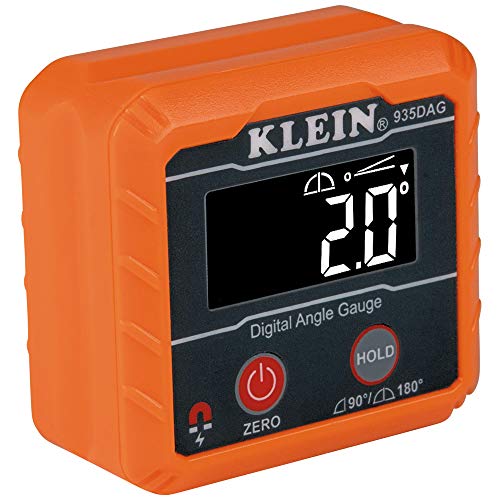
Klein Tools built the 935DAG as both an angle gauge and a pocket digital level. It measures over two ranges, 0 to 90 degrees and 0 to 180 degrees, and a zero calibration function lets you set any surface as the reference for relative readings, as when moving from a saw table to a blade. The reverse-contrast, auto-rotating display keeps the numbers upright when the gauge is flipped.
Klein rates accuracy tightest at the settings woodworkers use most: plus or minus 0.1 degree at level and plumb positions, with a wider tolerance at other angles. A strong magnetic base holds it to ferrous surfaces, and V-groove edges let it sit steadily on round stock as well as flat blades.
For jointer fence checks, the level function is handy: switch to absolute mode and the gauge reads against true level rather than your zeroed reference. It runs on two AAA batteries, with battery life not stated by the maker.
Specs:
– Model: 935DAG
– Measuring ranges: 0 to 90 degrees and 0 to 180 degrees
– Accuracy: plus or minus 0.1 degree at 0 and 90 degrees (maker figure); wider at other angles
– Resolution: 0.1 degrees
– Display: auto-rotating, reverse contrast
– Base: magnetic, with V-groove edges
– Zero calibration: yes
– Battery: 2 x AAA; battery life not stated
See the Klein Tools 935DAG on Amazon
SHAHE Digital Angle Gauge with Magnetic Base and Backlight

SHAHE, made by Wenzhou Sanhe Measuring Instrument, sells this cube as a general-purpose inclinometer and angle gauge for machine setup. It covers the core saw routine without extras: zero it on the table, move it to the blade on its magnetic base, and read the tilt on a backlit display that helps in the shadow of a blade guard.
The listing presents it as a magnetic level box and protractor in one, with absolute and relative measurement, in a compact body about 2.27 inches across the face.
SHAHE’s listing data is thinner than the big tool brands’: accuracy tolerance, resolution, and battery details are not stated in the listing information gathered for this guide, so they appear as not stated below rather than borrowed from similar-looking gauges. Treat it as a relative-reading tool: zeroed against your own table and blade, its repeatability does the work.
Specs:
– Model: 5315-90C
– Manufacturer: Wenzhou Sanhe Measuring Instrument Co., Ltd
– Base: magnetic
– Display: backlit LCD
– Modes: absolute and relative measurement
– Size: about 2.27 inches across the face
– Accuracy, resolution, battery: not stated
See the SHAHE Digital Angle Gauge on Amazon
GemRed 82412 Digital Angle Gauge

The GemRed 82412 is the straightforward, aluminum-framed cube that shows up in a lot of shops as a second gauge or a first purchase. Its distinguishing feature is a bright green backlit display that reads clearly under poor overhead light. The aluminum framework gives it more substance than all-plastic cubes, and a magnetic base holds it to blades and tables.
GemRed publishes accuracy of plus or minus 0.2 degrees with 0.1 degree resolution, in line with the rest of this class, and the gauge measures through four 90 degree quadrants, covering any blade tilt or bevel a woodworking machine can produce. A zero button sets a relative reference on the table; it can also read absolute angles against level.
The 82412 runs on a single AAA battery; GemRed publishes no battery life figure, so it is listed as not stated below.
Specs:
– Model: 82412 (LB-01)
– Accuracy: plus or minus 0.2 degrees (maker figure)
– Resolution: 0.1 degrees
– Display: green backlit LCD
– Frame: aluminum
– Base: magnetic
– Battery: 1 x AAA; battery life not stated
– Absolute and relative modes: yes
See the GemRed 82412 on Amazon
Klein Tools 935DGGP Digital Angle Finder

The 935DGGP is Klein’s dedicated angle finder with a strong magnetic base, aimed at users who move between the woodshop and site work. Its signature feature is unit conversion: readings can be shown in degrees, percent grade, inches per foot, or millimeters per meter. The degree mode behaves as a saw setup gauge should, with a zero function for relative measurement, and the magnetic base holds firmly to steel blades and fences, leaving both hands free for the tilt handwheel. Klein positions this finder for repeated setup work where the gauge gets stuck on and pulled off machines all day.
Klein’s listing emphasizes conversion and the magnetic base over a full specification table, so figures such as accuracy tolerance and battery life are recorded as not stated here rather than guessed. If your decision hinges on a published accuracy figure, the 935DAG or the Wixey is the safer comparison.
Specs:
– Model: 935DGGP
– Display units: degrees, percent grade, inches per foot, millimeters per meter
– Base: strong magnetic
– Zero function: yes
– Accuracy, resolution, battery, battery life: not stated
See the Klein Tools 935DGGP on Amazon
How to Choose
Start with the published accuracy figure, and read it properly: accuracy is how close the reading is to the true angle, while resolution is only the smallest step the screen can show. A gauge displaying finer steps than its accuracy tolerance is not more accurate; the extra digits only show drift sooner. For furniture work, plus or minus 0.2 degrees is the realistic class standard, and errors that small disappear into wood movement and glue-line tolerance. Where a maker publishes no figure, treat the gauge as a relative tool and lean on its zero function.
Next, think about magnets and your shop’s surfaces. Magnets hold only on ferrous metal: steel blades, cast iron tables, and steel fences. They do nothing on aluminum fences, melamine, or wood. With mostly cast iron and steel machines, any pick here works; with an aluminum-top saw, plan to hold the gauge by hand.
Modes matter more than marketing. You need a relative zero, which makes any surface the reference, and ideally an absolute level mode for leveling machines; several gauges here add that level mode.
Finally, consider the display and battery. A backlight helps in a dim corner, and an auto-rotating display helps on miter saws where the gauge ends up sideways. AAA cells are the easiest batteries to stock, and auto shut-off protects a gauge left on in a drawer.
Who Should Skip
Skip a digital angle gauge entirely if your work is rough carpentry or framing, where the saw’s own scale and a speed square are honestly accurate enough. Also skip it if you only ever cut at ninety degrees and already own a known-accurate machinist square, which answers that question faster.
Skip finer-resolution models if you expect the extra digit to deliver joinery that a plus or minus 0.2 degree tolerance cannot; the limiting factors are arbor runout and fence alignment, not the display. And skip any gauge if you will not zero it on the machine table before every setup: used carelessly, these tools produce confident, precise, wrong numbers.
FAQ
Do I need to level my saw before using a digital angle gauge?
No. Zero the gauge on the machine table first, and every reading after that is relative to the table, which is the relationship that determines your cut. Absolute level only matters when you deliberately use the gauge’s level mode for machine leveling.
Why do my readings change when I move the gauge on the blade?
The gauge must sit flat and clear of the blade’s teeth and any raised lettering. Rest it on the flat plate of the blade, keep it perpendicular to the table, and let the reading settle.
Can a digital angle gauge check a jointer fence?
Yes. Zero it on the jointer bed, then place it against the fence to confirm ninety degrees, or set a bevel for chamfer work. Magnets will not hold on some aluminum fences, so hold it firmly against the fence while reading.
How long do the batteries last?
It varies by model and by how often the backlight runs; auto shut-off extends life considerably. Where a maker publishes no figure, this guide lists battery life as not stated rather than estimating one.
Final Verdict
For a single gauge that handles table saw tilt, miter saw bevels, and jointer fence checks without fuss, the Wixey WR300 Type 2 remains the default recommendation: honest published accuracy, a backlit screen, strong magnets, and a common AAA battery. The Klein 935DAG is the better pick if you also want a pocket level with the tightest published tolerance at level and plumb. The GemRed 82412 covers the same ground with an easy-reading green display, the SHAHE offers a compact backlit cube for relative setup work, and the Klein 935DGGP adds slope-unit conversions for mixed shop and site work. Whichever you choose, the habit matters more than the hardware: zero on the table, measure the blade, then cut.
Related guides
More from Amazon
Programs that pair well with the guide above. Offers and eligibility are set by Amazon and may change.
A free business account with business pricing and bulk-buying tools for work, shop or home office.
Create a business accountFree shipping on eligible items, Prime Video and more. Eligible new members can start with a free trial.
Start a Prime free trialAudiobooks and podcasts to listen to on the go. Eligible new members can start with a free trial.
Try Audible freeAd-free music streaming. Eligible new subscribers can start with a free trial.
Try Music Unlimited freeAs an Amazon Associate we earn from qualifying purchases.










Write Your Review
No reviews yet. Be the first to share your experience!