Best Band Saws with Stable Frames for Tall Resaw Cuts
What's inside
As an Amazon Associate I earn from qualifying purchases. This post may contain affiliate links at no extra cost to you.
A tall resaw cut puts more stress on a band saw than ordinary curve cutting. The blade is under high tension, the upper guide post is extended, and a wide board can push sideways against the blade for several minutes. A saw with a light stand, flexible frame, or small wheels may still cut accurately on short stock, but it can wander when resawing 8-, 10-, or 12-inch boards.
The best band saws for this work have a rigid frame, substantial wheels, a strong table, and guides that stay aligned when the blade is tensioned. They also need enough motor power to maintain speed in hardwood. A taller cutting capacity alone does not make a saw suitable for stable resawing.
As an Amazon Associate we earn from qualifying purchases at no extra cost to you.

Contents
What Makes a Band Saw Stable
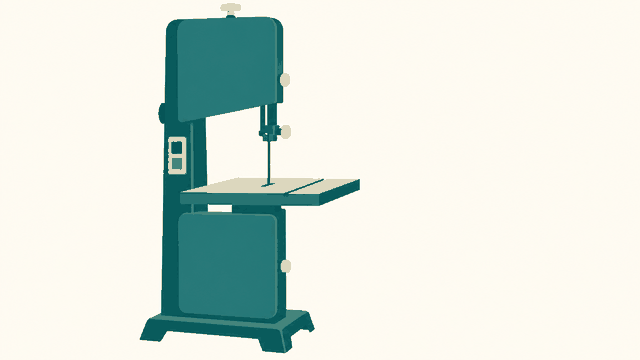
Frame stiffness is the first consideration. A welded steel frame can be very rigid, while a cast-iron frame resists vibration well and usually feels more solid when the saw is running. A narrow, lightweight stand is a weak point on some cheaper machines. If the stand flexes or rocks, the frame cannot do its job.
Look for a wide base, levelers, and a stand that can be firmly anchored if necessary. A saw weighing roughly 200 pounds will generally be less prone to movement than a benchtop machine weighing 60 to 100 pounds. Weight is not a guarantee of quality, but it is useful evidence when comparing otherwise similar saws.
Wheel diameter also matters. A 14-inch saw is a common practical size for serious shop resawing. Larger wheels provide a longer blade path and generally run more smoothly, but they also raise the machine’s cost and footprint. The wheels should be balanced and have tires in good condition. A damaged or uneven tire can cause vibration and make precise tensioning impossible.
Capacity and Blade Selection
For tall resaw cuts, compare the actual distance from the table to the upper guide assembly, not just the manufacturer’s advertised capacity. A listed capacity of 12 inches may leave little clearance for a tall workpiece and dust hood. At least 10 inches of capacity is useful for many furniture projects; 12 inches or more gives considerably more flexibility.
A wide blade is usually more stable than a narrow one. For straight resawing, a 3/4-inch blade with three teeth per inch is a sensible starting point on a 14-inch saw. A 1-inch blade can be better for very tall stock if the saw accepts it and has enough tensioning capacity. A 1/2-inch blade is easier to steer and may be preferable on smaller machines, but it is more likely to deflect in thick hardwood.
Tooth count is a trade-off. A coarse blade clears sawdust from a deep kerf and cuts faster. A finer blade leaves a smoother surface but can clog with resin and heat up in thick material. A blade that is too fine is a common cause of slow cutting, burning, and wandering.
For a dependable selection of replacement blades, compare 3-TPI resaw band saw blades by width, length, and tooth style rather than buying on tooth count alone.
Features Worth Paying For
A cast-iron table is valuable because it stays flat and does not flex under a heavy board. A table that tilts in both directions can be useful, but a solid, square table is more important for resawing. Check that the table trunnions are substantial and lock securely. If the table shifts while feeding stock, the cut can move several millimeters over a long board.
The upper guide post should move smoothly and lock without twisting. Rack-and-pinion height adjustment is convenient, but the guide assembly must remain parallel to the blade. Ceramic guides or quality bearing guides can both work well when adjusted correctly. The guide faces should sit close to the stock—normally about 1/8 inch above it—without touching during a free-running cut.
A quick-release blade tension lever is convenient, especially if you remove tension after each session. However, it does not replace proper tension adjustment. Some small saws have inaccurate tension scales, so the scale should be treated as a starting point. The blade must track correctly, run without excessive flutter, and cut straight under load.
A reliable fence is another major advantage. A tall, rigid resaw fence makes it easier to support wide boards and maintain a consistent feed angle. On many machines, the stock fence is adequate for 6-inch work but flexes when raised for taller cuts. A sturdy aftermarket fence can improve a cheaper saw more than a decorative feature or electronic speed display.
Band Saw Types Compared
| Type | Typical resaw use | Strengths | Limitations |
|---|---|---|---|
| Benchtop saw | Boards up to about 4–6 inches | Low cost, compact, easy to store | Limited tension, smaller wheels, more vibration |
| 14-inch floor saw | Regular 6–10 inch resawing | Good balance of capacity, stability, and price | May need a riser or upgraded fence for taller work |
| Large-frame saw | Frequent 10–14 inch resawing | Rigid frame, stronger tension system, larger table | Expensive, heavy, and requires more shop space |
A cheaper benchtop machine is fine when the work is occasional, the stock is narrow, and portability matters. It is a poor choice if the plan is to routinely resaw thick hardwood. In that case, start with a 14-inch floor-standing band saw with a rigid stand and enough tension capacity for a 3/4-inch blade.
How to Prepare for a Tall Resaw Cut
Before cutting, flatten one face and joint one edge of the board. A band saw can follow a rough or twisted surface, but it cannot reliably correct a board that rocks on the table. Mark the cut line on both ends and along the edge. If the marks do not agree, the board may be bowed or the intended cut may not be practical.
Install a sharp blade and tension it according to the blade manufacturer’s guidance. Set the thrust bearing just behind the blade and the side guides just clear of it. The fence should be parallel to the blade’s actual tracking direction, not necessarily parallel to the miter slot. Make a test cut in scrap before committing expensive lumber.
Feed at a steady rate. Forcing the board slows the wheel and makes the blade deflect; feeding too slowly can produce heat and burning. If the cut curves toward the fence, the blade may be dull, the teeth may be uneven, the fence may be misaligned, or the wood may contain internal stress. Do not solve repeated drift simply by pushing harder.
A Practical Buying Priority List
Spend first on frame rigidity, wheel quality, guide adjustment, and usable tension capacity. Next consider table size and the quality of the fence. Motor horsepower matters, but its rating is less useful than how well the saw maintains blade speed under load. A properly tuned 1- to 1-1/2-horsepower saw can outperform a poorly built machine with a larger advertised motor.
If your work includes occasional veneer or guitar-body resawing, a well-tuned 14-inch machine is usually the sensible middle ground. For daily production work or boards over 10 inches, the added cost of a large-frame resaw band saw buys less vibration, better blade control, and fewer frustrating setup compromises.