Portable Thickness Planer Review
Key takeaways
- A criteria-led look at benchtop planers: what bed flatness, cutterhead design, feed geometry, and dust ejection tell you before you spend a dollar.
What's inside
As an Amazon Associate I earn from qualifying purchases. This post may contain affiliate links at no extra cost to you.
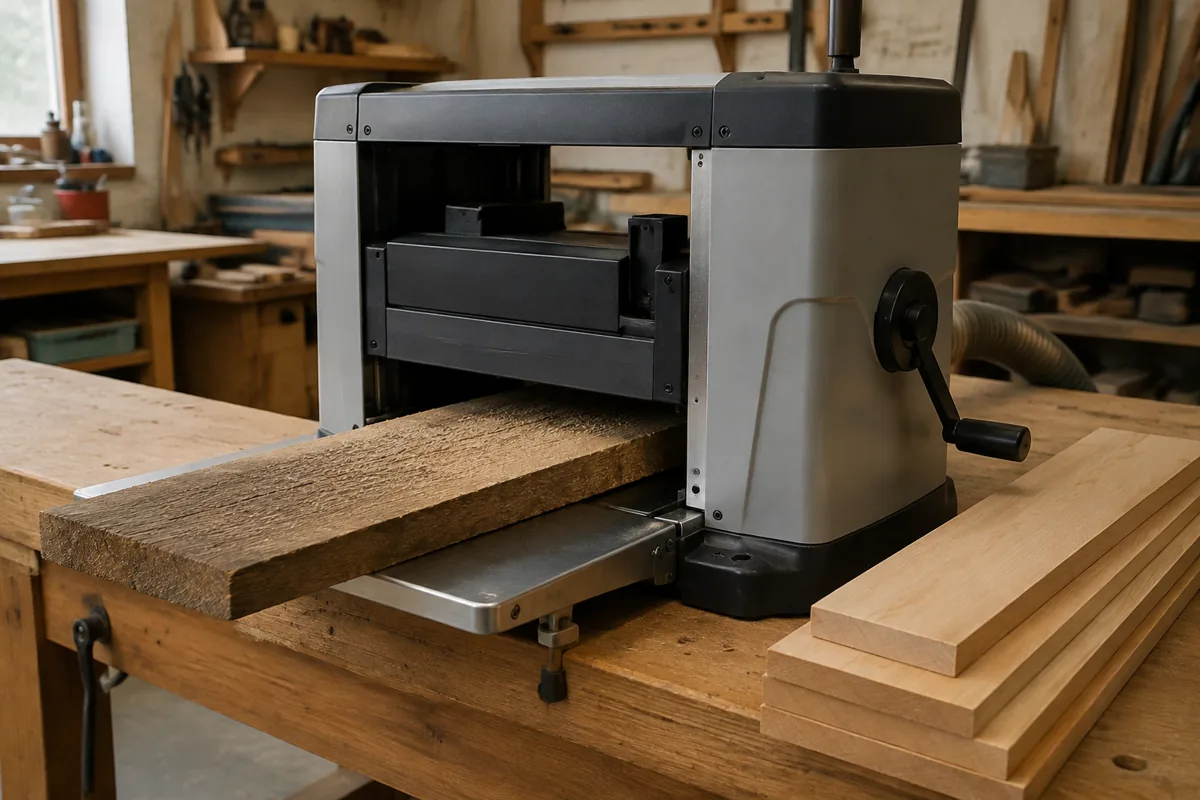
Rough lumber is never flat, and pre-surfaced boards from the home center are marked up and usually cupped by the time they reach the shop. Milling your own stock is the fix, and that is why a benchtop planer is the third machine most small shops buy. This portable thickness planer review is a criteria-led look at that class: 12- to 13-inch machines that live on a stand, weigh 60 to 100 pounds, and are asked to turn rough boards into parallel, consistent stock.
Every machine here works the same way: two feed rollers pull the board past a spinning cutterhead while a screw-driven carriage sets the depth of cut. Because the mechanism is shared, advertised horsepower tells you almost nothing. What separates a planer you keep from one you fight is mechanical: bed and wing flatness, cutterhead design, whether the head locks, roller grip, and whether chips actually leave the housing. Those are the criteria we use, and we publish no bench numbers we did not record.
As an Amazon Associate we earn from qualifying purchases at no extra cost to you. Product prices and availability are accurate as of the date shown and are subject to change.




| Class | Typical capacity | Cutterhead | Watch for |
|---|---|---|---|
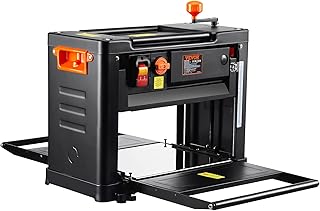
| Entry-level single speed | 12-1/2 in. x 6 in. | Two straight knives | Light stamped bed, no head lock, more snipe |
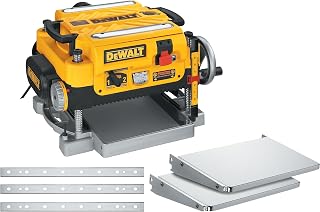
| Two-speed workhorse | 13 in. x 6 in. | Three straight knives | Weight, knife cost, blower noise |
| Factory spiral head | 12-13 in. x 6 in. | Rows of carbide inserts | Higher price, slower finish feed |
| Aftermarket retrofit head | Same as host machine | Helical insert head | Fits only certain frames, install time |
What This Portable Thickness Planer Review Judges
We apply the same short list to every machine in the class, in this order.
Bed and extension flatness. The bed is your reference surface. If it is dished, or the folding wings sit below the bed casting, the board rocks and you get taper and snipe regardless of the cutterhead. Check it with a straightedge along and across, and confirm the wings are adjustable.
Cutterhead and knife system. Three knives beat two for surface quality at the same feed rate. Disposable double-edged straight knives are cheap and index in minutes; segmented carbide inserts cost more and earn it on figured stock.
Head lock and column slop. A cutterhead lock, or four stiff posts with little backlash, is the most effective anti-snipe feature on a machine this size.
Feed rollers and chip clearance. Rubber-coated infeed rollers grip dusty rough stock better than fine-toothed steel, and fan-assisted ejection keeps chips from being pressed back into the surface.
Depth repeatability. A turret stop you can trust lets you return to the same thickness for matched parts days later.
Straight Knives or a Segmented Spiral Head
This is the real fork in the road. A three-knife straight head is standard on the two-speed 13-inch design that DeWalt popularized and half the industry copied. It cuts fast, knives are inexpensive, and a change takes ten minutes with the indexing pins. The costs are noise, tearout in curly and reversing grain, and a ridge across every board when you nick a knife on grit.
Segmented heads carry rows of small carbide inserts arranged in a spiral. The shearing angle cuts tearout, drops the pitch of the noise, and lets you rotate one damaged insert instead of scrapping a full-width knife. Cutech and Wahuda build benchtop machines with spiral heads, and Byrd’s Shelix heads retrofit several popular frames. Expect a slower feed for a finish-ready surface and a fussy insert change.
- ✔ Less tearout in figured and reversing grain
- ✔ Rotate a single insert instead of replacing a knife
- ✔ Noticeably lower cutting noise
- ✔ Long carbide life in hardwoods
- ✘ Higher purchase or retrofit cost
- ✘ Slower feed for a glass-smooth surface
- ✘ Insert changes need patience and a torque driver
- ✘ Fine scalloping shows under raking light
Best all-around: two-speed 13-inch three-knife planer
If you are buying one planer for general shop work, shop this class first. Insist on a cast bed, adjustable extension wings, a cutterhead lock, and a fan-assisted chip port, then budget for a heavy stand and a spare set of knives.
Snipe Is a Setup Problem, Not a Brand Problem
Snipe, the shallow dip planed into the first and last few inches of a board, happens when only one roller has the workpiece and the carriage tips. Nothing in this class is immune. A head lock and coplanar wings reduce it to something a sanding pass removes; a flexing bed and loose columns leave dips you have to plane out.
Technique closes most of the rest. Support the board in line with the bed, lift gently on the trailing end going in and the leading end coming out, butt boards end to end so the rollers never lose contact, and keep the last two passes light. Mill long, then trim the sniped ends off.
Dust Ejection, Noise, and Bench Reality
A planer makes more waste per minute than anything else in a small shop, so treat the dust port as a primary criterion rather than a footnote. A 4-inch port feeding a real dust collector is the combination that keeps up. A shop vacuum on a small port will clog, and then the outfeed roller presses chips into your fresh surface. Machines with a chip-blower fan can throw waste into a barrel without a collector, which is a legitimate garage-shop answer.
Noise is the criterion buyers underestimate. Universal motors in this class are loud enough that hearing protection is mandatory, and the two-speed machines with blower fans are the loudest of the group. Bolt the planer to a stand with some mass in it; vibration you can feel in the bed shows up as chatter in the surface.
Quietest route: benchtop planer with spiral cutterhead
Worth the premium if you work curly maple, walnut crotch, or reclaimed boards. Check the insert count and whether replacement inserts are a common size before you commit.
Portable Thickness Planer FAQ
Do I still need a jointer? A planer makes faces parallel, not flat, so a cupped or twisted board comes out thinner and still cupped. A planer sled, a hand plane, or a router jig will carry you for a while, but flattening one face is part of the system either way.
How thin can I plane safely? Most machines in this class stop gripping reliably somewhere around 1/4 to 3/8 inch, and thin stock can shatter. Use a sacrificial carrier board with a stop at the back.
Straight knives or inserts for a first planer? Straight knives, unless most of your work is figured hardwood. Cheap replacements matter the day you plane into a hidden staple in reclaimed lumber.
The Verdict
Judged on the criteria that matter, the two-speed 13-inch three-knife machine is still the sensible default: cast bed, adjustable wings, head lock, chip blower, and knives cheap enough that reclaimed boards do not scare you. Step up to a factory or retrofit spiral head if figured wood or shop noise drives the decision. Step down to an entry-level 12-1/2 inch single-speed planer only when the budget is fixed, and go in knowing you are trading bed stiffness and snipe control for the price.
Whatever you buy, spend the first hour on setup instead of lumber. Straightedge the bed, set the extension wings dead coplanar or a hair proud, index the knives, and plumb the chip path into a collector or a barrel. A tuned budget planer beats a neglected premium one every time.
Tight budget: 12-1/2 inch single-speed planer
An honest entry point for softwoods and shop furniture. Plan on lighter passes, careful board support, and a heavy stand to settle the vibration.