How to Resaw Thin Boards Without Wavy Cuts
What's inside
As an Amazon Associate I earn from qualifying purchases. This post may contain affiliate links at no extra cost to you.
Wavy resaw cuts usually come from a moving workpiece, a dull or poorly set blade, or asking the saw to cut faster than the blade can clear waste. A wider blade and more horsepower can help, but they will not fix bad setup. Get those basics right before buying a new saw.
Contents
Check the saw before changing blades
Unplug the band saw and inspect the blade for dull or damaged teeth, cracks, and pitch buildup. A blade that has cut a lot of abrasive or resinous stock may look intact but still struggle to track straight. Replace it if the teeth are rounded, missing, or visibly uneven.
Check that the blade is tensioned and tracking according to the saw maker’s instructions. There is no reliable universal tension setting: tension scales vary, and some are inaccurate. The blade should run steadily on the wheels without drifting, and the guides should support it close to the work without pinching it. Set the thrust bearing just behind the blade, not pressing against it during an unloaded cut.
Inspect the fence and table, too. A fence that is not parallel to the blade’s natural cutting path can make the board bind or force you to steer it. Do not assume the blade must be parallel to the table slot; the relevant alignment is how the blade cuts through the stock. Use a test cut to judge that, then adjust the fence to suit.
Choose a blade for the cut
For resawing, a blade with fewer, larger teeth clears sawdust better than a fine-tooth blade. A common starting point is a 3/4-inch blade with 2 or 3 teeth per inch on a saw designed to tension it. A narrower blade may be necessary on a small saw, but it is more likely to deflect under load. Follow the saw’s stated blade-width limit rather than fitting the widest blade that physically fits.
Tooth geometry matters as much as width. A blade made for resawing, often with a deeper gullet and a positive rake, can feed more smoothly than a general-purpose blade. The trade-off is that a coarse blade leaves a rougher surface, which you will need to clean up with a planer or drum sander. Search for resaw band saw blades by width and tooth count, then confirm compatibility with your saw.
| Blade choice | Best fit | Trade-off |
|---|---|---|
| Wide, coarse resaw blade | Deeper cuts and steady feed on a saw that can tension it | Needs adequate saw capacity; leaves a rougher surface |
| Narrower general-purpose blade | Small saws, occasional resawing, or curved cuts | More prone to deflection and usually slower in thick stock |
| Thin-kerf blade | Reducing waste when the saw handles it well | Can wander if the blade is dull, poorly tensioned, or fed too hard |
Prepare and support the board
Start with stock that has one flat face and one straight reference edge. Joint one face and edge, or use a planer and jointer if the board needs flattening. A twisted board rocks on the table; a bowed edge can steer the cut. If you lack a jointer, a straight-line ripping jig can establish a dependable edge before resawing.
Mark the intended cut on both ends and along the edge. Check the board’s thickness at several points and avoid resawing stock with metal, loose knots, or severe internal stress. Wood can pinch the blade as the kerf opens or closes. Keep your hands clear of the blade path and use push blocks or a resaw fence for control.
For a tall or heavy board, add an infeed and outfeed support at table height. A helper can support the board’s weight, but should not push or steer it. Uneven support can twist the workpiece partway through the cut, producing a wave even when the blade setup is sound.
Set the fence and feed steadily
Make a test cut in scrap of similar thickness. Feed slowly enough that the saw does not bog down, but steadily enough to avoid stopping with the blade buried in the kerf. If the motor slows, the board starts vibrating, or sawdust builds up behind the blade, back off the feed. Forcing the cut bends the blade and creates a curved or wavy surface.
Some blades naturally cut at a slight angle to the body of the blade. If the board keeps pressing against a fence while the cut wanders, do not fight it by pushing harder. Adjust the fence angle to the blade’s actual cutting path, using a short test cut. A tall resaw fence helps keep the board upright; a low point fence can be easier to align to the drift angle but offers less support to a wide board. Choose based on the stock and your ability to hold it securely.
A band saw resaw fence is useful if your factory fence is too short or difficult to adjust. A shop-made auxiliary fence is often enough for occasional work, provided it is straight, secure, and aligned with the blade’s cut.
Diagnose the cut before buying more power
Stop and inspect the board if the cut starts wavering. A repeating wave can indicate a dull blade, loose guides, insufficient tension, or an inconsistent feed. A gradual curve often points to fence alignment or blade drift. Burn marks suggest the blade is rubbing or the feed is too slow; a cut that closes on the blade suggests wood movement or stress. Correct one cause at a time and make another test cut.
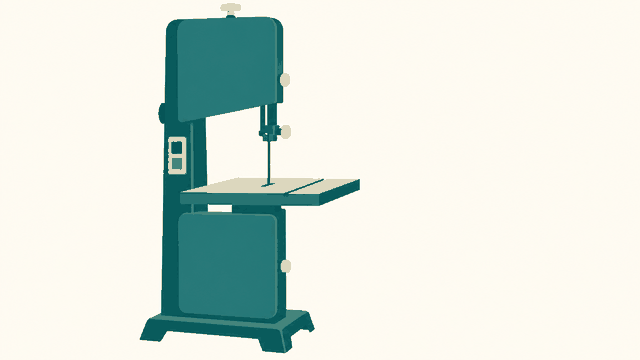
Also check the saw’s resaw capacity and motor limits. A small benchtop saw may handle thin stock, but its narrow blade and limited power can make a tall cut frustrating. If you resaw only occasionally, a sharp, suitable blade and careful feed may be cheaper than upgrading. If the saw repeatedly stalls or cannot tension a blade wide enough for the work, a larger band saw is a more meaningful change than buying several specialty blades.
Plan for cleanup and thickness
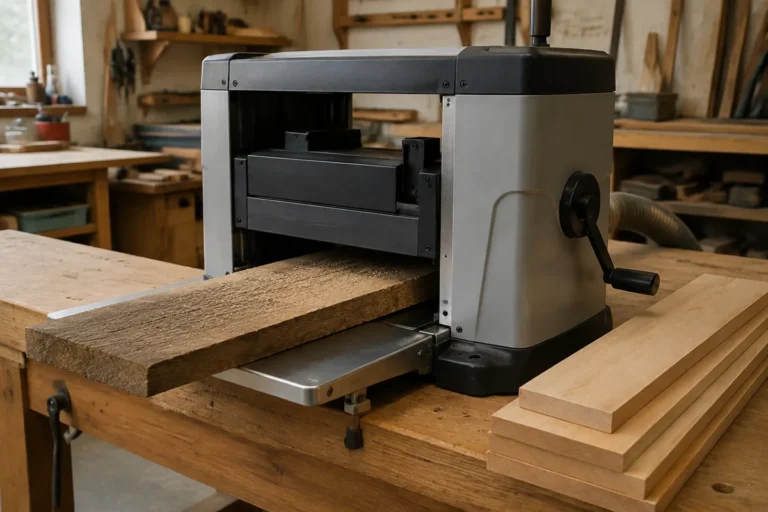
Leave extra thickness for flattening. A resawn surface may vary by 1/32 to 1/16 inch or more, depending on the saw, blade, board, and operator. If you need two finished boards at 1/4 inch, do not start with exactly 1/2-inch stock; allow material for the kerf and cleanup. After cutting, let the halves rest if the wood is stressed, then flatten and bring them to final thickness with a planer or sander.
A resaw setup guide can help with blade tracking and fence adjustment, but the decisive test is still a cut in representative scrap. Keep the blade sharp, support the stock, and feed at a pace the saw can maintain. Those steps usually do more for a straight cut than a bigger motor alone.