Best Jointers for Preparing Thick Furniture Stock
What's inside
As an Amazon Associate I earn from qualifying purchases. This post may contain affiliate links at no extra cost to you.
Contents
Choosing a Jointer for Thick Stock
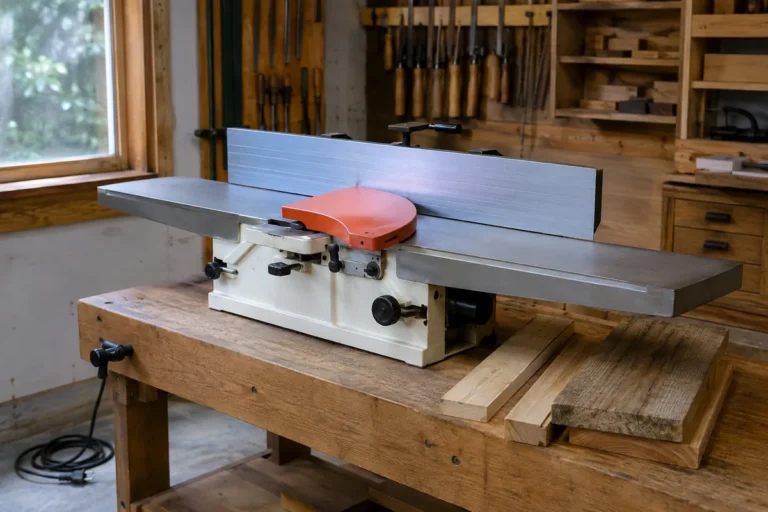
Preparing thick furniture parts starts with one flat reference face and one straight reference edge. A jointer does that work; a planer then makes the opposite face parallel and brings the board to final thickness. For most furniture shops, the best jointer is not the machine with the deepest cut. It is the widest, longest, and most rigid machine you can fit and power safely.
For boards used in tables, doors, benches, and casework, an 8-inch jointer is the practical minimum. It can handle most furniture components, but wide tabletops may need to be flattened in sections, with a router sled, or by paying for professional surfacing. A 12-inch jointer costs more and takes considerable floor space, but it removes that limitation for many home-shop projects.
As an Amazon Associate we earn from qualifying purchases at no extra cost to you.

If your stock routinely arrives at 10 inches or wider, shop for 12-inch jointers rather than trying to make an 8-inch machine do oversized work. If wide boards are occasional, an 8-inch machine paired with a good thickness planer may be the better financial choice.
Features That Matter on Thick Lumber
Bed length and width: Long tables make it easier to keep heavy boards stable through the cut. Look for at least 60 inches of combined table length on an 8-inch machine; longer beds are more forgiving with boards over 6 feet. A narrow bed increases the chance that a board rocks or twists as you feed it.
Fence rigidity: The fence must remain square when pressure is applied. A tall, sturdy fence is useful for jointing edges on thick legs and rails. Fence travel also matters: if it cannot move far enough to expose an unused section of cutterhead, knives wear unevenly and leave a ridge.
Cutterhead type: Traditional straight knives are inexpensive to replace and can produce an excellent surface when sharp. They are also louder and more likely to show tearout in reversing grain. Helical or spiral cutterheads use multiple small carbide inserts. They usually cost more initially, but inserts can be rotated instead of sending the whole knife set out for sharpening.
Depth of cut: A normal pass removes about 1/32 inch to 1/16 inch. Heavy cuts of 1/8 inch are possible on some machines, but they demand a strong motor, a stable board, and a firm feed. Deep cuts do not fix a badly bowed board efficiently; they increase kickback risk, motor strain, and tearout. Buy a helical-head jointer for surface quality and noise reduction, not as a substitute for correct technique.
Jointer Types Compared
| Type | Best use | Advantages | Limitations |
|---|---|---|---|
| 8-inch benchtop | Small shops and occasional furniture work | Lower price, easier storage, modest power requirements | Shorter tables, narrower capacity, less stable with long heavy boards |
| 8-inch floor-standing | General furniture construction | Better beds, fences, dust collection, and support than benchtop machines | Cannot flatten boards wider than 8 inches in one setup |
| 12-inch floor-standing | Wide slabs, large tabletops, and production furniture | Handles wider stock, usually has longer and heavier tables | High cost, large footprint, often needs a 240-volt circuit |
| Jointer-planer combination | Shops with limited floor space | One machine performs both operations, often with a wider capacity | Conversion takes time; planer setup and dust routing may be less convenient |
Motor Power and Electrical Requirements
Thick stock is heavy, but thickness alone does not require a huge motor. A straight, 2-inch-thick board can be easy to joint if you take light cuts. A twisted, cupped board creates much more resistance because the cutterhead is removing material unevenly.
Many 8-inch jointers use motors in the 1-1/2 to 2 horsepower range. That is adequate for a careful home shop. Larger 12-inch machines commonly use 3 horsepower or more and may require 240 volts. Check the motor plate and circuit requirements before buying; a machine that cannot receive adequate current will bog down, trip breakers, and leave a rough surface.
Do not judge capacity by horsepower alone. A rigid table, accurate cutterhead alignment, and reliable infeed rollers matter more than a large number printed on the motor housing.
Surface Quality and Dust Collection
Furniture stock needs a face flat enough that the planer can reference it. A jointer that leaves scallops, snipe-like dips, or a ridge at the edge creates extra work at the table saw and during glue-up. Check that the infeed and outfeed tables align without a step. Even a 0.005-inch misalignment can become obvious on a long edge.
Dust collection is especially important with thick hardwood. A 4-inch port connected to a collector moving roughly 600 to 800 cubic feet per minute at the machine will usually outperform a shop vacuum. Poor collection allows chips to pack around the cutterhead, restricts airflow, and leaves the floor slippery. Some combination machines use smaller ports, so inspect the actual dust path rather than trusting the advertised port diameter.
How to Joint Thick Furniture Parts Safely
Inspect every board for nails, screws, loose knots, and embedded grit. Mark the concave face and place it down first. Take a light initial pass, usually 1/32 inch, until the board has a continuous flat reference area. Keep the board pressed down over the infeed table at the start, then transfer pressure to the outfeed table after the cutterhead.
Never reach over the cutterhead to retrieve a short piece, and do not joint stock shorter than the machine’s stated minimum. For long boards, use level support stands at both ends. Without support, the board can lift into the cutterhead at the beginning or dip into it near the end, producing a tapered surface and potentially causing kickback.
After one face is flat, run that face against the planer bed. Plane in several passes, removing about 1/16 inch or less per pass until the opposite face is clean. Then return to the jointer to straighten the edge before ripping the final width on the table saw.
What to Buy
For most serious furniture work, choose an 8-inch floor-standing jointer with long cast-iron tables, a rigid fence, a 1-1/2 to 2 horsepower motor, and a 4-inch dust port. Straight knives are fine when the budget is tight and you are willing to sharpen or replace them. A floor-standing 8-inch jointer is often the best value.
Choose a 12-inch machine when wide stock is a regular part of your work, not merely because it appears more professional. For a small shop that needs both operations but cannot spare space, a jointer-planer combination machine can be sensible. The cheaper option is entirely adequate when your boards are narrower than 8 inches, your cuts are light, and you have enough table length and support to control the stock.