Best Stationary Planers for Dense Exotic Hardwood
What's inside
As an Amazon Associate I earn from qualifying purchases. This post may contain affiliate links at no extra cost to you.
Dense exotic hardwoods such as ipe, lignum vitae, wenge, and many rosewoods put more strain on a planer than ordinary construction lumber. They are heavy, often abrasive, and unforgiving of dull knives, poor support, and aggressive cuts. The right machine is not simply the one with the biggest motor: cutterhead design, feed control, knife availability, and the ability to take light, repeatable cuts matter just as much.
As an Amazon Associate we earn from qualifying purchases at no extra cost to you.


Contents
What to look for in a planer
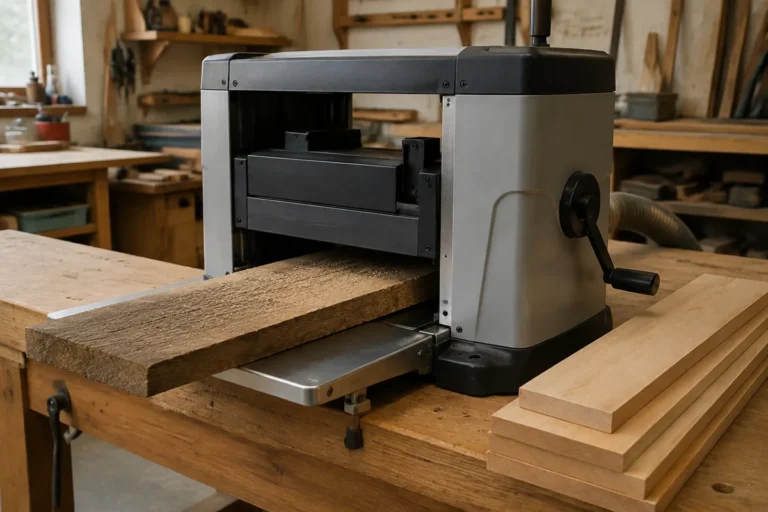
For occasional furniture parts, a 12- or 13-inch benchtop planer can work if you keep cuts shallow and feed the stock steadily. For regular work in dense species, a heavier stationary machine with a longer bed, substantial rollers, and a 15-inch or wider capacity is easier to use and less prone to chatter. Check the actual motor rating and electrical requirements before buying; some larger machines need 230-volt power.
Knife choice affects both finish and upkeep. Straight knives are usually cheaper to replace, but a chipped edge can leave a visible line across the board. A helical or segmented carbide cutterhead costs more upfront, yet individual inserts can be rotated or replaced, and the angled cutting action often reduces tear-out on difficult grain. Carbide holds an edge well against abrasive wood, but it is not immune to damage from grit, hidden metal, or careless handling.
Look for feed speeds around 16 to 30 feet per minute, with a slower setting useful for a finer finish. A two-speed machine is convenient, but not essential: a single-speed planer can still produce good results when you take light passes. A dust port that matches your extractor or collector also matters. Dense hardwood chips are heavy, and a clogged hood can leave chips trapped under the rollers or recut into the surface.
Which type makes sense?
| Planer type | Best fit | Trade-off on dense hardwood |
|---|---|---|
| 12- or 13-inch benchtop | Small shops, occasional boards, limited budget | Short bed and lighter frame make support and shallow cuts especially important |
| 15-inch stationary | Furniture parts and regular hardwood work | Higher price and larger footprint; check power requirements |
| 20-inch or wider stationary | Wide panels, production work, larger stock | Expensive, heavy, and often unnecessary for boards narrower than 15 inches |
A benchtop machine is a reasonable buy if your pieces are short and narrow and you can accept slower work. Compare 13-inch benchtop planers with helical cutterheads if quieter cutting and replaceable inserts are priorities. If you will routinely flatten wide, heavy stock, the extra bed length and mass of a stationary machine are worth paying for.
Choosing capacity for the work
For a serious small shop, a 15-inch stationary planer is often the practical middle ground. It handles most furniture boards while fitting into a smaller shop than a 20-inch model. Search for a 15-inch stationary thickness planer with a sturdy stand, adjustable feed rate, and readily available knives or inserts. Before ordering, confirm the maximum thickness, minimum stock length, and whether the machine includes the cutterhead configuration you want.
Choose a wider planer only if you regularly work with panels or boards beyond a 15-inch capacity. A 20-inch machine takes more space and may need heavier electrical service; it is poor value if most of your stock is narrower. If wide boards are occasional, gluing up narrower, surfaced pieces can be more economical than buying capacity you rarely use.
Do not assume a larger motor eliminates snipe or tear-out. Snipe is a deeper cut near the end of a board, often caused by the stock lifting as it enters or exits the rollers. Long infeed and outfeed supports, a coplanar stand, and feeding boards end-to-end can reduce it. Tear-out is more often a grain-direction and depth-of-cut problem than a horsepower problem.
How to plane dense exotic hardwood
Start with dry, clean, jointed stock. A planer makes one face parallel to the other; it does not reliably flatten a bowed or twisted board. If a board rocks on the bed, flatten one face first with a jointer, a planer sled, or a wide-belt sander. Remove bark, embedded grit, and metal before feeding it. A single hard particle can nick a knife or carbide insert and leave repeating marks on every later board.
Take about 1/32 inch per pass as a conservative starting point on very dense stock, then reduce the cut if the motor labors, the board advances unevenly, or the surface develops ridges. On a benchtop machine, even 1/64 inch may be the sensible cut for wide or highly figured pieces. Feed with the grain where practical, and use the slower feed setting for the final pass if available. Keep hands clear of the rollers; never force a reluctant board through.
Sharp knives matter more than squeezing out the last fraction of capacity. Straight knives can dull faster in abrasive species, and a small chip may produce a line down the full length of the work. A segmented head lets you rotate one damaged insert rather than changing a full knife set, but replacement inserts and the initial cutterhead upgrade can be costly. Compare 15-inch planers with carbide insert cutterheads against straight-knife machines based on replacement-part cost as well as purchase price.
A practical buying decision
Buy a benchtop planer if you process dense hardwood only occasionally, work mainly with narrow parts, and can support long stock on both sides. It is the cheaper option, but expect more attention to feed, cut depth, and snipe. Choose a 15-inch stationary planer for regular furniture work, especially if you want a longer bed and less vibration. Step up to a 20-inch machine only when wide stock is a routine requirement.
Before committing, check the shop’s electrical supply, dust-collection capacity, available floor space, and local access to knives or inserts. Those details can matter more in daily use than a small difference in advertised motor power. On dense wood, a well-supported board, a clean cutterhead, and shallow passes will protect the finish and the machine whichever capacity you choose.