Best Table Saws for Cutting Thick Glue-Up Panels
What's inside
As an Amazon Associate I earn from qualifying purchases. This post may contain affiliate links at no extra cost to you.
Contents
What matters when cutting thick glue-up panels
A thick panel asks more of a table saw than a routine rip. The blade must reach through the stock with enough clearance for the guard and splitter, the motor must keep the blade turning without bogging down, and the table and fence need to support a heavy, awkward workpiece. A saw can have ample depth of cut and still be a poor choice if the panel is too large to handle safely.
Measure the finished thickness before shopping. A 3-inch panel is a different problem from a 4-inch one: many 10-inch saws cut around 3 inches at 90 degrees, but exact capacity varies by model and blade. Check the manufacturer’s published depth-of-cut figure, then allow for the blade’s height setting and any required guard or riving knife. A 12-inch saw generally offers more depth, but costs more, takes up more space, and may require a larger electrical supply.
For a straight cut, a sharp, appropriate blade matters too. A ripping blade with roughly 24 to 30 teeth can feed more freely through thick solid wood than a high-tooth-count crosscut blade. Don’t force the feed to make up for a dull blade or a struggling motor. Burning, a slowing blade, or a cut that starts to wander are reasons to stop and reassess—not to push harder.
Which saw type makes sense?
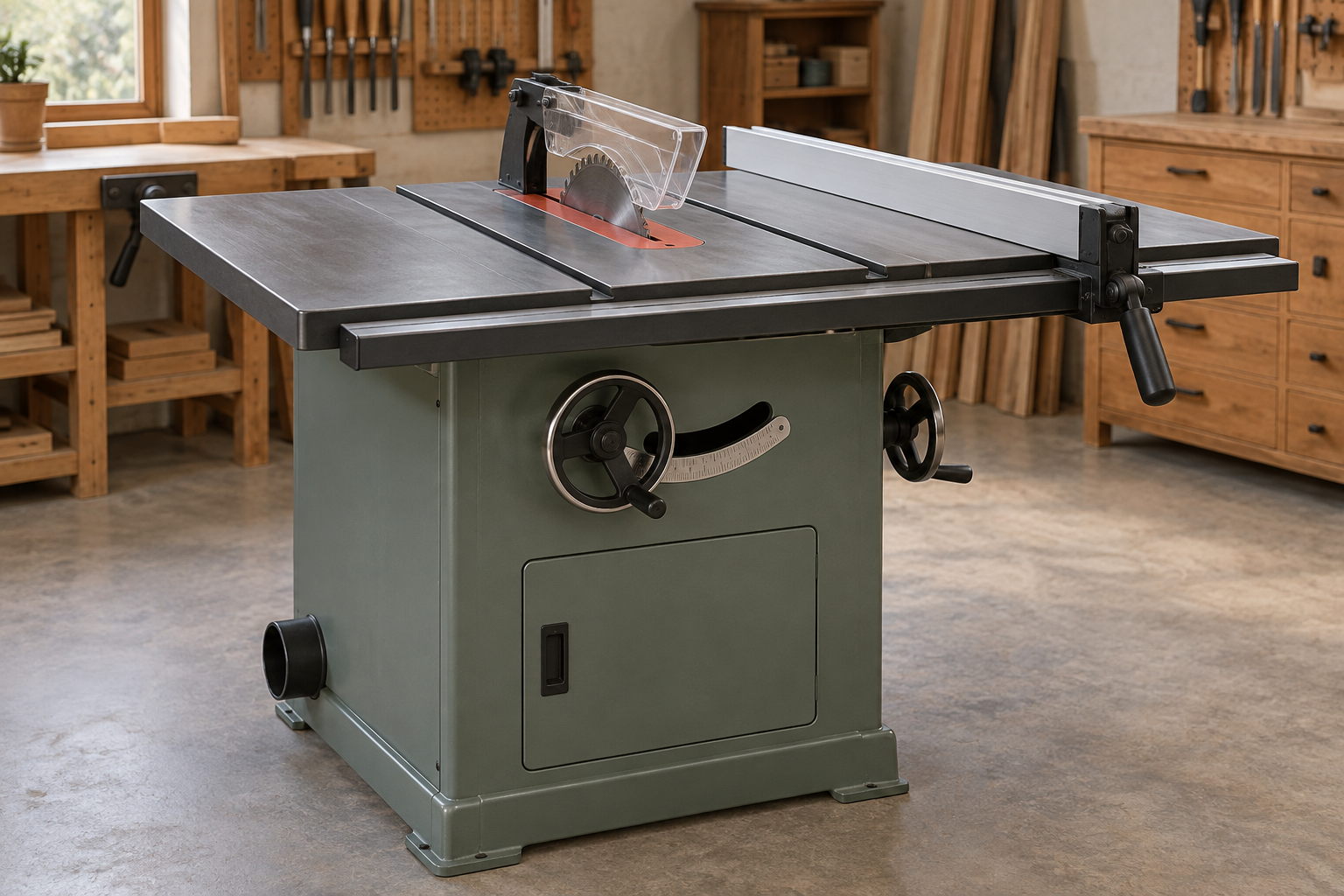
A cabinet saw is the strongest all-around choice for a shop that regularly processes thick hardwood panels. Its mass and stable table help with controlled feeding, while many models offer a 10-inch blade and a powerful motor. A typical 3 hp cabinet saw is commonly wired for 240 volts; confirm your shop’s circuit and the saw’s requirements before buying. Three horsepower is not a guarantee of effortless cutting, but it offers more reserve than a typical contractor-style saw.
A hybrid saw can be a sensible middle ground for a serious hobby shop. It is usually more substantial than a portable jobsite saw without taking up as much space or costing as much as a full cabinet saw. Check the actual cutting capacity and motor specification rather than relying on the “hybrid” label; configurations differ.
A jobsite saw is cheaper, portable, and adequate for occasional cuts in stock within its depth capacity. It is not the first choice for repeatedly ripping thick, dense panels. Limited table support, lower power, and lighter construction make the work harder to control. If a panel will not clear the blade at a safe setting, do not try to force the cut by removing safety equipment or making an unstable pass.
For a frequent thick-panel workload, compare 3 hp cabinet table saws. If budget or floor space is tighter, look at hybrid table saws and verify their depth of cut against your stock.
Table saw options compared
| Saw category | Best fit | Typical trade-off | Check before buying |
|---|---|---|---|
| Cabinet saw, 10-inch | Regular shop use and panels within its cut capacity | Heavy, expensive; many require 240 V | Published depth at 90 degrees, fence travel, electrical supply |
| Hybrid saw | Frequent hobby use with limited space or budget | Less power or mass than a full cabinet saw, depending on model | Motor, arbor capacity, table and extension support |
| Jobsite saw | Occasional work and portability | Less support and reserve for thick hardwood | Actual cut depth, stable outfeed support, safe feed path |
| 12-inch table saw | Stock thicker than a 10-inch saw can handle | Higher price and larger shop requirements | Capacity, blade availability, power and required setup |
Features worth paying for
Prioritize a fence that locks parallel to the blade and stays put under pressure. A long rip capacity is useful only if the fence is repeatable and the table extensions are rigid. A well-made fence can be more valuable than a headline motor rating for ordinary shop work, but it cannot make an undersized saw suitable for stock beyond its safe cutting capacity.
Look for a riving knife and a blade guard that are practical to use. The riving knife helps prevent the kerf from closing on the blade and causing kickback. Keep it installed for through-cuts, and use the guard where the cut allows. A dado set may require a different insert and safety setup; follow the saw’s manual rather than assuming every accessory fits.
Dust collection is another practical difference. A cabinet saw with a closed base often collects dust better than an open portable saw, though a capable extractor and a well-fitted port still matter. If thick stock is a routine job, also budget for a suitable blade and safe outfeed support rather than spending every dollar on the saw itself.
How to make the cut safely
Plan the panel’s path before switching on the saw. A heavy glue-up can be difficult to steer, and an unsupported end may twist or lift as it leaves the blade. Use an outfeed table or roller support set level with the saw table, and get a capable helper when the size or weight makes solo handling uncertain. Keep the panel flat against the table and fence; do not reach across the blade to catch the offcut.
Set the blade just high enough to clear the workpiece by about 1/8 to 1/4 inch, while maintaining the guard and riving knife arrangement specified by the saw manufacturer. Feed steadily and let the blade do the work. If the motor bogs, the cut burns, the panel binds, or the fence-side edge begins to close on the blade, stop the saw and wait for it to stop completely before investigating.
For stock deeper than the saw’s rated cut, or too unwieldy to control, use another method: have a mill or cabinet shop resaw it, use a suitable band saw followed by planing, or make a supported cut with a track saw. The cheapest saw is fine when the panel fits its capacity and the job is occasional. When thick glue-ups are a regular part of the work, a properly powered stationary saw with reliable support is a worthwhile upgrade; no saw substitutes for a controlled feed and a safe setup.
