Sidewinder vs Rear Handle Circular Saw
Key takeaways
- An editorial comparison of sidewinder and rear handle circular saws, judged on sightlines, base rigidity, torque delivery and dust control rather than spec-sheet numbers.
What's inside
As an Amazon Associate I earn from qualifying purchases. This post may contain affiliate links at no extra cost to you.
Most circular saw buying advice stops at amps and blade diameter, which explains why so many shop owners end up with a saw that fights them on the cut line. The real fork in the road is sidewinder vs rear handle circular saw geometry: where the motor sits relative to the blade, and what that placement does to your sightlines, your wrist, and the saw’s willingness to track a straightedge. Two saws with identical blade sizes and similar power ratings can feel like completely different tools depending on which side of that divide they fall on.
We judge saws on mechanical criteria you can inspect at the bench: base flatness and stiffness, fence and bevel detent quality, guard action, blade-to-base squareness, and how much vibration reaches your hand at full speed. Those criteria fall differently across the two layouts, so the honest answer is not that one design wins. It is that each design fails in predictable ways, and knowing which failure mode you can live with is the whole decision.
As an Amazon Associate we earn from qualifying purchases at no extra cost to you. Product prices and availability are accurate as of the date shown and are subject to change.

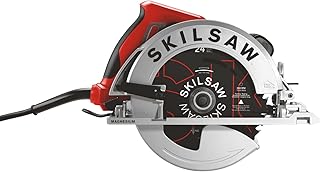


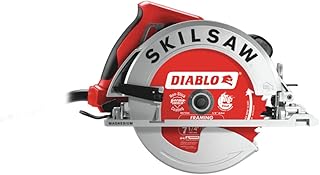


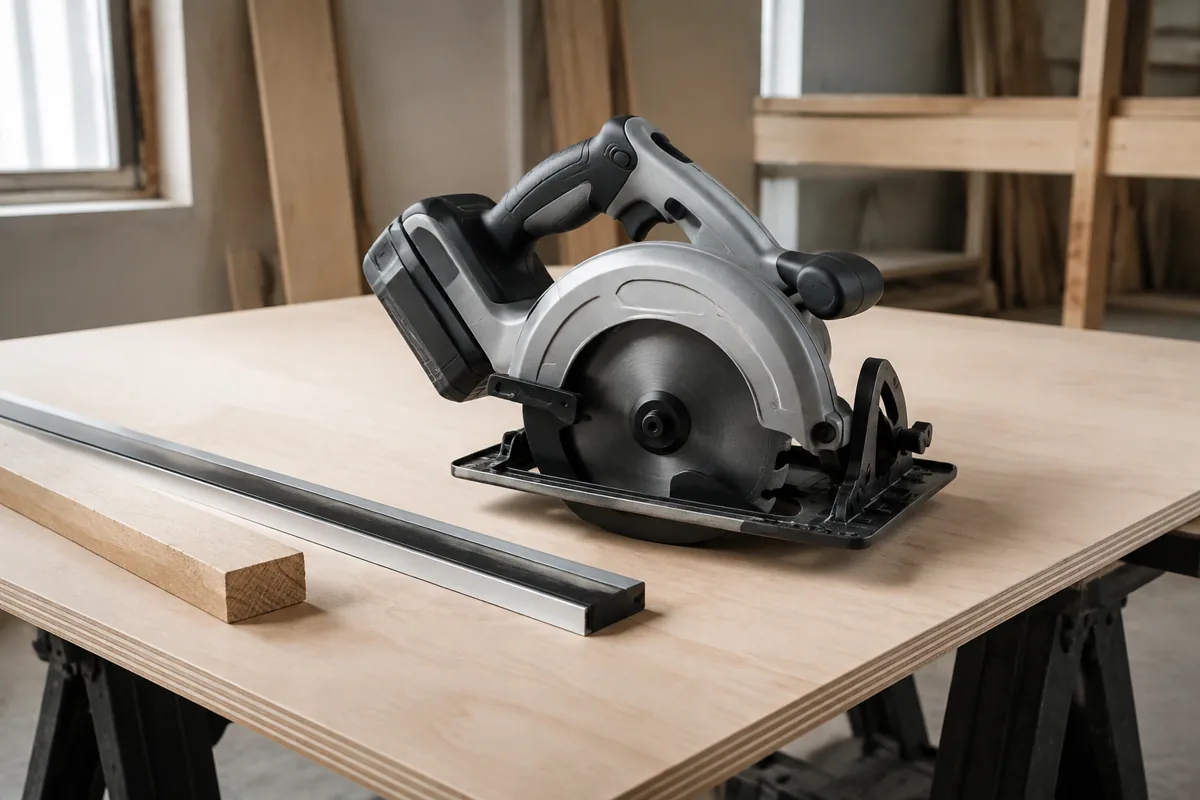
Sidewinder vs Rear Handle Circular Saw: The Mechanical Difference
A sidewinder, also called an inline or direct-drive saw, mounts the motor on the same axis as the blade, spinning it directly. The motor body sits out to the side, the handle sits above and slightly behind the blade, and the whole package is short front to back. A rear handle saw, still commonly called a worm drive after the gear set that made the layout famous, puts the motor behind the blade and turns the corner through a reduction gearbox. The handle ends up at the very back of a long, narrow body.
That single layout choice cascades into everything else. Direct drive means the blade turns at roughly motor speed, so sidewinders spin fast and light. Gear reduction means the blade turns slower with more torque at the arbor, which is why rear handle saws chew through wet framing lumber and stacked sheet goods without bogging. Blade side also flips: most sidewinders put the blade on the right of the motor, most rear handle saws put it on the left, and that determines whether a right-handed user looks straight down at the cut or across the motor housing at it.
| Criterion | Sidewinder (inline) | Rear Handle (worm drive) |
|---|---|---|
| Motor position | Beside the blade, on axis | Behind the blade, geared |
| Typical blade side | Right of motor | Left of motor |
| Balance | Side-heavy, compact | Long, front-to-back, nose-forward |
| Torque character | High rpm, lower arbor torque | Lower rpm, high arbor torque |
| Best at | Sheet goods, trim, overhead, cordless work | Wet lumber, thick stock, long rips, bevels |
| Usual weight class | Lighter | Heavier |
| Maintenance | Sealed, minimal | Gear oil checks on many models |
Sightlines, Balance and Base Rigidity
Sightline is the criterion buyers underrate most. With a left-blade rear handle saw, a right-handed user’s dominant eye sits directly over the blade and the kerf stays visible for the entire cut. That is the single biggest reason experienced framers and sheet-goods cutters keep reaching for the layout, and it matters even more when you are following a pencil line freehand instead of riding a track.
With a right-blade sidewinder, the motor housing sits between your eye and the cut. Manufacturers compensate with cut-line windows, notched shoes and open guard geometry, and the better ones genuinely work. Some brands also offer left-blade sidewinders, which solve the sightline problem while keeping the compact body, at the cost of putting the blade closer to your torso. Check the guard’s lower edge and the front shoe notch on any saw you are considering, because a poorly shaped notch turns line-following into guesswork.
Balance follows the same logic. A sidewinder’s mass hangs to the side of the blade, which makes it want to tip off a narrow edge but keeps it easy to lift overhead or run one-handed on a bench. A rear handle saw’s mass sits behind the blade, so the nose leads and the saw tracks straight almost on its own. Push it, don’t steer it, and it holds a line beautifully. On a wall or above your head, though, that same length becomes a lever working against your shoulder.
Base construction cuts across both categories and deserves the closest look of anything on the tool. Thin stamped-steel shoes flex when you clamp a guide to them and go out of square if the saw takes a fall from a sawhorse. Thick stamped bases and magnesium castings hold flatness far better. Set any candidate on a known-flat surface, check for rock at the corners, then square the blade to the base with a small engineer’s square and see whether the 0-degree bevel detent actually lands at 90 degrees. Also confirm the base is wide enough to support the saw on the offcut side, since a narrow shoe encourages tipping mid-rip.
Cordless Sidewinder Circular Saws
For most woodworkers the compact brushless sidewinder is the sensible first saw: light enough for overhead and one-handed work, short enough to store, and now powerful enough on high-capacity packs to break down sheet goods all day. Look for a magnesium shoe, a wide base, a bevel stop you can actually reach, and a dust port that accepts your vacuum hose without an adapter you have to fabricate. Battery platform matters more than any single spec, so buy into the system you already own.
Torque Delivery, Vibration and Blade Guides
Gear reduction is not a marketing story. A worm drive or hypoid rear handle saw delivers more twisting force at the arbor, which shows up as steadier feed rate in wet pressure-treated stock, doubled LVL, and thick hardwood. The saw slows less as the blade loads, so the cut face stays cleaner and the blade heats less. Direct-drive sidewinders make up ground with higher blade speed, which is genuinely better for thin material and fine crosscuts, but they will complain sooner in heavy stock. Brushless cordless motors with electronic feedback have narrowed the gap considerably; they have not erased it.
Vibration is where cheap saws expose themselves. Grip a running saw with no blade contact and note whether the buzz stays in the tool or travels into your forearm. Rear handle saws often feel smoother simply because the mass is spread along a longer body and the gearbox damps motor pulses. Sidewinders vary widely, and a saw that tingles at no load will chatter on a cut and leave a wavy edge.
Check the blade guides and arbor while you are at it. Spin the blade by hand and watch for wobble at the rim. Look at how the upper guard supports the blade near the arbor, and whether the lower guard retracts smoothly or hangs up on a bevel cut. A guard that snags is not a nuisance, it is a safety problem and a source of scored workpieces. Finally, look at the dust port. Rear handle saws frequently vent chips out the back where a hose can catch them cleanly, while sidewinder ports are often small and awkwardly angled. Neither layout guarantees good extraction, but a molded port with a real hose interface is worth paying for if you cut indoors.
- ✔ Sidewinder: lighter, shorter, easier overhead and one-handed
- ✔ Sidewinder: dominant cordless format with the widest model selection
- ✔ Rear handle: unobstructed cut line for right-handed users
- ✔ Rear handle: high arbor torque holds feed rate in wet or thick stock
- ✔ Rear handle: long body tracks a straightedge with little steering effort
- ✘ Sidewinder: motor housing can block the cut line on right-blade models
- ✘ Sidewinder: side-heavy balance tips on narrow edges
- ✘ Sidewinder: small dust ports on many models
- ✘ Rear handle: heavier and long, tiring overhead and in tight bays
- ✘ Rear handle: fewer models, higher entry price, gear oil service on some
Matching the Layout to the Work You Actually Do
Furniture and cabinet shops that break sheets down before moving to the table saw are usually better served by a sidewinder, especially paired with a track. The saw spends its life on a guide rail where the tool’s own tracking behavior barely matters, and light weight pays off every time you lift it across a sheet. Trim carpenters and remodelers who work on ladders, in crawlspaces, and inside stud bays want the compact tool for the same reason.
Deck builders, framers, timber workers, and anyone repeatedly bevel-ripping long stock get more out of a rear handle saw. Long rips reward a saw that tracks itself, wet lumber rewards torque, and the sightline advantage compounds over hundreds of freehand cuts. Note that many rear handle models also offer deeper cut capacity at 90 and 45 degrees, which matters for 4x material in a single pass.
If you own one saw and your work is genuinely mixed, buy the sidewinder and add a track or a shop-made straightedge guide. If you own one saw and it lives on job sites cutting structural lumber, buy the rear handle model and accept the weight. The two-saw answer is not extravagant either, since a compact sidewinder is one of the least expensive quality tools in any cordless lineup.
Rear Handle Worm Drive Circular Saws
If you rip long stock, cut wet lumber, or want the clearest possible view of your line, this is the layout to buy. Prioritize a cast magnesium shoe, a bevel scale with positive stops you can set without tools, and a diving-depth adjustment that locks without creep. Corded versions remain the value pick; cordless rear handle saws from the major high-voltage platforms have gotten legitimately good but cost meaningfully more and demand large packs to perform.
Buying Criteria Worth More Than the Spec Sheet
Whichever layout you choose, the same short list separates good saws from disappointing ones. Base flatness and thickness come first, because nothing downstream can fix a shoe that rocks. Bevel and depth adjustments should lock positively with levers you can operate wearing gloves, and the detents should be verifiable against a square rather than trusted. Guard action should be smooth from full retract to full return, on square and bevel cuts alike.
Look for an arbor bolt you can reach with the included wrench and a spindle lock that engages cleanly. Cord strain relief on corded saws and battery interface stiffness on cordless ones both predict long-term reliability. Electric brake, rafter hook, and LED work light are conveniences that turn out to matter daily. Ignore maximum rpm claims in isolation, ignore peak horsepower marketing entirely, and put your money into the shoe, the adjustments, and a quality blade. A 24-tooth framing blade or a 40-tooth plywood blade will change your results more than a hundred dollars of tool upgrade.
FAQ
Is a worm drive saw the same thing as a rear handle saw? Not quite. Rear handle describes the layout, with the motor behind the blade and the grip at the back. Worm drive describes one gear type used to make that layout work; hypoid gearing is the other common approach and runs in sealed oil with less routine service. Most cordless rear handle saws use gearing other than a traditional worm set, so the term has become a loose category name rather than a precise spec.
Can a cordless sidewinder replace a corded rear handle saw for framing? For most residential framing, a high-capacity brushless sidewinder with a sharp 24-tooth blade will keep up, and the weight savings are real over a full day. Where it falls behind is sustained heavy ripping in wet or engineered lumber, where the geared saw’s arbor torque holds a steadier feed and generates less heat. If that describes a large share of your work, keep the rear handle saw.
Does blade side matter more than motor placement? For cut visibility, yes. A right-handed user gets a clear view of the kerf with a left-blade saw regardless of whether it is a sidewinder or a rear handle model. Motor placement drives balance, torque character, and overall length instead. If sightline is your main complaint, look specifically for a left-blade version of whichever layout suits your work, and check whether the guard and shoe notch actually expose the line.
Verdict
Neither layout is obsolete and neither is universally better. The compact sidewinder is the correct default for shop work, sheet goods, track use, and anything overhead, and the cordless generation of these saws is the strongest value in the category right now. The rear handle saw remains the better instrument for long freehand rips, wet or thick structural stock, and anyone who wants an unobstructed view of the line without compromise, and it earns its weight penalty honestly in that work.
Judge candidates by pressing on the shoe, squaring the blade, cycling the guard, and feeling the vibration at no load. Those four checks tell you more in two minutes than any spec sheet, and they apply equally to a sixty dollar saw and a premium one. Buy the layout that matches the cuts you make most, spend the savings on good blades and a straightedge guide, and the saw will stop fighting you.
Check prices on Amazon →