Table Saw vs Sliding Table Saw for Squaring Oversized Panels
What's inside
As an Amazon Associate I earn from qualifying purchases. This post may contain affiliate links at no extra cost to you.
Contents
The short answer
A conventional table saw can square oversized panels, but the panel has to be supported and guided without tipping, twisting, or pulling the cut off line. That becomes difficult as panel size and weight increase. A sliding table saw carries the workpiece on a moving carriage, so it is usually the more controlled choice for repeated, accurate crosscuts and squaring large sheet goods.
For an occasional cabinet project, a track saw or a well-supported panel cut to rough size before finishing on a standard table saw may be the cheaper, safer solution. A sliding saw earns its floor space and cost when you routinely process full sheets or need dependable square cuts in production.
As an Amazon Associate we earn from qualifying purchases at no extra cost to you.


What squaring a panel actually requires
Squaring means establishing one straight reference edge, then cutting an adjacent edge at 90 degrees to it. A panel that is merely cut to a specified width is not necessarily square: if the reference edge wanders, the next cut can preserve or enlarge the error.
Start with a factory edge only if it is straight and undamaged. Otherwise, make a straight cut with a track saw or another reliable guide, mark that edge, and use it as the reference. Check the saw’s 90-degree setting with a reliable square, and make a test cut on scrap. A 1/16-inch error across a 24-inch width may look small, but it can leave cabinet parts visibly out of square or cause a door to bind.
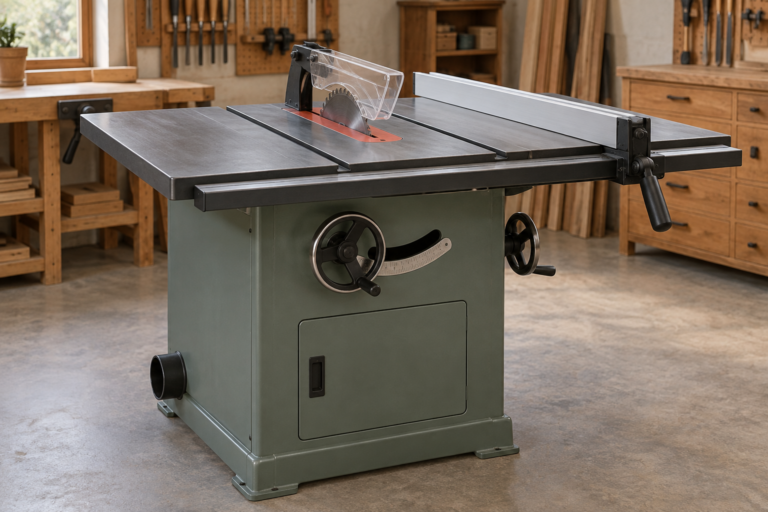
Using a standard table saw
A table saw is often the economical choice if you have one already and cut large panels only now and then. It works best when the panel is brought down to manageable dimensions first. For example, rough-cut a 4-by-8-foot sheet into a 24-by-48-inch blank with a track saw, then use the table saw and a crosscut sled or accurate fence setup to bring the blank to final size.
The main limitation is support. A sheet hanging far off the infeed, outfeed, or side of the table can sag, rotate, or catch. That can push the workpiece into the blade, spoil the cut, or cause a kickback. An outfeed table and a helper can reduce handling problems, but a helper must support the material rather than steer it sideways. Never reach across the blade to hold a drooping corner.
For crosscutting, do not trap a large panel between the rip fence and a miter gauge or sled unless the setup is designed to prevent offcut binding. Pinched offcuts can be thrown back. Use the fence to establish the cut length, then clear it before the crosscut when appropriate; keep hands out of the blade path and use push blocks or handles suited to the operation. Follow the saw manual and use the guard and riving knife whenever the cut allows.
A standard saw is a reasonable buy for occasional panel work if you can cut sheets down safely and your shop has room for stable support. A table saw outfeed support can help with long material, but it does not replace a safe method for controlling a wide sheet.
What a sliding table saw changes
On a sliding table saw, the panel rests on a carriage that travels past the blade. The carriage supports and guides the work through the cut, reducing the need to balance a large sheet on a small fixed tabletop. Many machines also have a scoring blade for cutting laminated faces cleanly, though not every model includes one.
The carriage is especially useful for crosscutting and trimming an edge square to a reference. Its travel determines the maximum practical crosscut length, so check that dimension before buying; a machine that cannot carry your intended panel size is not a solution. Also measure the machine’s footprint and the clearance needed to extend the carriage. Sliding saws can occupy substantially more floor space than a contractor or cabinet saw.
Cost and setup matter. A sliding saw is a substantial purchase, and a poorly aligned carriage or fence can still produce inaccurate cuts. Check alignment as the manufacturer specifies, keep the carriage clean, and support large panels during loading. For a small shop doing a few panels a year, the extra capacity may sit unused. For a cabinet shop cutting full sheets regularly, the improved support and repeatability can save time and reduce handling risk.
Which setup fits the job?
| Factor | Standard table saw | Sliding table saw |
|---|---|---|
| Large-panel support | Depends on extensions, stands, and careful handling | Carriage supports the work during travel |
| Best use | Occasional work; smaller panels after rough sizing | Frequent sheet goods and accurate crosscuts |
| Shop space | Usually easier to fit, though support space is still needed | Needs room for carriage travel and loading |
| Initial cost | Lower if a saw is already owned | Higher; alignment and setup also matter |
| Common failure | Panel sags or twists, changing the cut or creating a hazard | Carriage alignment or limited travel undermines accuracy |
What to buy for your workload
If you mostly cut plywood for occasional furniture or cabinetry, consider a track saw and guide rail for breaking down sheets, then use your table saw for smaller, controlled cuts. This avoids wrestling a full sheet onto a saw table and is often a better use of money than upgrading machines. Confirm that the rail is long enough for your cuts, or use a compatible extension or joining system.
Choose a standard table saw if panels are usually under control once rough-cut, you have enough infeed and outfeed support, and the budget matters more than throughput. Choose a sliding table saw if you regularly square large panels, need repeatable crosscuts, and can accommodate its travel and footprint. Before buying, compare carriage travel, maximum panel capacity, fence adjustment, scoring-blade availability, dust collection, and service support.
A reliable cutting sequence
For either saw, inspect the panel for nails, screws, or debris, and let sheet goods acclimate if moisture changes are likely to affect dimensions. Rough-cut an oversized panel a little proud of final size; removing a small amount in the finishing cut is easier to control than trying to correct an undersized or crooked part. Mark the reference edge, keep the panel flat against the intended guide, and verify the finished corner with a square.
If the panel is too heavy to hold steady or too large to support through the full cut, stop and change the setup. Cut it down with a guided saw, get suitable support, or use a machine designed for the panel. Accuracy is not worth forcing an unstable cut.