Best Planers for Processing Reclaimed Hardwood Lumber
What's inside
As an Amazon Associate I earn from qualifying purchases. This post may contain affiliate links at no extra cost to you.
Contents
Why reclaimed hardwood is hard on a planer
Reclaimed lumber asks more of a planer than clean, kiln-dried boards. Old flooring, beams, and framing can hide nails, grit, paint, and broken fasteners. Even after metal detection, abrasive dirt can dull knives quickly, while knots and grain that changes direction can tear out under a heavy cut. A planer can make a board uniformly thick; it cannot make contaminated or dangerously unstable stock safe.
Before buying, decide how wide and thick your typical boards are, how many you will process, and whether you have space and power for a stationary machine. Also budget for dust collection, replacement knives or inserts, and the time required to inspect and prepare every board. For occasional projects, a modest portable planer may be adequate. Regular batches of wide, dense hardwood are a different job.
As an Amazon Associate we earn from qualifying purchases at no extra cost to you.


Prepare stock before planing
Remove hardware and loose debris, then scan both faces and edges with a reliable metal detector. Check suspect areas with a magnet, too, but do not treat that as a substitute: nonferrous fasteners may not respond. A single nail can nick straight knives, damage carbide inserts, or become a dangerous projectile. A stone or embedded grit can do similar damage without showing up on a metal detector.
Cut away badly contaminated sections when practical. Brush or scrape off dirt and finish, and avoid feeding stock with loose bark, unstable knots, or a bowed shape that can rock on the planer bed. Plane only one board at a time unless the machine manufacturer explicitly allows paired feeding. Keep boards at least as long as the machine’s stated minimum, and support long stock in line with the bed so it does not tip at the infeed or outfeed.
Which planer type fits
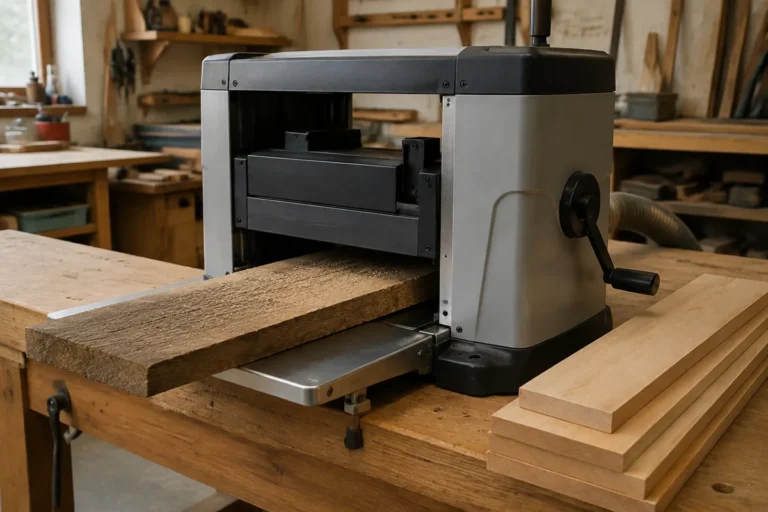
A portable benchtop planer is the sensible choice for a small shop, occasional furniture work, and boards within its width capacity—commonly about 12 to 13 inches. It is less expensive, easier to move, and can produce good results with sharp knives and careful passes. The trade-offs are a shorter bed, more noise, less mass, and greater sensitivity to snipe and difficult grain.
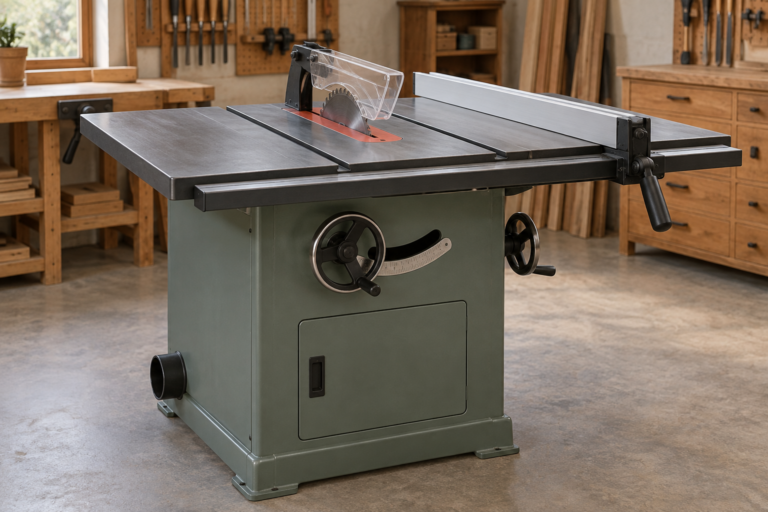
For frequent work or wide, heavy stock, consider a stationary planer with a longer bed and a wider capacity, often 15 inches or more. Its added weight and support can improve handling and consistency, but it costs more, takes up floor space, and usually needs suitable electrical service and dust collection. Check the actual width and thickness capacities, required voltage, and machine weight before assuming it will fit your shop.
Compare 13-inch benchtop thickness planers if your stock stays within that width and throughput is modest. If you regularly process broad slabs or large batches, compare 15-inch stationary planers instead.
Planer options at a glance
| Type | Typical fit | Main advantage | Main compromise |
|---|---|---|---|
| Benchtop, straight knives | Occasional projects; narrower boards | Lower purchase cost and easy storage | Knives need attention; more prone to tear-out and snipe |
| Benchtop, helical-style cutterhead | Frequent small-shop use | Small inserts can be rotated when an edge dulls or chips | Higher initial cost; inserts still need replacement |
| Stationary planer | Regular production; wider or heavier stock | More capacity, mass, and bed support | Higher cost, space, power, and handling demands |
“Helical” and “spiral” are used loosely in listings, so inspect the cutterhead design and replacement-insert availability rather than relying on the label. For reclaimed lumber, segmented carbide inserts can be convenient because a damaged edge may not require replacing a full knife set. They are not immune to nails or grit, and replacement costs add up.
Features worth paying for
Prioritize capacity, a stable bed, usable dust collection, and readily available knives or inserts. A good depth scale helps with repeat settings, but make final measurements with calipers or a reliable thickness gauge. Feed speed and cut quality vary with species, grain, cutter condition, and depth of cut; horsepower claims alone do not tell you how well a machine will handle a rough reclaimed board.
Budget for a dust collector or extractor that matches the planer’s port and chip volume. Planers produce large amounts of chips quickly, and a shop vacuum alone may clog or struggle on a long run. Check that the machine has guards and a working anti-kickback system, and learn the manufacturer’s rules for stock thickness, length, and permissible cut depth. Do not remove guards to make awkward stock fit.
Use shallow, controlled passes
Make a light first pass—about 1/32 inch is a cautious starting point for uncertain reclaimed hardwood—then inspect the surface and listen for changes in the cut. Reduce the depth further for very hard wood, reversing grain, or stock that strains the machine. Heavy cuts can overload a benchtop motor, leave a rough surface, cause tear-out, and increase snipe. Remove only enough to reach clean wood; extra passes waste time and shorten knife life.
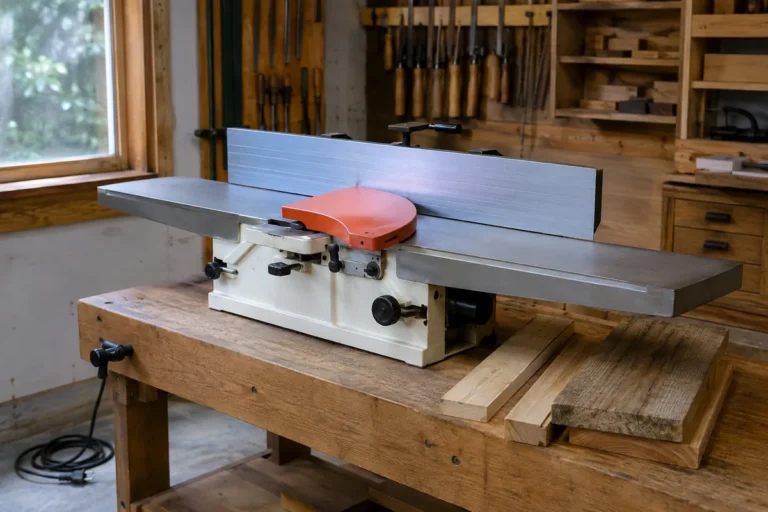
Use a jointer or a safe sled to establish a flat reference face when the board is cupped or twisted. A thickness planer follows the face riding on its bed; it does not flatten a warped board by itself. If you do not have a jointer, a planer sled can help, but the workpiece must be secured so it cannot shift or tip. Never feed a loose, rocking board and hope the rollers will flatten it.
When the cheaper planer is enough
A basic benchtop machine is often the better buy if you process a few clean boards each month, work mostly below 12 inches wide, and can tolerate slower progress. Sharp straight knives can leave a fine finish, especially with straight-grained stock and light cuts. Spend the savings on inspection tools, knife sets, support stands, and dust collection rather than paying for capacity you will rarely use.
Move up when wide stock routinely exceeds your machine’s limit, you need long production runs, or the portable planer’s bed and feed system make safe handling difficult. Before purchase, measure the largest lumber you actually expect to use and confirm the planer’s minimum and maximum thickness. A machine that accepts a wide board is not automatically suited to it: heavy reclaimed slabs still need sound support, careful inspection, and conservative cuts.