Portable Planer vs Stationary Planer for Furniture Stock
What's inside
As an Amazon Associate I earn from qualifying purchases. This post may contain affiliate links at no extra cost to you.
Contents
What “portable” and “stationary” mean
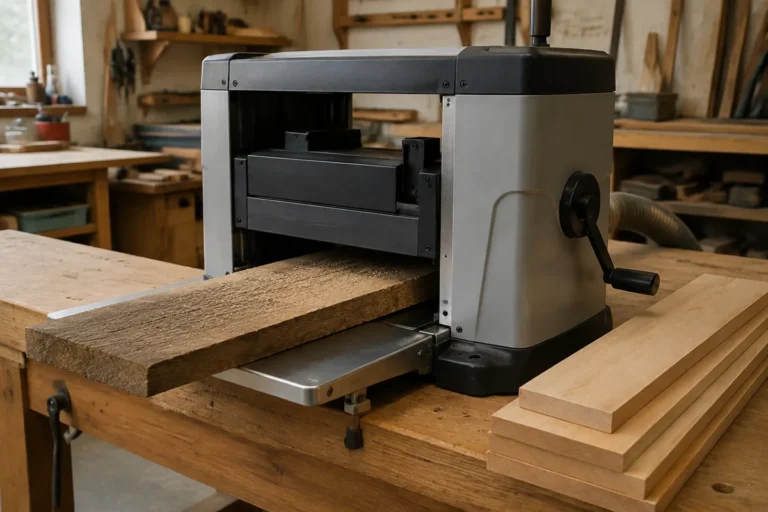
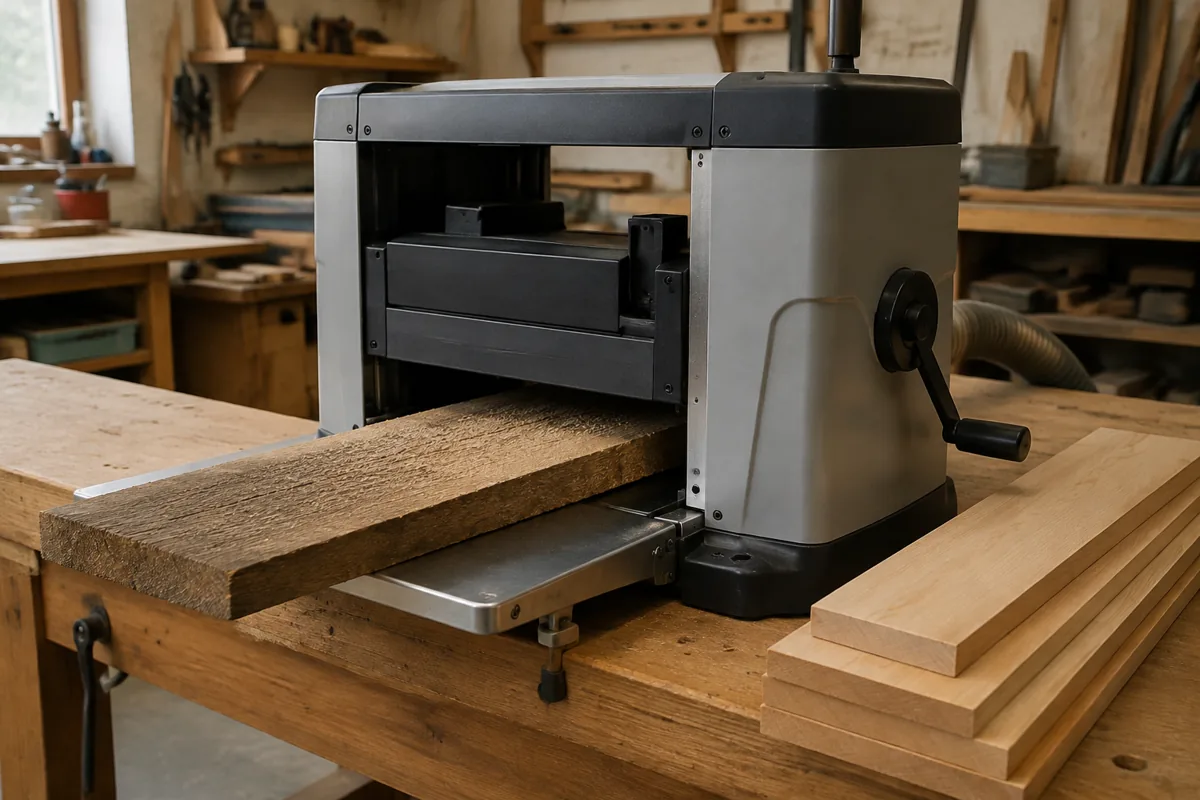
A portable planer is a benchtop thickness planer, usually with a cutterhead width around 12 or 13 inches. It is small enough to carry or store between jobs, but it still needs a sturdy stand or bench and room to feed long boards. A stationary planer is heavier, wider, and typically built for more frequent use. Depending on the machine, it may offer a wider capacity, more stable support, stronger feed, or a helical cutterhead.
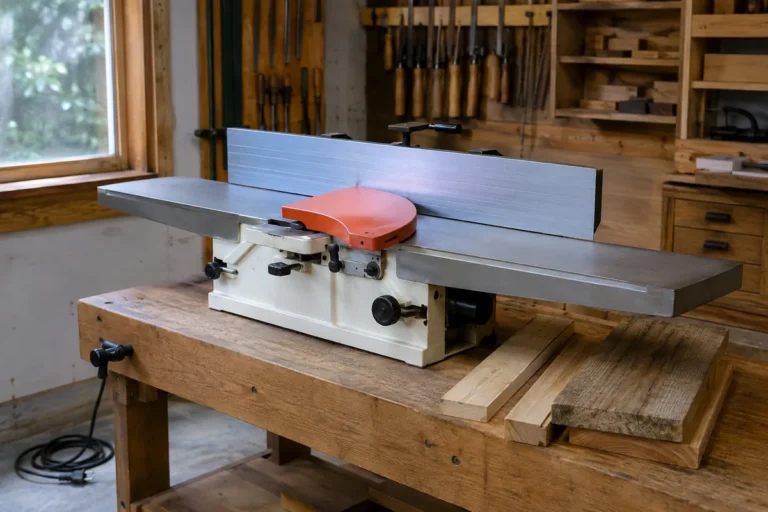
Both types thickness stock: they make opposite faces parallel and bring boards to a consistent thickness. Neither replaces a jointer. If a board has a bowed or twisted face, a planer generally follows that shape rather than flattening it. For furniture work, start with one flat reference face—made with a jointer, a planer sled, or another reliable method—before thicknessing.
As an Amazon Associate we earn from qualifying purchases at no extra cost to you.

Quick comparison
| Factor | Portable benchtop planer | Stationary planer |
|---|---|---|
| Typical width | About 12–13 inches | Often 15 inches or wider |
| Setup | Needs a bench or stand and infeed/outfeed clearance | Needs dedicated floor space, power, and material support |
| Best fit | Occasional milling, smaller shops, moderate-width parts | Regular production, wider stock, and heavier workloads |
| Common trade-off | More snipe, noise, and limits on width or duty cycle | Higher cost, weight, and space requirements |
| Typical cutterhead choice | Usually straight knives; some models offer segmented heads | Straight knives or segmented/helical heads, depending on model |
Specifications vary, so check the machine’s maximum width, minimum and maximum thickness, feed rates, and electrical requirements before buying. A claimed cutting capacity does not guarantee that every board near that limit will feed cleanly.
When a portable planer is enough
For a hobbyist building cabinets, tables, or small furniture, a benchtop planer can be the sensible buy. It costs less, takes less floor space, and can produce useful results on hardwood when the knives are sharp, the board is properly prepared, and cuts are conservative. If most of your stock is under 12 inches wide and you mill only a few boards at a time, the capacity may be entirely adequate.
Portable planers often struggle most at the ends of boards. The cutterhead can lift or press stock as it enters and exits, leaving a shallow snipe—a lower section near one or both ends. Support long boards at the same height as the planer table, take a light finishing pass, and feed sacrificial boards before and after valuable pieces. Snipe can still happen, so leave extra length for trimming when possible.
They are also loud. Wear hearing protection, collect dust with a suitable extractor, and avoid treating repeated deep cuts in hard maple or oak as normal operation. Heavy cuts can bog down the feed, leave a rough surface, or trip a breaker. For a first machine, browse 13-inch benchtop thickness planers and compare capacity, knife availability, and dust-port requirements rather than choosing on price alone.
When stationary is worth the space
A stationary planer earns its footprint when you process stock often, work with wide boards, or need a more repeatable production setup. A 15-inch machine, for example, can handle panels that will not fit through a 13-inch planer, though you still need to check the actual maximum width. More mass can help the machine stay planted during demanding cuts, and a larger table or better support arrangement can make long work easier to manage.
Consider the whole installation, not just the planer. A machine weighing several hundred pounds may need a dedicated stand, a clear feed path, dust collection, and a circuit that meets its specified voltage and amperage. A stationary planer is a poor choice if boards cannot be safely supported on both sides or if moving stock through the shop requires twisting around other machines.
For frequent furniture milling, compare 15-inch stationary thickness planers. A segmented or helical cutterhead can reduce the sharpness of tear-out on figured grain and may be quieter than straight knives, but it does not eliminate tear-out or poor setup. It also costs more; check replacement-insert availability and price before committing. Straight knives can leave a good surface and are a reasonable choice if you can sharpen or replace them economically.
How to get cleaner furniture stock
Use a consistent milling sequence. Flatten one face first, then plane the opposite face parallel; joint one edge, then rip the board to width on a table saw. If you skip the reference face, the planer can make a board evenly thick while leaving its bow or twist intact. That stock may look uniform but still be difficult to assemble into flat furniture.
Take shallow passes, especially on figured wood, wide boards, or a machine near its capacity. A reduction of roughly 1/32 inch per pass is a cautious starting point for difficult stock; ordinary straight-grained boards may tolerate more, depending on the planer and species. Listen for the motor slowing and watch the surface. If the board stalls, chatters, or develops pronounced tear-out, stop and reduce the cut depth rather than forcing it through.
Feed boards with the grain where practical. Reversing direction can help when grain changes, but mark the board and test a short or spare piece first. Check the knives for nicks: a repeated ridge or line along the width often points to a damaged knife or insert. Clean resin from the cutterhead and rollers, and keep tables free of pitch so stock feeds consistently. Wax or a suitable low-friction treatment can help, but it will not fix misaligned tables or poor support.
A practical buying decision
Choose portable if your stock fits its width, your workload is occasional, and you can manage noise, support, and some end cleanup. It is the cheaper option that makes sense for many one-person furniture shops. Choose stationary if you routinely mill wide stock, run batches, or need a setup built for sustained use—and if your floor space, electrical service, and dust collection can support it.
Before buying either type, measure the widest board you actually use, not the widest board you hope to use someday. Include room for infeed and outfeed support, verify cutter and insert costs, and find out how the machine handles snipe in real use. Capacity and convenience matter more than an impressive maximum cut depth; a planer that fits your shop and your stock is the one you are more likely to use well.