How to Choose Planer Width Capacity for Furniture Stock
What's inside
As an Amazon Associate I earn from qualifying purchases. This post may contain affiliate links at no extra cost to you.
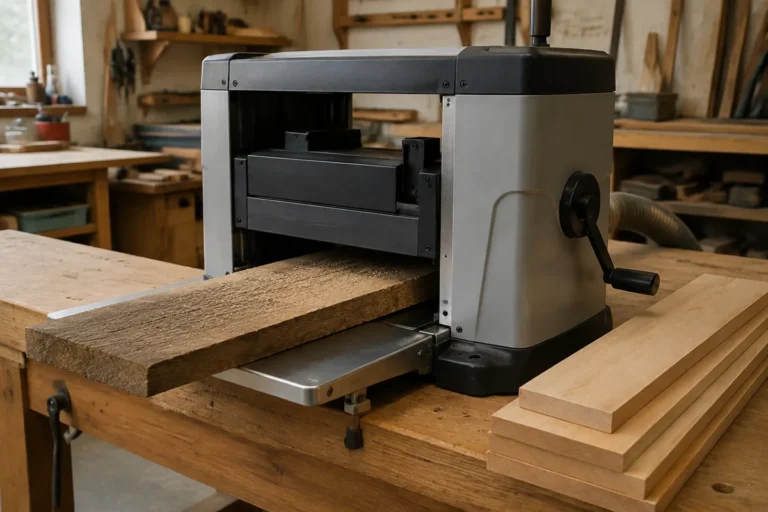
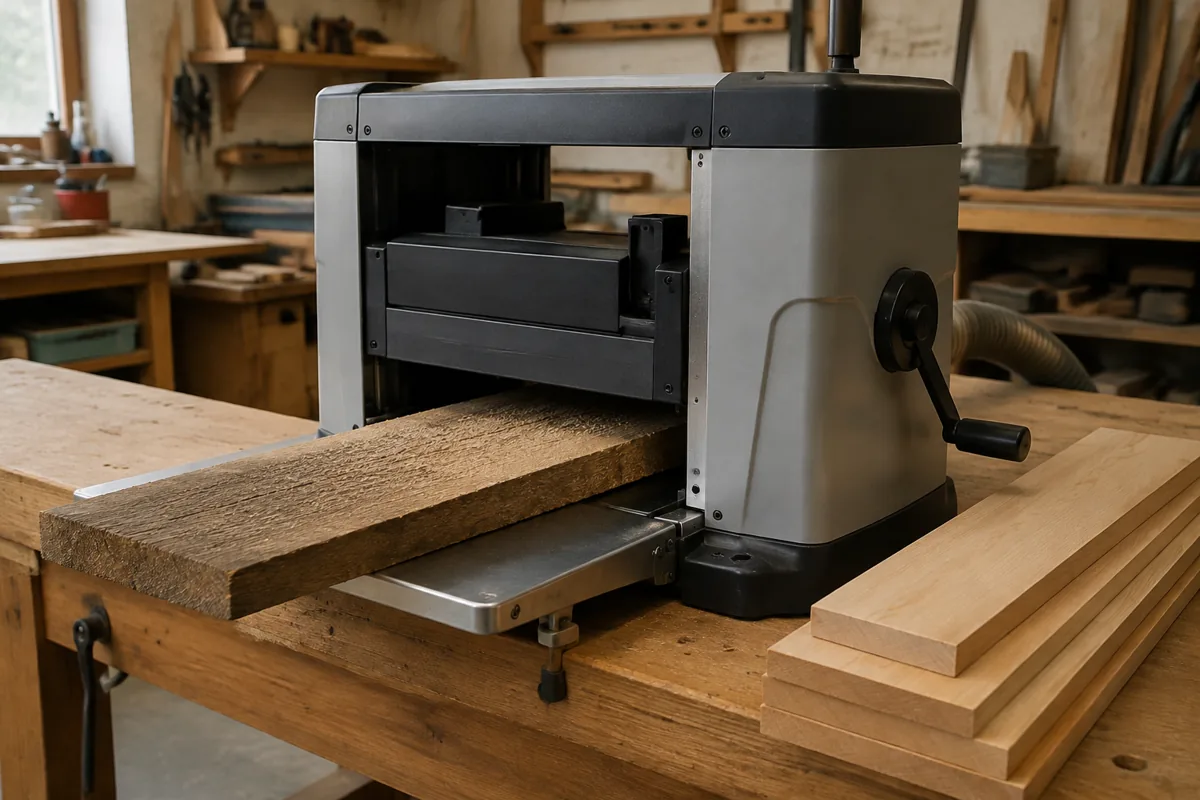
Planer width capacity determines the largest board you can thickness in one pass. For furniture work, that number affects more than convenience: it limits panel width, changes how many glue-ups you need, and determines whether a planer can process the stock you actually buy. A 12-inch planer may be excellent for table legs, rails, and narrow boards, but it cannot thickness a 14-inch tabletop blank without another method.
Contents
What planer width capacity means
A planer’s stated width is its maximum practical board width, measured across the cutterhead. A 12-inch machine accepts boards up to roughly 12 inches wide; a 15-inch machine accepts boards up to roughly 15 inches. The usable opening may be slightly smaller than the advertised capacity, and edge damage or uneven stock can reduce it further.
Width is separate from thickness capacity. Most stationary planers handle stock from about 1/8 inch to 6 inches thick, although the minimum and maximum vary. A machine may also have a maximum cut width that is different from its feed-table width. Check the manufacturer’s specifications before assuming a “15-inch planer” will comfortably process a full 15-inch board.
For furniture planning, measure the finished parts you expect to make, not just the lumber you currently own. A 10-inch-wide cabinet door may start as an 11-inch blank after jointing and trimming. That extra material can push a nominally adequate planer past its useful limit.
Match capacity to furniture parts
Most furniture components are narrower than finished tops. Table legs, aprons, drawer parts, shelves, and cabinet stiles rarely need more than a 12-inch planer. Dining-table tops and wide cabinet sides are the parts that drive the capacity decision.
| Planer capacity | Typical useful work | Main limitation |
|---|---|---|
| 12 to 13 inches | Furniture parts, narrow shelves, drawer stock, small panels | Wide tabletop boards must be split, edge-jointed, or flattened by another method |
| 15 inches | Wider shelves, cabinet panels, many table components, some wide boards | Still too narrow for many large single-board panels |
| 18 to 20 inches | Broad furniture stock and larger panels with fewer glue lines | Higher cost, more floor space, and greater electrical and dust-collection demands |
| 24 inches or more | Wide slabs, oversized panels, and production furniture work | Usually excessive for a small shop unless wide stock is a regular requirement |
Do not assume that a wider planer eliminates all panel glue-ups. A 20-inch cutterhead still cannot process a 24-inch tabletop in one piece. Many furniture builders intentionally glue narrower boards together because the seams are stable, easier to handle, and less wasteful than buying very wide lumber.
Choose based on stock and glue-ups
Start by listing the widest finished component you expect to make. Add at least 1 inch for rough-sawn stock, edge defects, and final trimming. If your widest regular part is 10 inches, a 12-inch planer is normally sufficient. If you routinely make 13-inch cabinet sides or bench seats, a 15-inch machine provides useful working room.
Wide boards also create handling problems. A 15-inch-wide, 8-foot hardwood board can be heavy and awkward to feed, especially when it is near the planer’s maximum thickness. A narrower machine may be slower for a specific job but easier to support accurately. Long infeed and outfeed tables, roller stands, or a helper can matter as much as another 3 inches of capacity.
For tabletops, consider whether you need one-piece boards at all. A 12-inch planer can produce a 10-inch-wide board accurately, then several boards can be edge-jointed and glued into a top. This is often the cheaper and more flexible option. It also lets you orient grain, remove defects, and reduce the risk of a large board cupping after it is milled.
Planer size and cut quality
Width alone does not guarantee better surfaces. Cutterhead design, feed speed, bed length, chip extraction, and machine rigidity affect the result. A wider machine with a short or flexible bed can still produce snipe and uneven thickness.
For furniture stock, a helical or segmented carbide cutterhead is attractive when working figured maple, oak, or other tear-out-prone wood. It usually costs more, but damaged inserts are replaceable and the cut can be quieter. A conventional straight-knife cutterhead is cheaper and works well on ordinary grain when knives are sharp and the feed rate is controlled. If you mainly thickness pine, poplar, beech, or straight-grained hardwood, the cheaper configuration may be entirely adequate.
Every planer can show snipe at the beginning and end of a board. Support the stock level with the bed, keep the board moving at a consistent speed, and use sacrificial lead and trailing boards when the part allows it. A wider capacity does not prevent this failure mode.
Stationary versus benchtop capacity
Benchtop planers commonly fall in the 12- to 13-inch range. They cost less, fit smaller shops, and can process most furniture components. Their limits are usually lower feed speed, lighter construction, shorter beds, and less comfortable handling of wide or heavy stock. They also need a sturdy stand; placing one on an unstable workbench makes feeding less predictable.
A 15-inch stationary planer is a sensible step up for frequent furniture work. It typically has a longer bed, stronger feed rollers, better dust extraction options, and more consistent thicknessing. The trade-off is space, price, noise, and often a 240-volt electrical requirement. Before buying, verify available power, door clearances, ceiling height, and the path needed to move the machine into the shop.
If your work is mostly narrow furniture parts, compare 12-inch benchtop planers rather than paying for capacity you will rarely use. For a shop that regularly handles wider cabinet panels and table components, look at 15-inch stationary planers.
When extra capacity is worth buying
Choose the next size up when your widest parts are within about 2 inches of the machine’s limit, when you process wide stock weekly, or when repeated glue-ups are costing more time than the price difference. Extra capacity also helps when you buy rough lumber from small local mills, where board widths are inconsistent.
Stay with the cheaper, narrower planer when wide parts are occasional and you already own a reliable jointer, router sled, or wide-belt service nearby. A 12-inch planer plus careful glue-ups can build excellent furniture. The best capacity is the one that covers your normal parts with room for waste, without making the machine unnecessarily difficult to power, move, and feed.