How to Choose a Planer Width for Furniture-Making Projects
What's inside
As an Amazon Associate I earn from qualifying purchases. This post may contain affiliate links at no extra cost to you.
Planer width determines the widest board you can thickness in one pass. For furniture work, that affects more than convenience: it shapes which rough lumber you can buy, how you break down parts, and whether a wide tabletop can be made from one board or must be glued up. The right choice is usually the narrowest machine that fits your normal stock, with a plan for the occasional wider panel.
Contents
What planer width actually means
A planer’s advertised width is the maximum board width that can pass through its cutterhead and feed system. Common benchtop machines handle about 12 or 13 inches; larger stationary planers commonly handle 15 inches or more. Check the manufacturer’s specifications: the usable width can be slightly less than the headline figure, and maximum width does not tell you the maximum thickness or length the machine accepts.
Width is also different from the capacity of a jointer. A planer makes the opposite face parallel to the face riding on the bed; it does not reliably flatten a twisted or cupped board by itself. For accurate furniture parts, flatten one face first with a jointer, a sled and shims, or hand tools. Then thickness the board.
Match the width to your furniture parts
List the widest parts you expect to make from solid wood, not the overall dimensions of the furniture. A 30-inch tabletop made from three 10-inch boards does not require a 30-inch planer. A single 14-inch slab does. Also account for rough stock: a board sold as 12 inches wide may have irregular edges or need trimming before it can feed safely.
For tables, desks, and casework, many parts are made from narrower boards and edge-glued. A 12- or 13-inch planer can handle a large share of that work, especially if you are comfortable milling components separately. A wider machine is useful for broad solid-wood panels, wide door parts, and stock you want to keep in one piece. It does not eliminate the need to flatten faces or manage grain direction.
Compare common planer widths
| Planer width | Good fit for | Main trade-off |
|---|---|---|
| 12–13 inches | Most furniture parts, narrower boards, and edge-glued panels | Wide boards need ripping, careful repositioning, or another flattening method |
| 15 inches | Wider solid boards, larger case parts, and fewer width-related workarounds | Higher cost, more floor space, and often a more demanding power and dust setup |
| 20 inches and wider | Large slabs and production work with frequent wide stock | Substantial cost and space; excessive capacity for many small-shop furniture projects |
When a narrower planer is enough
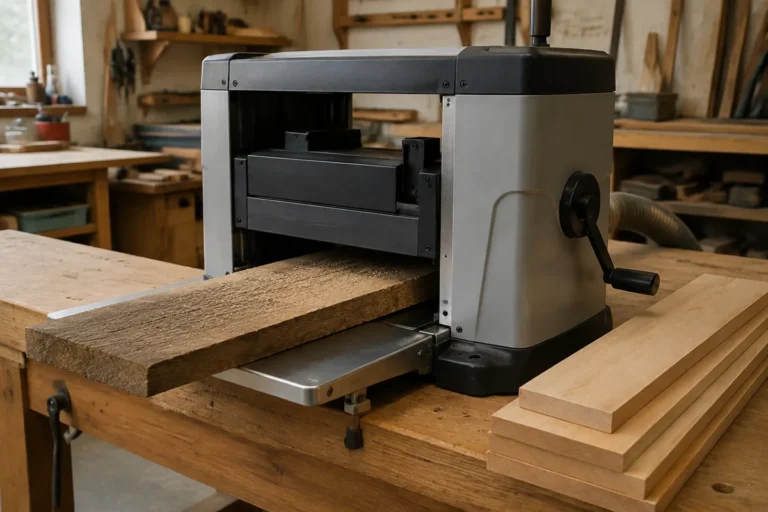
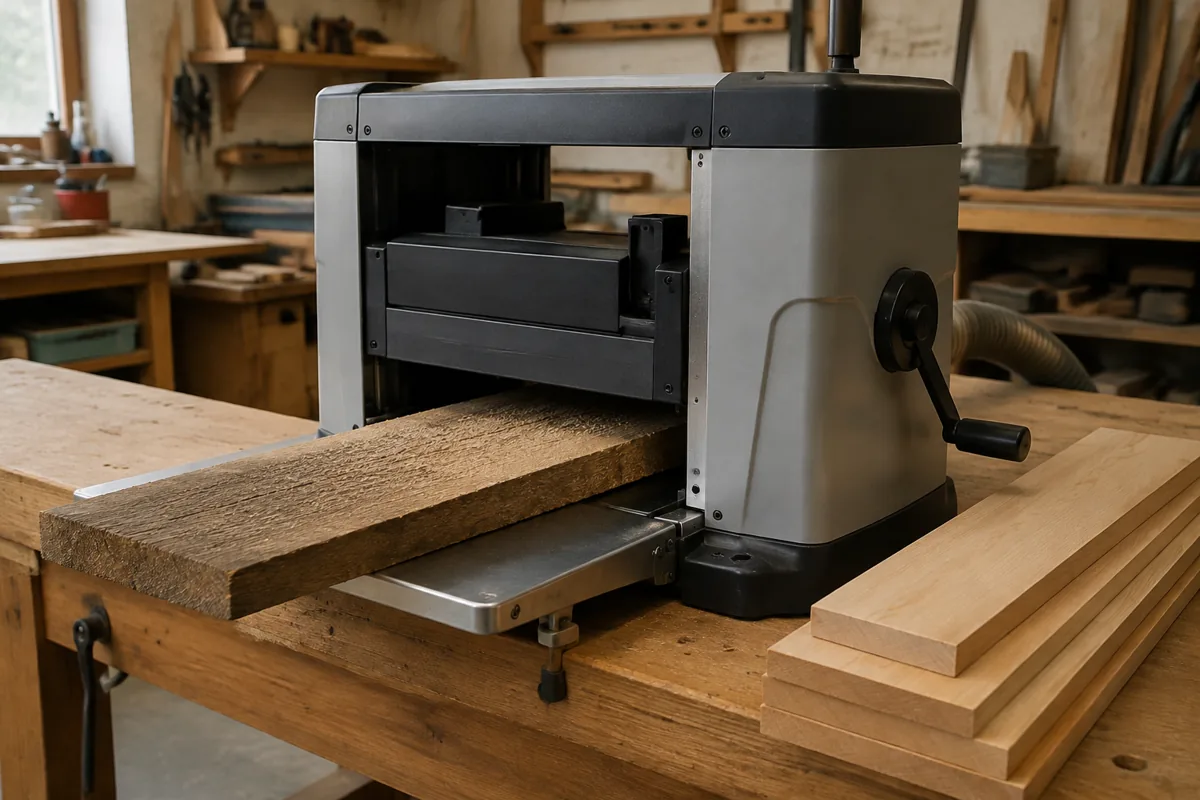
A 12- or 13-inch benchtop planer is a sensible buy if most of your lumber is under about 10 inches wide and you make panels by edge-gluing several boards. Leaving a little margin below the machine’s rated capacity makes feeding easier and reduces the chance that a rough, uneven edge catches or wanders. It also leaves room to square the board before thicknessing.
For the occasional wider piece, consider whether it can be ripped into narrower strips and reglued. That is often practical for a tabletop, but less attractive for a single wide door panel or a figured board whose grain and appearance matter. A planer sled can help with flattening a face, but it does not increase the machine’s maximum opening. Some shops also use a router sled or hand plane for wide panels. Those are workable options, not substitutes for a wide planer when wide stock is a routine part of the workload.
If a compact machine suits your stock, compare 12-inch benchtop planers by capacity, cutterhead type, infeed and outfeed support, and parts availability. A lower purchase price can be the right choice when you rarely need extra width.
When extra width earns its cost
Move up to a 15-inch planer if you regularly work with boards in the 12- to 14-inch range, or if breaking wide parts into strips would create visible seams or waste good material. The extra capacity is useful, but it is not unlimited: a nominal 15-inch machine gives little room for a full-width rough board, and lumber may need to be trimmed first.
Before buying, check more than width. A wider planer may need a 240-volt circuit, a suitable dust collector, and enough space to support long boards at both ends. Confirm the machine’s maximum stock thickness, minimum stock length, cutterhead setup, and recommended dust collection. Short boards can be pulled through unevenly or create snipe; long boards can sag if the supports are too low. Neither problem is solved just by buying a wider model.
If wide stock is common, browse 15-inch stationary planers and compare the complete installation cost, not just the sticker price. A wider machine that cannot be powered or dust-collected properly is a poor fit for the shop.
Avoid common width-related problems
Do not feed a board that is wider than the machine’s stated limit, or force a board through because it is only slightly over. The board can bind, damage the cutterhead or feed rollers, and put your hands too close to moving parts. Leave clearance, remove loose bark and debris, and use a steady feed rather than pushing against the rollers.
Near maximum width, take light cuts. A deep cut across a wide board puts more load on the motor and can leave a rough surface, stall the feed, or trip a breaker. Start with roughly 1/32 inch per pass on difficult or wide stock, then adjust based on the species, machine, and cut quality. Listen for slowing or straining and reduce the cut if it occurs. Alternate the board’s orientation when practical, and inspect for tear-out, especially around reversing grain.
Make the choice from your lumber list
Measure the widest rough boards you actually expect to buy, then allow for trimming and safe feeding. If nearly all are below 10 inches and wide panels are glued up, a 12- or 13-inch planer is often the economical choice. If 12- to 14-inch solid boards are a regular part of your projects, a 15-inch machine can save time and preserve material. Buy substantially wider only when your work and shop space justify it. The best width is the one that handles your usual stock without turning an occasional oversize board into an expensive requirement.