Best Stationary Planers with Easy Knife-Change Access
What's inside
As an Amazon Associate I earn from qualifying purchases. This post may contain affiliate links at no extra cost to you.
Contents
What easy knife-change access means
On a stationary planer, “easy knife changes” can mean very different things. A benchtop thickness planer may have a cutterhead designed for disposable double-edged inserts, while a larger floor-standing machine may use long straight knives held by wedges or gib screws. The first style typically asks you to rotate or replace many small pieces; the second may require setting long blades to the same height across the cutterhead.
Before shopping, check what the machine actually uses. Look for the cutterhead type, the number of knives or inserts, how they are retained, whether a setting jig is included, and whether replacement parts are readily available. A quick-access cover is useful, but it does not make a change simple if the knives are hard to align or the fasteners are awkward to reach.
Three cutterhead styles to compare
| Style | What changes | Main advantage | Main trade-off |
|---|---|---|---|
| Disposable straight knives | Long blades, usually turned or replaced as a matched set | Simple, low-cost edge replacement | Many fasteners; blade height and seating matter |
| Indexed inserts | Small, individually replaceable or rotatable carbide inserts | No long knife-setting procedure; a damaged insert can be changed locally | More parts to inspect, and replacement inserts can cost more |
| Resharpenable straight knives | Long steel knives sent out for grinding or reset with a jig | Can make sense for frequent use and established sharpening service | More downtime and setup; not the easiest choice for occasional users |
“Helical” and “spiral” are often used loosely in listings. Confirm whether the cutterhead has indexable inserts and how they are arranged. Insert count alone is not a reliable measure of finish quality; knife geometry, feed rate, wood species, and machine alignment matter too.
Benchtop planers: practical for most small shops
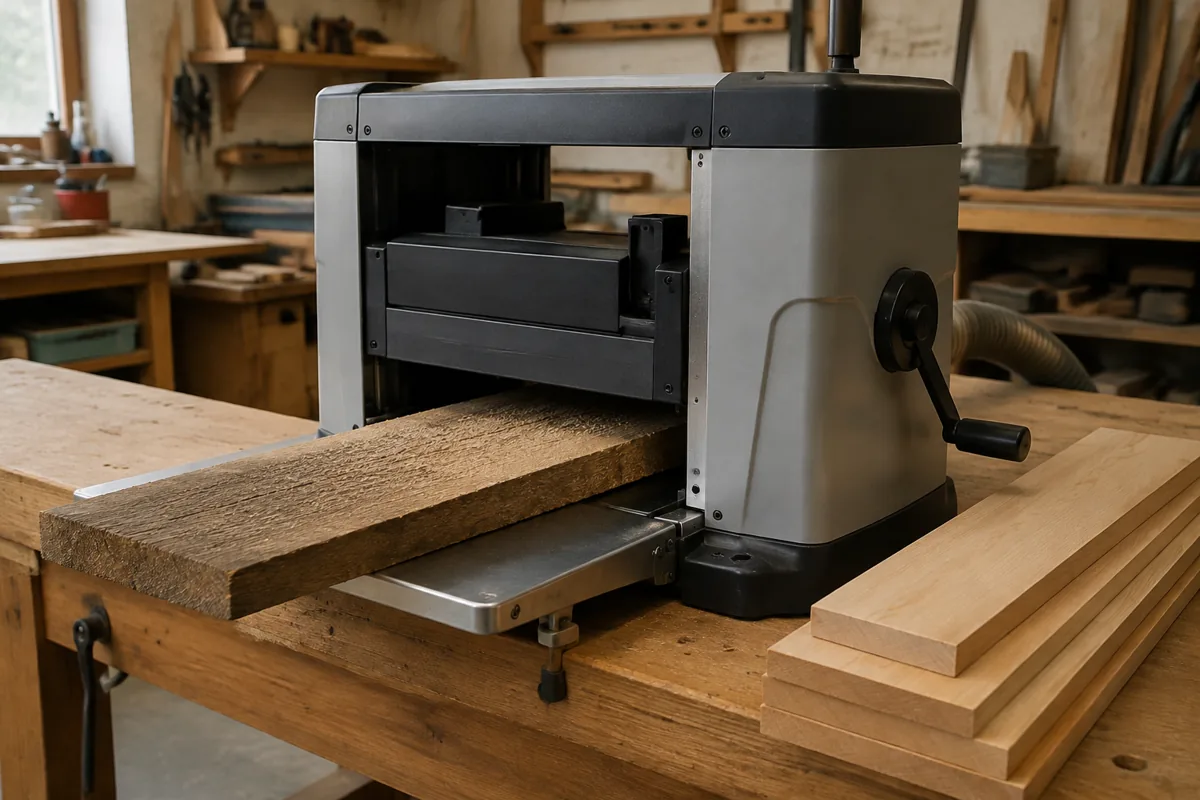
For a garage shop or occasional furniture work, a benchtop planer with indexed inserts is often the easiest option to maintain. When one insert chips, you can rotate it to a fresh edge or replace it without removing and setting a full-length blade. This is especially useful when reclaimed wood may contain hidden grit or when a board has a localized defect.
The trade-off is that there may be dozens of inserts to check. A damaged insert can leave a repeated mark, and a loose or incorrectly seated one can spoil the cut. Keep the supplied screws and driver organized, clean each pocket before installation, and tighten fasteners to the manufacturer’s instructions. Do not assume every insert uses the same screw or torque.
A benchtop planer with disposable straight knives may be the better-value purchase if you plane clean, kiln-dried stock and use the machine intermittently. Rotating a two-edged knife set is a straightforward maintenance job, and replacement knives are often less costly than a full insert set. Compare the access cover and knife-setting method, not just the advertised cut width. A benchtop thickness planer with an indexed-insert cutterhead is a sensible category to consider when reducing knife-setting time matters more than minimizing consumable cost.
Floor-standing machines: choose for workload and support
A floor-standing planer is appropriate for wider stock, longer production runs, or a shop that needs a heavier-duty feed system. Some use long straight knives; others offer insert-style cutterheads. With long knives, access depends on more than the cutterhead cover: you need room to withdraw the blades, support them safely, and use the required setting gauge without rushing.
Ask whether the machine includes a knife-setting jig and whether replacement knives are sold as a matched set. A small height mismatch can cause uneven cutting, extra noise, or a ridge in the board. On machines with replaceable inserts, check how inserts are numbered or indexed and whether the manufacturer provides a torque specification. A floor-standing planer with an insert cutterhead can reduce blade-setting work, but it costs more upfront and still needs careful cleaning and inspection.
For a low-volume shop, a conventional straight-knife floor machine is not automatically a poor buy. If a local sharpening service is convenient and you can schedule downtime, resharpenable knives may be economical over years of use. If downtime is costly, or you do not want to learn knife alignment, inserts are usually the more forgiving maintenance choice.
How to compare access before buying
Read the manual before you order. It should show the knife-change steps, required tools, and whether the cutterhead can be locked in position. If those details are missing, ask the seller or manufacturer. Also check replacement-part availability: an easy-change system is not convenient if its inserts are difficult to source or sold only in expensive kits.
Think about the whole job. You will need to unplug the machine, remove the dust hood or access cover, clean pitch and chips from the cutterhead, change or rotate the edges, then reinstall the guard and verify free movement by hand if the manual calls for it. Never reach into a cutterhead while the machine is connected to power. Gloves may help when handling sharp knives, but remove them before operating the machine.
Common failure modes are predictable: chips trapped under an insert, screws tightened unevenly, a knife installed backward, and continued use after an edge is visibly chipped. Each can lead to poor finish, vibration, or damage. Use the specified driver, keep a small parts tray nearby, and replace damaged fasteners rather than forcing them.
Which planer makes sense?
Choose indexed inserts if you value localized repairs, want to avoid setting long knives, and can accept a higher parts bill. Choose disposable straight knives if purchase price and inexpensive replacement edges matter most, and you are comfortable following a setting procedure. Choose resharpenable knives when the machine will see regular use and sharpening support is nearby. For any style, prioritize clear instructions, available parts, and safe access over marketing claims about quick changes.