Best Stationary Planers for Flattening Wide Hardwood Boards
What's inside
As an Amazon Associate I earn from qualifying purchases. This post may contain affiliate links at no extra cost to you.
A planer makes the two faces of a board parallel and brings it to a consistent thickness. It does not, by itself, flatten a twisted or cupped board: the cutterhead follows the face riding on the planer bed. For wide hardwood, that distinction matters as much as the machine’s cutting width. Choose a planer that fits your board size, power supply, and expected workload—and plan on jointing or sledding stock that is not already flat.
As an Amazon Associate we earn from qualifying purchases at no extra cost to you.


Contents
What a planer can—and cannot—flatten
If a board is flat on one face but too thick, a thickness planer is the right tool. Run the flat face against the bed, then plane the opposite face parallel. If both faces are warped, first flatten one face with a jointer or a planer sled. A sled supports the board so it cannot rock; shims or wedges hold it steady during the cut. Once one face is flat, remove the sled and plane the other side.
Trying to force a twisted board flat with downward pressure can produce a board that springs back after it leaves the machine. On a wide panel, that mistake can waste a lot of expensive hardwood. Check for twist with winding sticks or a straightedge before planing, and remove high spots gradually rather than taking a deep cut to “fix” the whole board at once.
Compare planer types
| Type | Typical capacity | Best fit | Main trade-off |
|---|---|---|---|
| Benchtop, two-knife or three-knife | 12–13 inches wide | Small shops and occasional furniture work | Affordable and portable, but limited width and more setup attention |
| Benchtop with helical-style cutterhead | 12–13 inches wide | Frequent use, figured grain, or quieter cutting | Usually costs more; inserts can be rotated, but the machine still cannot plane wider stock |
| Floor-standing 15-inch planer | About 15 inches wide | Furniture shops handling wider boards | More capacity and mass, but needs floor space, dust collection, and often 240-volt power |
| Wide-belt or industrial planer | 20 inches and wider | Production shops or consistently wide panels | High purchase, power, and space requirements |
Choose by board width and workflow
Measure the widest stock you expect to process, not just the boards in your current project. A 12-inch planer handles most narrower furniture parts but cannot take a 14-inch tabletop board in one pass. You can sometimes rip a wide board, plane the pieces, and rejoin them, but that changes the glue line and may not suit a continuous-grain panel. For regular work above 12 inches, a 15-inch machine is a more useful step up. For panels wider than that, consider whether a sled, resawing and regluing, or a larger shop machine makes more sense.
For occasional hobby use, a well-set-up benchtop planer is often enough. A 12-inch benchtop planer is the cheaper choice if your boards fit its capacity and you can flatten one face by another method. Pay attention to infeed and outfeed support: long boards can sag, lifting the ends and worsening snipe. A stable stand and roller supports help, though rollers must be level with the table rather than tilted upward.
A 15-inch floor-standing planer suits a shop that repeatedly processes wide stock. These machines are heavier and generally more stable, but they need more room and may require a 240-volt circuit. Confirm the actual electrical requirements before buying; a larger cutterhead is no help if the shop cannot power it.
Cutterhead, finish, and maintenance
Conventional straight knives are inexpensive to replace and can leave a good finish when sharp and aligned. They are less forgiving of figured or reversing grain: tear-out can appear even with a light cut and a slow feed. Helical-style heads use many small carbide inserts, often arranged to shear the wood. They can reduce tear-out and are quieter in operation, but they add to the purchase price. Individual inserts can be rotated when an edge is damaged; they are not maintenance-free.
Knife or insert choice does not eliminate tear-out. Test the grain direction, take light cuts, and use a sharp cutterhead. On difficult figured hardwood, a cut around 1/32 inch or less is a sensible starting point; a deep pass may overload a small machine, leave ridges, or pull fibers out. Some boards need a scraper or sanding after planing regardless of cutterhead type.
Check capacity and shop requirements
Compare maximum width and thickness with your stock, but also check minimum thickness, maximum cut depth, feed speed, and the length of the tables. A stated maximum cut depth is not a realistic target for every hardwood. Dense wood and a wide cut put more load on the motor; reduce the depth of cut when the machine strains, slows, or leaves a rough surface.
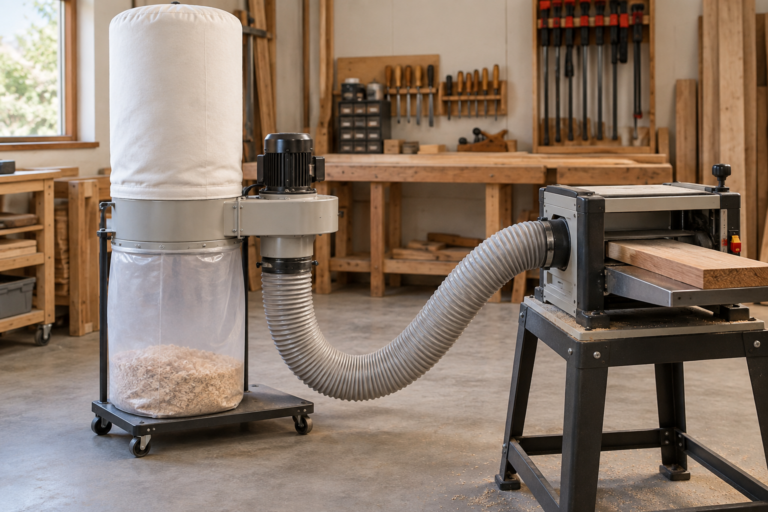
Plan for chip removal. Planers produce a large volume of chips quickly, and a clogged chute can cause poor cuts or force chips back onto the board. A suitable dust collector or high-capacity extractor is preferable to assuming a small shop vacuum will keep up. Wear hearing and eye protection, and never reach into the cutter area to clear a blockage while the machine is connected to power.
Avoid snipe and uneven results
Snipe is a deeper cut near the leading or trailing end of a board. It often comes from the board tipping as it enters or exits, or from feed rollers pressing unevenly. Support long stock, keep it level, and follow the manufacturer’s instructions for adjusting table extensions and roller pressure. If a project allows it, plane slightly overlength and trim the ends after milling.
Feed boards consistently and do not force short or unstable pieces through the machine; use the manual’s minimum-length guidance. Inspect stock for nails, screws, and embedded grit before cutting, since a small piece of metal can nick knives or chip a carbide insert. For best results, flatten one face first, take modest cuts, and check thickness across the board after each pass.