
Key takeaways
- Compare the best table saw blades for fine woodworking projects, from 24-tooth rip blades to 80-tooth plywood blades, with grinds and kerfs explained.
What's inside
- Quick Answer
- Freud LU83R010 10-Inch 50-Tooth Thin Kerf Combination Blade
- Freud LU87R010 10-Inch 24-Tooth Thin Kerf Rip Blade
- Freud LU88R010 10-Inch 60-Tooth Thin Kerf Fine Finish Crosscut Blade
- Diablo D1060X 10-Inch 60-Tooth Fine Finish Blade
- Freud LU80R010 10-Inch 80-Tooth Ultimate Plywood and Melamine Blade
- How to Choose
- Who Should Skip
- FAQ
- Final Verdict
As an Amazon Associate I earn from qualifying purchases. This post may contain affiliate links at no extra cost to you.
On a fine woodworking project, the cut edge is often a finished edge. A glue joint, a miter on a picture frame, or the side of a plywood cabinet may receive nothing more than a light sanding before finish goes on, so the blade decides how much cleanup follows every cut. Tooth count, tooth grind, and kerf width all change the result, and a bundled general-purpose blade is adequate at everything and excellent at nothing.
As an Amazon Associate, we earn from qualifying purchases.
This guide compares five 10-inch blades with 5/8-inch arbors covering the cuts fine woodworking actually involves: a combination blade that can stay on the saw, a dedicated rip blade, two fine-finish crosscut blades, and a specialist for veneered plywood and melamine. Every specification comes from the maker’s own listing data.
This article contains affiliate links, and we may earn a commission if you purchase through them, at no additional cost to you.
Contents
- Quick Answer
- Freud LU83R010 10-Inch 50-Tooth Thin Kerf Combination Blade
- Freud LU87R010 10-Inch 24-Tooth Thin Kerf Rip Blade
- Freud LU88R010 10-Inch 60-Tooth Thin Kerf Fine Finish Crosscut Blade
- Diablo D1060X 10-Inch 60-Tooth Fine Finish Blade
- Freud LU80R010 10-Inch 80-Tooth Ultimate Plywood and Melamine Blade
- How to Choose
- Who Should Skip
- FAQ
- Final Verdict
Quick Answer
For one blade to handle most fine woodworking, choose the Freud LU83R010. Its 50-tooth combination grind rips and crosscuts cleanly, the thin kerf suits contractor and hybrid saws, and the Perma-SHIELD coating resists pitch. Add the LU87R010 for heavy ripping and the LU80R010 for veneered plywood and melamine.
Freud LU83R010 10-Inch 50-Tooth Thin Kerf Combination Blade
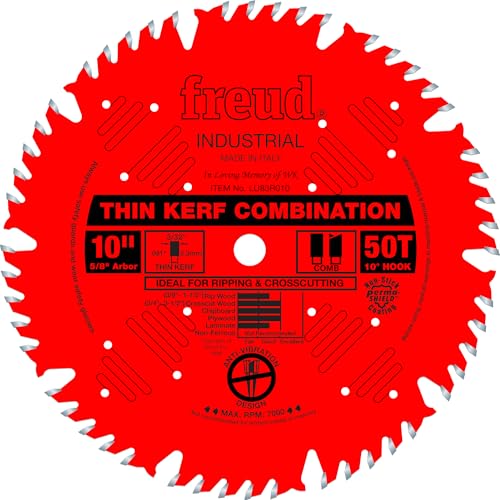
The LU83R010 is the blade in this group designed to be left on the saw. Its 50 teeth use Freud’s combination grind: groups of alternate top bevel teeth followed by a flat-top raker. The beveled teeth slice crosscut fibers cleanly while the raker clears the kerf during rip cuts. Freud rates it for ripping and crosscutting wood, plywood, laminate, and chipboard.
The thin .091-inch kerf removes less material than a full-kerf blade, easing the load on smaller saws. The teeth are TiCo Hi-Density carbide, the plate carries the Perma-SHIELD coating against pitch and heat, and laser-cut anti-vibration slots keep it running true. Its limits sit at the extremes: thick hardwood rips faster on the 24-tooth blade below, and veneered plywood exits cleaner from the 80-tooth specialist.
Specs:
– Diameter: 10 inches
– Teeth: 50
– Tooth grind: Combination grind (ATB teeth with flat-top raker, per Freud)
– Kerf: .091 inch (thin kerf)
– Plate thickness: .071 inch
– Arbor: 5/8 inch
– Coating: Perma-SHIELD non-stick coating
– Tooth material: TiCo Hi-Density carbide
– Intended cuts (per Freud): ripping and crosscutting wood, plywood, laminate, chipboard
See the Freud LU83R010 on Amazon
Freud LU87R010 10-Inch 24-Tooth Thin Kerf Rip Blade

The LU87R010 does one job: ripping solid wood along the grain. Its 24 teeth use a flat-top grind with deep gullets and a 20-degree hook angle, a geometry that feeds aggressively and clears chips fast instead of polishing the cut face. Freud rates it for hardwoods and softwoods from 3/4 inch to 2-3/4 inches thick.
The kerf is a thin .094 inch on a .071-inch plate, so the blade asks little of smaller saws even in thick stock. The teeth are Freud’s TiCo Hi-Density carbide ripping blend under the line’s Perma-SHIELD coating. The flat-top grind also leaves a flat-bottomed kerf, useful for shallow grooves and spline slots. It is not a crosscut blade: flat-top teeth tear fibers across the grain. Treat it as the second blade in a rotation, mounted for heavy ripping and swapped out for joinery.
Specs:
– Diameter: 10 inches
– Teeth: 24
– Tooth grind: FTG (flat-top grind)
– Kerf: .094 inch (thin kerf)
– Plate thickness: .071 inch
– Arbor: 5/8 inch
– Hook angle: 20 degrees
– Coating: Perma-SHIELD non-stick coating
– Tooth material: TiCo Hi-Density carbide, ripping blend
– Intended cuts (per Freud): ripping hardwoods and softwoods 3/4 inch to 2-3/4 inches thick
See the Freud LU87R010 on Amazon
Freud LU88R010 10-Inch 60-Tooth Thin Kerf Fine Finish Crosscut Blade

Where the LU83 compromises, the LU88R010 specializes. Freud sells it as a thin kerf fine finish crosscut blade, and its 60 alternate top bevel teeth slice across the grain rather than chopping through it, keeping the shoulder of a tenon crisp and the corner of a miter closed.
The .091-inch thin kerf and .071-inch plate keep it easy to drive on mid-power saws, and the TiCo teeth carry the Perma-SHIELD coating shared with the other Freud industrial blades here. In a rotation with the LU87R010, it stays mounted for sizing, joinery, and final trimming. Its weakness mirrors the rip blade’s: pushed through thick stock along the grain, 60 closely spaced teeth pack the gullets, feed slowly, and build heat that can scorch the cut face. Keep it for crosscuts and sheet goods.
Specs:
– Diameter: 10 inches
– Teeth: 60
– Tooth grind: ATB (alternate top bevel)
– Kerf: .091 inch (thin kerf)
– Plate thickness: .071 inch
– Arbor: 5/8 inch
– Coating: Perma-SHIELD non-stick coating
– Tooth material: TiCo Hi-Density carbide
– Intended cuts (per Freud): fine-finish crosscutting of wood, plastic, and non-ferrous metal
See the Freud LU88R010 on Amazon
Diablo D1060X 10-Inch 60-Tooth Fine Finish Blade

Diablo is Freud’s retail blade line, and the D1060X fills the same fine-finish role as the LU88R010 with one meaningful difference: its 60 teeth use a Hi-ATB grind, a steeper bevel than standard ATB that shears fibers more sharply. Diablo positions it for polished finish cuts in wood, plywood, melamine, and delicate molding.
The kerf measures .098 inch, between thin and full kerf, and the plate uses laser-cut stabilizer vents to reduce vibration. The teeth are TiCo Hi-Density carbide with the Perma-SHIELD coating used across the Freud-made blades here. Choose between this blade and the LU88R010 by your work: for solid-lumber crosscuts the two are close substitutes, but if you regularly crosscut veneered panels, melamine shelving, or small moldings where a chipped corner ruins the piece, the Hi-ATB grind is the more suitable geometry.
Specs:
– Diameter: 10 inches
– Teeth: 60
– Tooth grind: Hi-ATB (high alternate top bevel)
– Kerf: .098 inch (thin kerf)
– Plate thickness: not stated
– Arbor: 5/8 inch
– Coating: Perma-SHIELD non-stick coating
– Tooth material: TiCo Hi-Density carbide
– Intended cuts (per Diablo): fine-finish cuts in wood, plywood, melamine, and molding
See the Diablo D1060X on Amazon
Freud LU80R010 10-Inch 80-Tooth Ultimate Plywood and Melamine Blade

Veneered plywood and melamine-coated board chip where the teeth exit the panel. The LU80R010 is Freud’s answer, sold as the Ultimate Plywood and Melamine blade. Its 80 teeth use a Hi-ATB grind, so each tooth scores the face veneer with a steep bevel before the waste is cleared, and Freud designs it to leave chip-free edges on both faces.
Unlike the thin-kerf blades above, it is a full-kerf blade at .126 inch, with a low 2-degree hook angle according to retailer-published Freud spec sheets. That shallow hook feeds steadily through stacked panels instead of grabbing and self-feeding. The teeth are TiCo Hi-Density carbide with the Perma-SHIELD coating. Reserve it for sheet goods: eighty fine teeth are slow and heat-prone in thick solid stock, and ripping lumber wastes the edge quality you paid for.
Specs:
– Diameter: 10 inches
– Teeth: 80
– Tooth grind: Hi-ATB (high alternate top bevel)
– Kerf: .126 inch (full kerf)
– Plate thickness: not stated
– Arbor: 5/8 inch
– Hook angle: 2 degrees
– Coating: Perma-SHIELD non-stick coating
– Tooth material: TiCo Hi-Density carbide
– Intended cuts (per Freud): plywood and melamine, chip-free on both faces
See the Freud LU80R010 on Amazon
How to Choose
Start with the cut, not the brand. Ripping favors few teeth with a flat-top grind and large gullets to clear long chips quickly. Crosscutting favors more teeth with an ATB grind for clean crosscuts. Veneered sheet goods favor a high tooth count with a Hi-ATB grind, whose steep bevel scores the fragile face before it can chip.
Read the grind before the tooth count, since two 60-tooth blades can behave very differently. ATB teeth alternate left and right bevels for clean crosscuts. Hi-ATB steepens that bevel for delicate faces. FTG teeth are flat on top: aggressive in rip cuts and flat at the bottom of the kerf. A combination grind mixes ATB teeth with a flat raker to cover both directions well, not perfectly.
Match the kerf to the saw. Thin-kerf blades suit contractor, hybrid, and jobsite saws, but check your riving knife: if the knife is thicker than the kerf, the workpiece binds on it, requiring a thinner knife or a full-kerf blade. Full-kerf blades run stiffer, resist deflection in thick stock, and suit higher-powered cabinet saws.
Finally, confirm diameter and arbor size match your saw; every blade here is 10-inch on a 5/8-inch arbor. Coatings slow pitch buildup but do not replace cleaning, and carbide teeth can be resharpened rather than discarded.
Who Should Skip
Owners of 12-inch saws, or any saw with a 1-inch arbor, should skip every blade here and shop in the correct size. Anyone cutting metal, masonry, tile, or fiber-cement board should also pass: these grinds and carbide blends are made for wood products only.
If your work is ripping construction lumber to rough dimension, a single 24-tooth rip blade covers it, and fine-finish blades are wasted money. Grooves and dadoes of varying widths call for a dado stack, not any single blade here. And if your shop runs a power feeder or a strict full-kerf setup, build the rotation from full-kerf industrial blades instead of mixing kerfs.
FAQ
Can one blade really handle both ripping and crosscutting?
Yes, within limits. A combination grind such as the LU83R010’s mixes alternate top bevel teeth with a flat-top raker, so it rips respectably and crosscuts cleanly enough for most furniture work. It gives up a little at each extreme: a dedicated rip blade feeds faster in thick stock, and a dedicated crosscut or Hi-ATB blade leaves a finer face on delicate material.
Is a thin-kerf blade always the better choice?
No. Thin kerf helps lower-powered saws and wastes less material, but the thinner plate can deflect in thick stock, and the cut must be wider than your riving knife to feed safely. On a full-size cabinet saw cutting thick hardwood, a full-kerf blade usually tracks straighter. Match the kerf to the saw’s power and your typical stock thickness.
Why does plywood chip on the underside, and which blade fixes it?
The teeth exit through the bottom face, where unsupported veneer fibers break away instead of being cut. A high-tooth-count Hi-ATB blade such as the LU80R010 scores the face with a steep bevel before clearing waste, greatly reducing the chipping. A zero-clearance throat insert supporting the fibers at the cut line helps any blade on sheet goods.
How do I know when a blade needs sharpening?
Clean the blade first, because hardened pitch buildup mimics dullness: it raises feed pressure, heats the cut, and leaves burn marks. If a clean blade still burns, feeds hard, or leaves a rougher face than it used to, the carbide edges are worn or chipped. Quality carbide blades can be resharpened, and individual teeth replaced, by a sharpening service.
Final Verdict
For most fine woodworking shops, the practical answer is a small rotation rather than a single perfect blade. Start with the Freud LU83R010 as the everyday default. Add the LU87R010 when thick ripping becomes regular work, choose the LU88R010 or the Diablo D1060X for crosscut finish quality, and give sheet-goods work its own blade in the LU80R010. Matched to the cut this way, every edge comes off the saw closer to finished, and each blade lasts longer in its proper role.
Related guides
More from Amazon
Programs that pair well with the guide above. Offers and eligibility are set by Amazon and may change.
A free business account with business pricing and bulk-buying tools for work, shop or home office.
Create a business accountFree shipping on eligible items, Prime Video and more. Eligible new members can start with a free trial.
Start a Prime free trialAudiobooks and podcasts to listen to on the go. Eligible new members can start with a free trial.
Try Audible freeAd-free music streaming. Eligible new subscribers can start with a free trial.
Try Music Unlimited freeAs an Amazon Associate we earn from qualifying purchases.


Write Your Review
No reviews yet. Be the first to share your experience!