
Key takeaways
- Compare the best marking knives for joinery layout: spear-point, single-bevel, and scalpel styles that scribe clean lines no pencil can match.
What's inside
As an Amazon Associate I earn from qualifying purchases. This post may contain affiliate links at no extra cost to you.
- Top Pick: Narex Dual Bevel Marking Knife with Rosewood Handle
- Runner-up: Clarke Brothers Marking Knife with Leather Sheath
- Also consider: Narex Right Hand Violin Knife 813701
Every tight joint starts as a line. A pencil line has real width, smears under a straightedge, and sits on top of the fibers instead of cutting them, so a saw or chisel has nothing to register against. A marking knife severs the fibers and leaves a fine groove that catches the light, stays put, and gives a chisel or dovetail saw a wall to drop into.
As an Amazon Associate, we earn from qualifying purchases.
Marking knives are not all built the same way, though. Spear-point blades beveled on both faces mark in either direction, single-bevel blades are ground flat on one side and sold in left-hand and right-hand versions, and scalpel-style knives trade durability for a thin, flexible point. Steel and hardness decide edge life; handle shape decides how precisely you can steer the tip in a pencil-style grip. The five knives below cover each style, and where each falls short.
This article contains affiliate links, so if you buy through them the site may earn a commission at no additional cost to you.
Contents
Quick Answer
For most woodworkers, a spear-point dual-bevel knife such as the Narex Dual Bevel is the best first marking knife: it registers flat against a square in either direction and suits dovetails and mortises alike. Choose a single-bevel knife for the tightest reference against one edge, and a scalpel-style knife only for delicate inlay and veneer work.
Narex Dual Bevel Marking Knife with Rosewood Handle
This is the reference design for a modern spear-point marking knife. The blade is ground with a bevel on both faces, meeting at a centered point, so either flat side can ride against a square or a dovetail marker. That symmetry suits dovetail layout, where tails and pins are marked from both faces of a board in one session. Laser-cut finger indents in the blade let you choke up and apply pressure close to the tip when tracing around a tail board into end grain.
The blade is AISI 420 stainless steel hardened to HRC 57, a deliberate middle ground: hard enough to hold a fine edge through a day of layout, quick to refresh on a strop, and stainless, so it will not rust in a damp shop. The square-profile rosewood handle gives a secure pencil-style grip and will not roll off the bench.
Specs
- Blade material: AISI 420 stainless steel, hardened to HRC 57
- Blade profile: dual-bevel spear point, 55-degree tip, 25-degree bevels
- Blade length: 1-7/8 inches; width 1/2 inch; thickness 0.060 inch
- Handle: Mexican rosewood scales, brass pins, 4 inches long
- Overall length: 5-7/8 inches
- Model: V2004070NX, made in the Czech Republic
Clarke Brothers Marking Knife with Leather Sheath
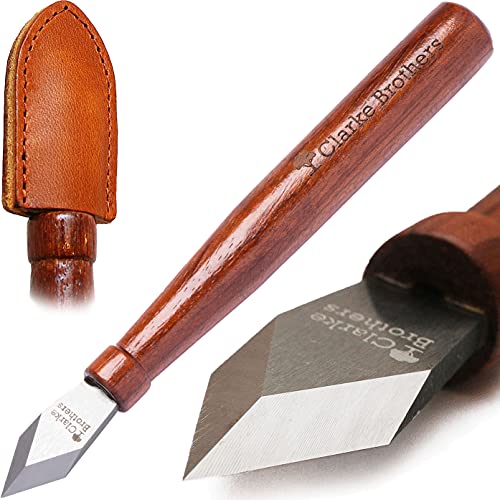
Clarke Brothers takes the traditional route: a high-carbon steel blade, a turned wooden handle, and a real leather sheath. The compound-bevel blade ends in a fine point, and at 5.5 centimeters it is short enough for a fingertip grip when tracing a hinge leaf for mortise layout, where the point must turn tight corners without levering out of the cut.
High-carbon steel takes a keener edge than most stainless blades and hones back to sharp with little effort, which matters for the cross-grain lines that dull an edge fastest. The trade-off is maintenance: it needs an occasional wipe of oil and rusts if stored damp. The cherry-finished handle is round and smooth, comfortable in a light pencil grip, though it can roll on a sloped bench.
Specs
- Blade material: high-carbon steel
- Blade edge: compound bevel
- Blade length: 5.5 centimeters
- Overall length: 160 millimeters
- Handle: wood, cherry finish
- Included: real leather sheath
- Weight: 1.76 ounces
Narex Right Hand Violin Knife 813701

The violin knife is the single-bevel specialist here. One face of the blade is ground; the other is flat. When the flat face rides against a square or the shoulder of an existing joint, no bevel pushes the edge away, so the line lands exactly on the dimension. This right-hand version is ground for cuts with the flat side registered on the left of the blade; left-hand versions exist for the opposite setup.
Narex sells the 813701 as a marking, striking, and notching knife: the blade is stout enough to tap lightly to deepen a line or start a notch, work that could snap a thin scalpel blade. That suits hinge mortises, where you trace the leaf and strike the outline deeper before paring, and transferring dovetail pins from a tail board. The compromise is direction: it registers perfectly one way only, so layout that constantly switches sides of a reference edge calls for a dual-bevel knife or a matched pair.
Specs
- Bevel: single bevel, right hand
- Intended uses: marking, striking, and notching
- Model: 813701
- Manufacturer: Narex (Mikov), Czech Republic
- Blade length, blade material, handle material: not stated
KAKURI Kiridashi Knife 15mm Curved Right Hand

The kiridashi is Japan’s traditional layout knife, older than the Western spear point. KAKURI’s version is hand forged from Japanese carbon steel with a hammered pattern that is not just decoration: the texture gives fingers purchase, because a kiridashi has no handle scales. The blade is one piece of steel ground to a single bevel, and this right-hand model has a gentle curve for rocking through long scribe lines and reaching into mortise corners.
A single bevel in hard, fine-grained carbon steel cuts exceptionally cleanly in end grain, which is why kiridashi are favored for marking dovetail pins and for trimming joints as well as laying them out. The 15-millimeter width is mid-range: wide enough to register against a square, narrow enough for small-scale work. Two cautions: the exposed edge runs much of the tool’s length, demanding care in handling and storage, and the bare steel grip is less comfortable over a long session than a wooden handle.
Specs
- Blade material: Japanese carbon steel, hand forged
- Bevel: single bevel, right hand
- Blade width: 15 millimeters
- Finish: hammered pattern
- Construction: one-piece steel, no handle scales
- Origin: made in Japan
X-ACTO #1 Z-Series Precision Knife

The scalpel-style entry is the odd one out, and it earns its place for specific work rather than general layout. The X-ACTO #1 pairs a slim aluminum handle with a replaceable number 11 blade, a long triangular point thinner and more flexible than any fixed blade here. That flex is a liability against a square on thick stock, but an asset for inlay, banding, and veneer work, where the blade must follow curves and slice delicate material without crushing it.
The Z-Series blade carries a zirconium nitride coating for edge life, and when it dulls you do not sharpen: you swap in a fresh blade with the easy-change collet. The honest limitation is structural. Number 11 blades are fragile, flex under side load, and should never be struck or levered. Treat this as a specialist second knife, and reach for a fixed-blade knife for dovetails, mortises, and everyday layout.
Specs
- Blade: number 11 fine point, zirconium nitride coated, replaceable
- Handle: aluminum, lightweight
- Blade system: easy-change collet, accepts other number 1 handle blades
- Included: safety cap and one number 11 blade
- Model: XZ3601W
- Manufacturer: Elmer’s
How to Choose
Start with bevel geometry, because it decides how the knife registers against your guides. A spear-point dual-bevel blade has a flat face on both sides of a centered point, so it tracks a square accurately in both directions and suits most joinery. A single-bevel blade registers perfectly against one reference face only, the most accurate arrangement from a single edge, but it is handed: buy the version ground for your dominant hand and the direction you pull the cut, or buy a left-and-right pair.
Next, match the steel to your sharpening habits. Stainless at HRC 57 shrugs off damp shops and hones easily. High-carbon steel takes a finer edge and refreshes fastest, at the cost of rust prevention. Harder blades hold an edge longer but take more care on the stones. Thickness matters too: blades around 0.060 inch slip into dovetail sockets and start lines with little pressure, while thicker blades tolerate being struck.
Handle shape is the third decision. A pencil-style grip with flats, finger indents, or a square profile gives fingertip steering and will not roll off the bench. Finally, know the marking versus striking distinction. A marking knife only scores, with hand pressure. A striking knife has a stronger blade and spine, so it can be tapped with a mallet to deepen lines in end grain when starting hinge mortises.
Who Should Skip
Skip the marking knife if your work stops at rough dimensioning. If lumber goes from the rack to a track saw or table saw guided by a construction pencil and a tape measure, a knife line adds nothing, because no joint is fitted to it. The same applies to sheet-goods casework and CNC workflows, where no line is read at all. A knife will not help if you are unwilling to hone, either: every fixed blade here needs occasional stropping. Buy a wheel marking gauge or a good mechanical pencil instead, and come back to a knife when you start cutting joinery that has to fit first time.
FAQ
What is the difference between a marking knife and a striking knife?
A marking knife scores a shallow line with hand pressure only. A striking knife is built with a thicker, stronger blade that can be tapped with a mallet to deepen the line, especially in end grain. Striking is how you start a hinge mortise outline or deepen a shoulder line before paring. Never strike a thin scalpel-style blade.
Should I choose a single-bevel or dual-bevel knife?
Choose dual bevel for general work, because it registers against a square from either direction and either hand. Choose single bevel when layout consistently references one face or edge, since the perfectly flat back puts the line exactly on the measurement. Single-bevel knives are handed, so confirm the grind suits your dominant hand before ordering.
How do I mark dovetails with a knife?
Saw and finish the tails first, then clamp the tail board in position on the pin board and trace each tail directly with the knife, flat face tight against the wood of the tail. Tracing the actual joint, rather than measurements, transfers the true angles and spacing, and the scored lines guide your saw and chisel cuts.
How do I keep a marking knife sharp?
Hone little and often: a few strokes on a loaded strop after each layout session maintains most edges. When stropping stops working, refresh the bevel on a fine waterstone or diamond plate; keep single-bevel blades flat on their back for a stroke or two to remove the burr. Store the blade sheathed.
Final Verdict
For a first and only marking knife, the Narex Dual Bevel is the pick: a true spear point, sensible stainless steel, and a handle shaped for control cover nearly every layout task. The Clarke Brothers is the traditional alternative for those who prefer carbon steel and a sheathed, pocketable tool. Add the Narex violin knife or the KAKURI kiridashi when your work leans on single-reference layout and the finest end-grain lines, and keep the X-ACTO #1 for inlay and veneer, where its thin replaceable blade does what no fixed blade can.
Related guides
More from Amazon
Programs that pair well with the guide above. Offers and eligibility are set by Amazon and may change.
A free business account with business pricing and bulk-buying tools for work, shop or home office.
Create a business accountFree shipping on eligible items, Prime Video and more. Eligible new members can start with a free trial.
Start a Prime free trialAudiobooks and podcasts to listen to on the go. Eligible new members can start with a free trial.
Try Audible freeAd-free music streaming. Eligible new subscribers can start with a free trial.
Try Music Unlimited freeAs an Amazon Associate we earn from qualifying purchases.
Write Your Review
No reviews yet. Be the first to share your experience!