Best Benchtop Planer: Milling Your Own Stock at Home
Key takeaways
- A benchtop planer is the gate between overpriced surfaced lumber and cheap rough stock, and the details that decide the good ones are not on the spec sheet.
What's inside
As an Amazon Associate I earn from qualifying purchases. This post may contain affiliate links at no extra cost to you.
Walk the lumber rack at any home center and the problem is visible at a glance: three or four species, nearly everything dressed to 3/4 inch, and a price per board foot that makes a hardwood dealer look generous. The moment a project calls for 7/8 inch drawer sides, a 1-1/4 inch apron, or cherry nobody has picked over, you have to mill your own stock. That is the case for the best benchtop planer you can justify: it turns cheap rough lumber into parts of consistent thickness with parallel faces, and it widens what you can build more than anything else at the same money.
It is also the category buyers misjudge most often. A benchtop planer is a portable universal-motor machine, usually 60 to 90 pounds, with a fixed bed and a cutterhead that rises and falls above it. The quality spread inside that description is wide, but the numbers on the box do not describe it. Amps, cuts-per-inch claims, and maximum depth of cut tell you little. Bed flatness, wing coplanarity, feed roller grip, whether the head locks, and how repeatably the height mechanism returns to a setting are what you live with.
As an Amazon Associate we earn from qualifying purchases at no extra cost to you. Product prices and availability are accurate as of the date shown and are subject to change.




| Planer class | Best for | What you trade away |
|---|---|---|
| 12-1/2 in. two-knife | Small shops that mill occasionally | Narrower width, coarser finish, more snipe |
| 13 in. three-knife, two-speed feed | Furniture work and wide glue-ups | Weight, noise, high chip volume |
| 13 in. segmented helical head | Figured and reclaimed stock | Purchase price, slower insert rotation |
| Budget spiral-head imports | Cut width per dollar | Fit, finish, and parts support |
What Separates the Best Benchtop Planer From the Rest
The bed and the wings. Sight a straightedge across the cast bed and out onto both extension tables. The wings should sit level with the bed or a whisker high at their outer ends, never low. Machines with adjustable wings let you correct that in ten minutes. Fixed wings leave you shimming forever.
A head lock. Four-post designs with a positive cutterhead lock hold the head down against the lifting force of the knives. It is the single most effective anti-snipe feature in the category, and it deserves priority over an extra half inch of cut width.
Feed rollers and drive. Even spring pressure on the infeed roller keeps the board moving at a constant rate. Inconsistent grip shows up as ripples and stall marks. A two-speed gearbox matters less for hogging than for the finish pass, where the slower feed lays down noticeably more cuts per inch.
Height mechanism and depth stop. Look for minimal backlash in the crank, a scale you can zero to a test board, and a turret stop with thicknesses you will actually use. Repeatability is what lets you mill a second batch of parts next month to the same number.
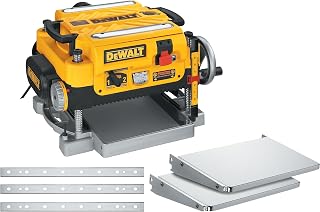
13-Inch Three-Knife Benchtop Planers
The sensible default for a furniture shop, and where DeWalt, Makita, and Ridgid all compete hard. Choose the one with adjustable extension wings and a locking head rather than the one with the loudest amp rating on the carton.
Cutterhead Choice: Straight Knives Versus Segmented Heads
Straight-knife machines run double-edged disposable blades that index on pins. Fresh knives leave an excellent surface, a set costs less than a good router bit, and a change takes about fifteen minutes. The weakness is the failure mode: one nick from a hidden staple or a grain of silica prints a raised line down every board you feed afterward.
Segmented heads, sold as helical or spiral heads, carry rows of four-sided carbide inserts set at a shear angle. Hit a nail and you rotate one insert. The shearing cut also drops the pitch of the machine and reduces tearout in curly maple and interlocked tropical grain. The costs are real: a higher price, a faint scalloped surface that wants light scraping on show faces, and a full rotation that means dozens of small screws.
Our rule of thumb is simple. Mill mostly straight-grained domestic lumber and a straight-knife machine plus a spare knife set is the better use of the money. Buy figured stock, work reclaimed boards, or plane in a garage attached to a house where people sleep, and the segmented head pays for itself.
Segmented Helical-Head Benchtop Planers
Worth the premium if figured wood, reclaimed lumber, or noise complaints are part of your reality. Confirm the maker sells individual inserts and screws before you buy, because insert availability is the real long-term cost here.
Snipe, and What Actually Reduces It
Snipe is the slightly deeper cut in the first and last few inches of a board. It happens when the stock sits under only one feed roller and the head can lift or the board can tip. No benchtop planer designs it away, so treat confident marketing claims with suspicion and treat technique as part of the tool.
What works, roughly in order of effect: lock the head if the machine allows it, set the wings level or a hair high at their far ends, support long stock at bed height instead of below it, butt sacrificial boards end to end so the cutterhead never sees a gap, and hold final passes to a 1/64 inch bite. Milling stock six inches long and trimming the ends afterward removes the problem outright.
- ✔ Turns cheap rough lumber into any thickness you need
- ✔ Excellent surface quality with sharp knives and light passes
- ✔ Portable enough to store on a cart or under a bench
- ✔ Straight-knife sets are inexpensive and quick to swap
- ✘ Some snipe is unavoidable on short parts
- ✘ Makes chips faster than a shop vacuum can clear them
- ✘ Loud enough that hearing protection is mandatory
- ✘ Cannot flatten a cupped or twisted board on its own
A Planer Is Only Half a Milling System
New owners discover this late: a thickness planer makes the top face parallel to the bottom face, not flat. Feed a cupped board through and the rollers press the cup out, the knives cut a parallel surface, and the board springs back cupped and thinner. You need a flat reference face first, from a jointer, a hand plane, or a shimmed sled that supports the board without flexing. Any of the three works. Skipping the step does not.
Two practical matters follow. Chip volume from a 13-inch machine outruns a shop vacuum inside a single board, so plan on a 4-inch port and a real dust collector. And give the machine a dedicated 15-amp circuit with a short, heavy cord if an extension is unavoidable, since voltage drop causes stalling that usually gets blamed on dull knives.
Compact 12-1/2 Inch Two-Knife Planers
The honest budget answer for a small shop that mills occasionally. Expect a coarser finish and more attention paid to snipe, but the thickness control is genuine and the width covers most solid-wood parts short of wide panels.
Frequently Asked Questions
Do I need a jointer before I buy a planer? No, but you do need a way to create one flat face. A shimmed planer sled handles occasional work, and hand-planing a reference face is faster than most people expect. Buy the planer first, because thickness control is what joinery depends on.
How thin and how short can I safely plane? Most benchtop machines stop gripping reliably somewhere around 1/8 to 3/16 inch, and short pieces can tip between the rollers. Glue or tape thin and short stock to a flat carrier board and plane the assembly instead.
Is a helical head worth the upgrade cost on a benchtop machine? If you plane figured or reclaimed wood, or noise matters where you work, yes. For straight-grained poplar, oak, and maple from a dealer, that money buys better results as dust collection and spare knives.
Verdict
Judged against the criteria that actually matter, coplanar and adjustable wings, a locking head, even feed pressure, and a repeatable height setting, the 13-inch three-knife class with a two-speed feed remains the center of the market for a home furniture shop. Step up to a segmented helical head if figured lumber, reclaimed boards, or a shared living space describe your work. Step down to a 12-1/2 inch machine only when bench space or budget forces it. Whichever class you pick, buy dust collection and a spare cutter set the same day, because those two do more for your finished surfaces than any gain in cut width.
Check prices on Amazon →