Best Motorized Grain Mills for All-Grain Home Brewing
What's inside
- Quick comparison of motorized grain mill options
- Best choices by brewing situation
- Motor power: torque matters more than RPM
- Two rollers versus three rollers
- How to choose the gap for a consistent crush
- Worked sizing example: is a 7-pound hopper enough?
- Noise, durability, and what wears first
- Cleaning and storage routine
- Final buying recommendation
- Quick comparison of motorized grain mill options
- Best choices by brewing situation
- Motor power: torque matters more than RPM
- Two rollers versus three rollers
- How to choose the gap for a consistent crush
- Worked sizing example: is a 7-pound hopper enough?
- Noise, durability, and what wears first
- Cleaning and storage routine
- Final buying recommendation
As an Amazon Associate I earn from qualifying purchases. This post may contain affiliate links at no extra cost to you.
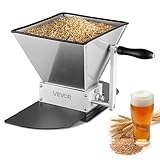
The best motorized grain mills for all-grain home brewing are a sturdy two-roller mill paired with a low-speed, high-torque drill for most brewers, while a three-roller Monster Mill MM3 is the better choice for frequent brewing and tighter control over the crush.
Motorizing a mill does not automatically make it better. The useful combination is enough torque to pull grain consistently, a hopper large enough for your batch, an adjustment system that stays put, and rollers that remain parallel after repeated use. The comparisons below focus on those brew-day realities rather than advertised motor speed alone.
As an Amazon Associate we earn from qualifying purchases at no extra cost to you.


Contents
- Quick comparison of motorized grain mill options
- Best choices by brewing situation
- Motor power: torque matters more than RPM
- Two rollers versus three rollers
- How to choose the gap for a consistent crush
- Worked sizing example: is a 7-pound hopper enough?
- Noise, durability, and what wears first
- Cleaning and storage routine
- Final buying recommendation
Quick comparison of motorized grain mill options
Most home-brew mills are sold with a hand crank. “Motorized” usually means adding a corded drill, cordless drill, or dedicated gearmotor through the mill’s drive shaft. The figures below are representative published specifications and common operating ranges; exact package contents vary by seller and revision.
| Mill or setup | Rollers | Roller size | Typical hopper | Practical motorized throughput | Adjustment and construction |
|---|---|---|---|---|---|
| Barley Crusher 2-Roller | 2 | 1.5-inch diameter, 7-inch length | 7 lb | 3–5 lb/min | Knurled steel rollers; gap adjusted with a dial and lock screws |
| Cereal Killer 2-Roller | 2 | 1.5-inch diameter, approximately 7-inch length | 7 lb | 3–5 lb/min | Adjustable gap; aluminum body and steel rollers |
| Monster Mill MM2 | 2 | 2-inch diameter, 8-inch length | 11 lb standard hopper | 4–8 lb/min | Large knurled steel rollers; frame and gap hardware designed for heavier use |
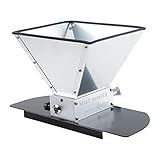
| Monster Mill MM3 | 3 | 2-inch diameter, 8-inch length | 11 lb standard hopper | 5–10 lb/min | Three-roller crush with independent gap settings and steel rollers |
| Generic 2-roller drill-mill kit | 2 | 1.5–2 inches, commonly 6–8 inches long | 6–11 lb | 2–6 lb/min | Quality varies widely; inspect frame stiffness, bearings, and adjustment locks |
Throughput depends on grain variety, moisture, gap, drill speed, and whether the hopper is kept full. A quoted maximum should not be treated as a guaranteed brew-day rate.
Best choices by brewing situation
- Best for occasional or first-time all-grain brewing: Barley Crusher or Cereal Killer with a drill. Their smaller rollers need less space and handle ordinary five- to ten-gallon recipes without requiring a dedicated motor.
- Best for frequent brewing: Monster Mill MM2. Its larger rollers grip grain more reliably at low speed and its heavier frame is better suited to repeated milling.
- Best for maximum crush control: Monster Mill MM3. The first roller breaks the kernels and the later rollers finish the crush, helping separate husk and endosperm when the mill is correctly aligned.
- Best for a limited budget: a basic two-roller mill plus an existing corded drill. Spend more on a rigid mount and a safe hopper support before paying for a high-powered motor.
- Best for a compact brew space: a 1.5-inch, two-roller mill. It is easier to store and usually fast enough for a normal 5-gallon batch.
- Best for large batches or group brewing: an 8-inch, three-roller mill with a 10- to 11-pound hopper. It reduces the number of refills and tolerates longer milling sessions better.
Motor power: torque matters more than RPM
A mill should generally run slowly, around 150–300 revolutions per minute at the rollers. High speed can increase noise, produce more flour, heat the bearings, and encourage the husks to shatter. A drill with a two-speed gearbox is useful because its low range supplies torque without requiring the operator to feather the trigger constantly.
For a two-roller mill, a corded drill rated around 6 to 8 amps or a cordless drill with a 12- to 18-volt battery and a substantial clutch is usually adequate. Larger three-roller mills benefit from a drill with a side handle. The handle is not cosmetic: a stuck kernel can produce a sudden torque reaction.
A dedicated gearmotor is worthwhile when the mill is permanently mounted or used for several batches per week. Choose a geared output near 150–300 RPM and enough torque to avoid stalling under a full hopper. Do not connect a fast direct-drive motor to a mill unless the system includes suitable speed reduction.
Two rollers versus three rollers
Two-roller mills are simpler. One roller is driven and the other turns from contact with the grain. They are easy to disassemble and generally have fewer parts to align. Their main weakness is that a narrow or inconsistent gap can make the crush vary across the batch.
Three-roller mills add a pre-crush stage. The first gap opens the kernel while the second gap completes the crush. This can preserve larger husk pieces while exposing the endosperm, but it also creates another adjustment point. A three-roller mill is not automatically more efficient if the rollers are misaligned or the gaps are set inconsistently.
How to choose the gap for a consistent crush
- Start near 0.035–0.045 inch. This is a useful starting range for many barley-based recipes, not a universal prescription.
- Measure with feeler gauges. Set both sides equally rather than relying only on a dial position.
- Mill a small sample. Examine whether most kernels are opened while the husks remain recognizable.
- Adjust in small increments. If intact kernels remain, narrow the gap by about 0.002–0.005 inch. If the husk is pulverized or the grain becomes excessively floury, widen it.
- Record the setting. Note the grain type, gap, and resulting lautering performance so the next batch starts from a known point.
Very hard wheat, rye, oats, and conditioned grain may require a different setting. A stuck mash is not always caused by the mill; excessive adjunct percentage, insufficient rice hulls, or an overly rapid runoff can produce the same symptom.
Worked sizing example: is a 7-pound hopper enough?
Suppose a recipe contains 12 pounds of grain and your mill hopper holds 7 pounds. You will need two fills: 7 pounds plus 5 pounds. At a realistic motorized rate of 4 pounds per minute, milling takes roughly 3 minutes of actual roller operation, plus time to weigh and refill.
For a 5-gallon batch, that is usually convenient. For a 20-gallon brew day with 45 pounds of grain, the same mill requires seven fills and repeated handling. An 11-pound hopper reduces that to five fills, while a dedicated grain chute or bucket under the mill becomes more important than a small difference in roller speed.
Noise, durability, and what wears first
The drill is usually louder than the mill. A low-speed corded drill commonly produces about 75–85 decibels near the operator, while a lightly loaded gearmotor may be quieter but can transmit vibration through a rigid stand. A rubber mat beneath the mill helps with rattling and protects the bench.
The first parts to inspect are usually the drive-side bearing, adjustment hardware, hopper fasteners, and the drive shaft or shaft coupler. Fine flour can work into bearings, and repeated overtightening can deform light adjustment plates. Stainless or hardened-steel rollers resist corrosion better than plain steel, but they still should not be washed and stored wet.
When buying, favor a mill with independently lockable gap adjustments, accessible bearings, replaceable drive components, and a frame that does not flex when the hopper is full. A heavy roller is useful because its inertia helps it pull grain, but frame stiffness determines whether that advantage becomes consistent crush quality.
Cleaning and storage routine
- Brush or vacuum out flour and husk immediately after milling.
- Rotate the rollers by hand while brushing the knurling clear.
- Do not rinse the mill unless the manufacturer specifically permits it.
- Keep grain away from the drive bearing and motor ventilation openings.
- Wipe exposed steel with a very light food-safe lubricant if the manufacturer recommends it.
- Store the mill dry, with the hopper empty and the drill disconnected.
Never use compressed air toward sealed bearings or toward yourself; it can drive fine grain dust into moving parts and create an inhalation hazard. If the mill has been exposed to damp grain, clean it promptly and inspect for rust before the next batch.
Final buying recommendation
For most home brewers, the best motorized grain mill for all-grain home brewing is a two-roller unit with 1.5- to 2-inch rollers, a 6- to 11-pound hopper, and a slow high-torque drill. Choose the Barley Crusher or Cereal Killer for occasional batches and lower cost. Move to the Monster Mill MM2 for frequent use, or the MM3 when crush control and larger batch capacity justify additional adjustment and maintenance. Whichever model you select, a rigid mount, measured gap, slow roller speed, and dry cleaning routine will contribute more to repeatable results than maximum motor RPM.