Kreg Mobile Project Center Review: Features, Setup, and Value
What's inside
- Kreg Mobile Project Center at a glance
- Folding setup: fast, but not completely effortless
- Is the work surface large enough?
- Load capacity and stability
- Clamping options and their limits
- Portability and storage in a small shop
- Who should buy it?
- Ownership realities: what needs attention?
- Value in practical terms
- Kreg Mobile Project Center at a glance
- Folding setup: fast, but not completely effortless
- Is the work surface large enough?
- Load capacity and stability
- Clamping options and their limits
- Portability and storage in a small shop
- Who should buy it?
- Ownership realities: what needs attention?
- Value in practical terms
As an Amazon Associate I earn from qualifying purchases. This post may contain affiliate links at no extra cost to you.
For a small shop, the Kreg Mobile Project Center is a worthwhile buy if you need a portable 350-pound work surface with built-in clamping, but it is not a replacement for a full-size workbench. Its folding setup, roughly 27-1/2-by-31-1/2-inch work area, and compact storage make it especially useful for assembly, drilling, sanding, and occasional outdoor projects.
As an Amazon Associate we earn from qualifying purchases at no extra cost to you.


Contents
- Kreg Mobile Project Center at a glance
- Folding setup: fast, but not completely effortless
- Is the work surface large enough?
- Load capacity and stability
- Clamping options and their limits
- Portability and storage in a small shop
- Who should buy it?
- Ownership realities: what needs attention?
- Value in practical terms
Kreg Mobile Project Center at a glance
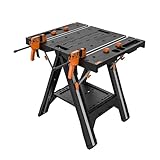
The Kreg Mobile Project Center—commonly identified as the KWS1000—combines a folding stand, split worktop, bench dogs, and clamp channels in one portable workstation. The top separates into two halves so a workpiece can be held between them, while the included clamping accessories help secure boards for cutting, routing, or assembly.
| Specification or feature | What it means in use |
|---|---|
| Work surface | Approximately 27-1/2 by 31-1/2 inches |
| Maximum load | Up to 350 pounds when properly assembled and supported |
| Working height | Approximately 32 inches |
| Product weight | Approximately 39 pounds |
| Worktop design | Split top with dog holes and clamping channels |
| Setup | Folding legs and folding work surface; no permanent installation required |
| Primary materials | Steel folding frame with molded composite worktop components |
Exact package contents and dimensional descriptions can vary between regional listings and production revisions, so check the current box contents before purchasing replacement accessories. The figures above are useful planning numbers rather than a reason to treat the Mobile Project Center like a certified industrial workbench.
Folding setup: fast, but not completely effortless
The main attraction is how little space the Kreg Project Center occupies between projects. The legs fold inward and the worktop folds down, allowing the unit to be stored against a wall or in a narrow closet. A practical setup sequence is:
- Place the folded center on a level floor with enough clearance for the legs to open.
- Unfold and lock the leg structure, checking that the frame is fully seated before applying pressure.
- Open the two worktop halves and confirm that the top is level and the locking points are engaged.
- Install the bench dogs or clamp accessories needed for the job.
- Push down on the worktop and check for rocking before placing a board or power tool on it.
Allow about two minutes for routine setup once the mechanism is familiar, plus additional time when fitting clamps or adjusting the workpiece. That is faster than assembling a temporary pair of sawhorses and plywood, but slower than using a permanent bench that is already clear.
The most common setup mistake is failing to open the legs completely. Another is positioning the center on an uneven garage floor and then blaming the folding frame for movement. On rough concrete, a thin rubber mat can improve grip, although it should not be used to compensate for an incompletely locked frame.
Is the work surface large enough?
The approximately 27-1/2-by-31-1/2-inch top provides about 6 square feet of working area. That is enough for cabinet doors, small tables, shelving parts, trim, boxes, drawer components, and most hand-tool operations. It is also a useful height for drilling pocket holes or assembling face frames.
It becomes restrictive with full sheets, long boards, or wide carcasses. A 4-by-8-foot sheet of plywood is about 32 square feet, so the Mobile Project Center supports only around 19 percent of that sheet at one time. It can still help with breakdown work, but the panel needs additional support from sawhorses, an outfeed table, or a second workstation.
The split top is more valuable than its area alone suggests. Narrow boards can be held between the halves, and dog holes allow a stop to be positioned against a workpiece. For glue-ups, however, the top is not as naturally rigid or expansive as a traditional bench with a thick wooden top and a permanently mounted vise.
Load capacity and stability
Kreg rates the Mobile Project Center for loads up to 350 pounds. That is ample for a benchtop planer, a compact table saw during temporary use, or a heavy assembly. The rating does not mean every 350-pound load is equally safe: a centered, stationary load is less demanding than a lighter load placed far to one side or moved aggressively during planing.
Use the center’s rated capacity as a limit for supported weight, not as a promise of zero movement. A portable frame can flex more than a fixed bench, particularly when hand-planing, chiseling, or applying sideways force. For those operations, keep the workpiece centered, widen the support with auxiliary surfaces where possible, and use a separate heavy bench when precision and rigidity matter more than portability.
Clamping options and their limits
The Mobile Project Center’s strongest feature is its integrated approach to holding work. Its bench dogs and clamp channels let you secure boards without permanently installing a vise. The two-piece top can close around a workpiece, while compatible Kreg-style clamps can apply pressure from above or from the sides.
This arrangement works well for:
- Holding a board while drilling pocket holes or pilot holes.
- Supporting parts during sanding, routing, and edge treatment.
- Keeping small assemblies aligned during fastening.
- Using bench dogs as stops for repeated cuts or layout work.
There are trade-offs. Clamp reach is limited by the available channels and accessory geometry, and very thick or unusually shaped workpieces may need a separate bar clamp. The top is also not a substitute for a full woodworking vise: it offers flexible temporary holding rather than deep, rigid jaws attached to a massive bench.
Portability and storage in a small shop
At roughly 39 pounds, the center is movable by one person, but it is not a lightweight camping table. The weight is useful because it reduces sliding during normal work; carrying it up stairs or loading it into a vehicle is still a two-handed task. Its folded shape is much easier to store than a fixed bench, yet it still requires a vertical footprint and clearance for the folding legs.
Measure the storage location before buying. A sensible allowance is at least 36 inches of wall width, roughly 12 inches of depth for the folded unit and accessories, and enough height to lift it without striking shelves. Store clamps and bench dogs in a labeled container. Losing one small accessory can reduce the usefulness of the entire clamping system.
Who should buy it?
| Your situation | Verdict | Reason |
|---|---|---|
| Very limited floor space | Strong fit | Folds away and provides a ready-to-use surface without permanent installation. |
| Occasional DIY and repair work | Strong fit | Clamping and moderate capacity cover many household projects. |
| Frequent furniture building | Conditional | Useful as a second station, but the top may feel small for large assemblies. |
| Heavy hand-planing or chopping | Weak fit | A heavier fixed bench offers better resistance to lateral force. |
| Lowest possible budget | Compare carefully | A pair of sawhorses and sheet goods costs less, but lacks integrated clamping and folds less neatly. |
| Need for vehicle or outdoor portability | Good fit | It is movable by one person and does not require a permanent shop location. |
Ownership realities: what needs attention?
The folding joints, locking points, clamp hardware, and plastic worktop surfaces are the areas most likely to show wear. Keep sawdust out of hinges and locking mechanisms; use a brush or vacuum rather than forcing debris deeper with compressed air. Do not oil a locking surface unless the manufacturer specifies a lubricant, because excess oil can attract abrasive dust.
Inspect the fasteners periodically, especially after transporting the unit. Tighten loose hardware without overtightening molded components. Replace damaged bench dogs or clamps rather than improvising with metal parts that could score the top or release unexpectedly.
For cutting directly over the worktop, use a sacrificial board. Although the surface is designed for workshop use, repeated saw-blade or router-bit contact will eventually damage it. Keep glue squeeze-out from drying in the dog holes and channels; masking the immediate area before a large glue-up can save cleanup time.
Value in practical terms
Consider a hobbyist who uses the center twice per month for four years: 24 sessions annually multiplied by four equals 96 uses. At a general market price in the roughly $150–$250 range, that works out to about $1.55–$2.60 per use before accessories. The value is strongest when each session would otherwise require moving a temporary table, finding clamps, and clearing a larger bench.
The Kreg Mobile Project Center earns its space by combining those jobs in one folding product. Buy it for portability, quick setup, and versatile temporary clamping. Choose a larger fixed bench instead if your priority is maximum rigidity, broad glue-up capacity, or comfortable support for full-size sheet goods. For many small shops, the most useful arrangement is not choosing one or the other: use the Mobile Project Center as a mobile assembly and support station alongside a simpler permanent bench.