Best Home-Built Router Table Options for Small Workshops
What's inside
- Quick comparison of the three practical designs
- Best choice for very small workshops: a removable benchtop table
- Best compromise: a folding-leg router table
- Best for frequent use: a compact cabinet table
- Decision matrix: match the build to your workshop
- How much top and fence do you actually need?
- Build details that affect ownership
- Final recommendation
- Related Guides
- Quick comparison of the three practical designs
- Best choice for very small workshops: a removable benchtop table
- Best compromise: a folding-leg router table
- Best for frequent use: a compact cabinet table
- Decision matrix: match the build to your workshop
- How much top and fence do you actually need?
- Build details that affect ownership
- Final recommendation
- Related Guides
As an Amazon Associate I earn from qualifying purchases. This post may contain affiliate links at no extra cost to you.
The best home-built router table for a small workshop is usually a removable benchtop table if floor space is limited, a folding stand if you need occasional full-size support, or a compact cabinet table if you use a router several times a week and need storage.
A home made router table can outperform many inexpensive ready-made tables, but only when the top remains flat, the fence locks securely, and the design matches the space available. The right choice depends less on the router brand than on workpiece size, storage, dust collection, and how often you are prepared to set up and recalibrate the table.
As an Amazon Associate we earn from qualifying purchases at no extra cost to you.


Contents
- Quick comparison of the three practical designs
- Best choice for very small workshops: a removable benchtop table
- Best compromise: a folding-leg router table
- Best for frequent use: a compact cabinet table
- Decision matrix: match the build to your workshop
- How much top and fence do you actually need?
- Build details that affect ownership
- Final recommendation
- Related Guides
Quick comparison of the three practical designs
| Build approach | Typical dimensions | Approximate material cost | Storage requirement | Best use |
|---|---|---|---|---|
| Removable benchtop table | 24 x 18 x 6 in; 61 x 46 x 15 cm | $60–$150 | Wall shelf or under-bench storage | Small parts, occasional routing, very limited floor space |
| Folding-leg table | 32 x 24 x 34 in; 81 x 61 x 86 cm when open | $100–$240 | About 8–10 in deep when folded | More support without a permanent workstation |
| Compact cabinet table | 36 x 24 x 36 in; 91 x 61 x 91 cm | $180–$400 | Permanent footprint; interior shelves | Frequent use, dust collection, router and bit storage |
| Full-size mobile cabinet | 48 x 32 x 36 in; 122 x 81 x 91 cm | $300–$650 | Approximately 11 sq ft of floor area | Large panels, long edges, production-style workflow |
These figures assume a plywood or MDF structure, a replaceable insert plate, a basic adjustable fence, and ordinary hardware. A lift, premium fence, routed T-track, or enclosed dust collection can add $100–$350.
Best choice for very small workshops: a removable benchtop table
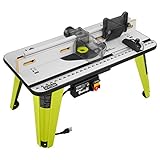
A benchtop design is the most adaptable option when the router table must share a workbench with other tools. Build the top from two layers of 3/4-inch plywood or medium-density fiberboard, then add a replaceable insert plate around the router collet. A finished top of about 24 x 18 inches is large enough for trim work, dados, rabbets, and small edge profiles without consuming permanent floor space.
The main limitation is workpiece support. A short table can feel unstable with long boards, especially when the fence is positioned near one edge. Add fold-out or clamp-on outfeed supports if you routinely work with pieces longer than about 36 inches. A benchtop table also needs a reliable method of securing it: bench dogs, toggle clamps, threaded inserts, or a pair of wide clamps are safer than relying on its weight alone.
What to include
- A 3/4-inch or thicker top with a hard, flat laminate or sealed surface.
- An insert plate at least 8 x 10 inches so the router can be removed without dismantling the table.
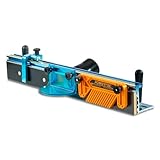
- A fence opening sized for the largest bit you intend to use, with replaceable MDF faces.
- Two featherboard mounting positions, preferably using T-track or threaded inserts.
- A dust port of approximately 2-1/2 inches, or a 2-1/2-inch port plus a larger cabinet port if the table is enclosed.
For occasional use, this design gives the lowest cost per square foot of workshop space. It is also easiest to repair: a worn top can be resurfaced or replaced without rebuilding the base.
Best compromise: a folding-leg router table
A folding table bridges the gap between a portable benchtop unit and a permanent cabinet. Its open dimensions should be close to 32 x 24 inches, with a working height of 34–36 inches. That gives enough support for typical cabinet rails, face frames, and trim while keeping the folded assembly narrow enough to stand beside a wall or behind a door.
Use rigid folding legs, not lightweight card-table hardware. The legs should lock positively in the open position, and the top should have diagonal bracing or a solid apron to prevent racking. Four locking casters are convenient, but they increase vibration unless the wheels lift clear of the floor or the table has adjustable leveling feet.
This is the strongest option for a shop where the router table is used once or twice a week but cannot remain in the center of the room. Add a lower shelf for the router, wrenches, inserts, and dust hose. Keeping those parts with the table reduces setup time and makes the folding design more practical than a bare tabletop stored in one place and its accessories in another.
Best for frequent use: a compact cabinet table
A cabinet table earns its extra floor space when routing is a regular part of your work. A 36 x 24-inch footprint is a useful small-workshop target: it provides a stable base, room for a dust port, and interior storage without becoming a second full-size workbench.
Build the cabinet from 3/4-inch plywood, with a doubled top or a top reinforced by an apron. Include a hinged front or rear access panel so the router can be adjusted and removed. A sealed cabinet improves dust collection, but it must still allow cooling air to reach the motor. Do not close every ventilation opening around a router that was designed for open-air use.
Use the cabinet interior for router bits, insert rings, collets, and the fence. Shelves are more useful than drawers if the cabinet is narrow, because a dust hose and power cord can remain connected. Locking casters are worthwhile only if the cabinet has leveling feet or a way to resist movement during cuts.
Decision matrix: match the build to your workshop
| Situation | Recommended build | Why | Prioritize |
|---|---|---|---|
| Under $100 and fewer than four routing sessions per month | Removable benchtop | Lowest material cost and simplest storage | Flat top, secure clamping, replaceable fence faces |
| Beginner with no dedicated floor space | Benchtop with clamp-on supports | Easy to inspect and modify as skills develop | Clear bit access and adjustable featherboards |
| One or two projects each week | Folding-leg table | Faster setup and better support without permanent occupation | Rigid legs, locking mechanism, lower shelf |
| Frequent cabinet or furniture work | Compact cabinet | Stable, quieter, and ready for dust collection | Storage, ventilation, leveling, fence adjustment |
| Long boards or sheet-goods edges | Cabinet with extensions | Greater support and resistance to tipping | Outfeed support, wide stance, auxiliary fence faces |
How much top and fence do you actually need?
Oversizing the table is a common mistake in a small workshop. For trim and joinery, a 24 x 18-inch top is usually adequate. Increase the width to 24 inches or more when the table must support wide panels. The fence should be at least 24 inches long for general work, although longer faces are helpful when straightening an edge.
A useful sizing calculation is to reserve at least half the table depth in front of the bit. If your workpiece is 12 inches wide and the bit is positioned near the centerline, a 24-inch-deep table leaves roughly 12 inches of support on each side. If the fence is offset toward the back, the front support area may be smaller, so measure from the bit opening rather than relying on the outside dimensions.
For a router with a 3-1/4-inch base, leave enough clearance beneath the top for the base, collet, and bit change. A practical under-table height is 8–10 inches. If the router is mounted to a lift or thick plate, measure the complete assembly before cutting the cabinet opening.
Build details that affect ownership
The top surface wears first around the insert opening and fence faces. Use replaceable hardboard or MDF fence faces rather than permanently gluing the fence to the table. Waxing a sealed wooden top reduces friction, while paste wax should be kept away from surfaces that will later receive finish unless they are cleaned thoroughly.
MDF makes a smooth, inexpensive top, but it swells quickly when exposed to moisture and can sag if unsupported. Plywood is tougher and holds screws better, though its surface should be sealed and flattened. A laminate-covered plywood top is a strong compromise for durability and low friction.
Dust is the second major ownership issue. Clean the router vents, insert plate, and cabinet interior regularly. Fine dust can restrict cooling and interfere with height adjustment. Check the fence hardware before each session; a fence that shifts during a cut can ruin a workpiece and create a dangerous kickback condition.
Common design mistakes to avoid
- Using a top thinner than 1-1/2 inches without a structural apron or underside reinforcement.
- Making the insert opening so large that small workpieces can drop into it.
- Installing a dust port that blocks router ventilation.
- Relying on a single knob to lock a long fence.
- Adding casters without a leveling or locking system.
- Leaving no access for collet changes, brush inspection, or router removal.
Final recommendation
Choose a 24 x 18-inch benchtop home-built router table when space and budget dominate the decision. Choose a 32 x 24-inch folding table when you need better support but must clear the floor after each project. Choose a 36 x 24-inch cabinet table when routing is frequent and integrated storage and dust collection will save setup time.
Whichever approach you build, spend more attention on flatness, fence rigidity, and safe access than on decorative cabinetry. Those three features determine whether the table remains useful after the first few projects—and whether it can be upgraded later with better inserts, featherboards, a lift, or a more precise fence.