Best T-Track Clamps for Jigs, Workbenches, and Router Tables
What's inside
As an Amazon Associate I earn from qualifying purchases. This post may contain affiliate links at no extra cost to you.
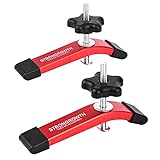
The best t track clamps for most shop setups are hold-down style clamps with a 3–4 inch reach that fit standard 3/8″ x 3/4″ T-track — but the right pick depends on your track profile, how much holding force you need, and whether you value speed over cost. This guide breaks down the decision criteria and matches specific clamp types to specific situations.
As an Amazon Associate we earn from qualifying purchases at no extra cost to you.



Contents
Track Compatibility Comes First
Nothing matters until your track clamp physically fits your track. Two dimensions control this:
- T-bolt head width: Most shop T-tracks (Incra, Kreg, generic extrusion) accept a 5/16″ or 3/8″ hex or T-bolt head. Some European and miter-gauge tracks use a narrower profile that requires a dedicated M8 or smaller head.
- Track depth: Shallow 1/2″ track needs short bolts so the stud clears the bolt head; deep 3/4″ extrusion gives you more thread engagement, which matters at high clamping force.
Universal clamps ship with interchangeable 5/16″ and 3/8″ bolts and sometimes a 1/4″-20 adapter. If you run mixed track across a workbench, drill press table, and router fence, universal-fit clamps for t track save you from buying three clamp sets.
Key Specs Compared
The table below compares the three dominant t-track clamp styles sold in 2026, using typical specs for mid-range products.
| Spec | Hold-Down Clamp | Inline/Push Clamp | Quick-Lever Clamp |
|---|---|---|---|
| Typical clamping force | 150–250 lbs | 200–400 lbs | 100–200 lbs |
| Clamp reach | 2.5–4.5 in | 2–3.5 in | 2–4 in |
| Height adjust range | 0–2.5 in | 0–1.5 in | Fixed or stepped |
| Set/reposition time | 5–10 sec (knob) | 3–6 sec | 1–2 sec (cam lever) |
| Material | Steel arm, nylon pad | Anodized aluminum body | Steel cam, plastic handle |
| Typical price range (each) | $12–$25 | $20–$40 | $15–$30 |
| Best use | Bench jigs, workholding | CNC spoilboards, fences | Fast repeat cuts, router tables |
Clamping Reach and Force: How Much You Actually Need
Reach is the horizontal distance from the track to the clamp foot. For 3/4″ plywood jigs on a workbench, a 3-inch reach handles most layouts. Wider sleds and crosscut platforms benefit from 4–4.5 inch reach so the track can sit near the edge of the fixture.
Holding force is where marketing inflates numbers. A few realities:
- Routing and sawing need restraint, not crushing. 150 lbs of downward force plus the friction of the clamp pad is enough to stop lateral creep on most cuts.
- CNC and drilling need more. Side loads from an end mill justify 300+ lb inline clamps or doubling up with two smaller ones.
- Thin stock needs spread, not force. On 1/4″ material, a wide rubber-padded foot at moderate force beats a narrow foot at high force — the latter dents or bows the workpiece.
Adjustment Speed for Repeatable Setups
If a track clamp takes 10 seconds to reset and you reposition 40 times in a batch-cutting session, that’s nearly 7 minutes of pure knob-turning. Quick-lever (cam) clamps cut repositioning to about 2 seconds — roughly 80 seconds for the same session — but sacrifice fine pressure control and typically max out at one or two clamping heights.
The practical rule: use knob-style hold-downs where pressure precision matters (finished surfaces, veneer, assembly jigs) and cam-style track clamps where cycle time matters (batch crosscutting, miter saw stations, production drilling).
Which Clamp for Which Situation
| Your situation | Recommended clamp | Why |
|---|---|---|
| Weekend hobbyist, one T-track workbench | Universal hold-down, 3″ reach, 2-pack | Cheap entry, fits any standard track, covers jigs and bench use |
| Batch cutting / production setup | Quick-lever cam clamps | Speed compounds over hundreds of repositioning cycles |
| CNC spoilboard or drill press | Inline/push clamps | Low profile clears toolpaths, high force resists side load |
| Router table fence work | Hold-down + cam pair | Hold-down locks the fence; cam clamps speed stock handling |
| Mixed 1/4″ and 3/8″ track in one shop | Clamp set with interchangeable bolts | One clamp t track kit serves every fixture |
Notable Options Worth a Look
Among established products, a few consistently stand out for fit and durability:
- POWERTEC universal T-track hold-downs — widely available, include multiple bolt sizes, good value per clamp for hobby setups.
- Kreg bench clamps and Automaxx-style clamps — auto-adjust mechanisms handle varying stock thickness without re-cranking, convenient on their own track systems and standard 3/8″ extrusions.
- Rockler hold-down clamps — solid build quality with generous reach options, well suited to jigs and sleds.
- Incra T-track clamps — designed around precision fixtures and miter sleds; a natural match if you already run Incra track.
At the budget end, generic aluminum hold-downs function fine for light duty, but check thread quality — rough bolt threads gall inside aluminum track after a few dozen uses.
Ownership Realities: What Wears and What Breaks
- Pads wear first. Rubber and nylon feet compress and split after a year or two of daily use. Clamps with replaceable pads last longer; otherwise keep spares.
- Sawdust kills cam mechanisms. Quick-lever clamps pack with fine MDF dust and lose their snap. Blow out the mechanism weekly and add a drop of dry lubricant monthly.
- Over-torquing bends arms. Steel arms rated at 250 lbs can be bent permanently by cranking the knob past spec — snug plus a quarter turn is usually enough.
- Common mistake: clamping too close to the track. Extending a track clamp to full reach multiplies leverage against the T-bolt and can pull heads out of MDF-mounted track. Keep the foot within 60–70% of maximum reach when possible.
Cost-Per-Use Check
A $20 hold-down clamp used in a weekly project shop (say, 40 sessions/year for 5 years) costs about $0.10 per session. The same clamp in a daily-use shop pays for itself in months. The takeaway: durability — steel arms, replaceable pads, quality threads — matters more than saving $5 per clamp if you use them often. Hobbyists cutting a few times a month can safely buy value-tier clamps; daily users should spend toward the $25–$40 range.
FAQ
Do all t track clamps fit all T-track?
No. Most clamps target the common 3/8″ x 3/4″ profile. Narrow 1/4″ track and some proprietary systems need matched bolt heads — verify the bolt size before buying.
How many clamps for t track do I need?
Two is the practical minimum for any jig. Four covers crosscut sleds and workbench fixtures comfortably. Buy in pairs — track clamps almost always work in opposition.
Can I clamp t track accessories to MDF-mounted track?
Yes, but moderate the force. T-bolts in epoxy- or screw-mounted MDF track pull out around 150–200 lbs of lift. For high-force workholding, mount track to plywood or hardwood.