Best Edge Sanders for Fast, Accurate Woodworking
What's inside
As an Amazon Associate I earn from qualifying purchases. This post may contain affiliate links at no extra cost to you.
The best edge sander for most small-to-mid-size shops in 2026 is a 6″ x 80″-89″ belt oscillating model with a tilting cast-iron table — it flushes solid wood edges, cleans up plywood layers without tear-out, and holds 90° reliably over years of use. Below, we break down what actually matters when comparing edge sanders, then match specific machines to different shops.
As an Amazon Associate we earn from qualifying purchases at no extra cost to you.


Contents
What an Edge Sander Actually Does Better
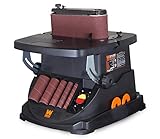
An edge sander is a horizontal belt sander with a long, narrow platen and a vertical work table. Compared to a random orbit sander or a belt sander dragged along by hand, it gives you a fixed reference: the table sets the angle, the platen keeps the belt flat, and the long belt dissipates heat so you can work an 8-foot glue-up edge without burning it or digging divots. If you joint, flush, or bevel edges more than occasionally, nothing else in the shop does it as fast or as repeatably.
Specs That Separate Good Machines from Frustrating Ones
Belt dimensions
Belt length determines heat management and abrasive life. Hobby machines run 4″ x 36″ (borrowed from combo bench sanders), serious benchtop models run 6″ x 48″ to 6″ x 89″, and floor machines go to 6″ x 132″. Longer belts run cooler per inch of contact and last proportionally longer — an 89″ belt on a Grizzly-style machine typically outlasts a 36″ belt three to four times before loading up.
Table adjustability
You want a table that tilts at least 45° down and ideally 10–15° up, locks at 90° with a positive stop, and slides toward/away from the platen to compensate for different belt positions. Cast-iron tables hold calibration far better than stamped steel. A miter gauge slot is a genuine time-saver for squaring frame parts.
Oscillation
Oscillating models move the belt side to side as it runs. This uses the full belt width, prevents grooves in one spot, and dramatically reduces heat streaks on end grain. On a 6″-wide belt, only using the middle inch is the single most common beginner mistake — oscillation fixes it automatically.
Dust collection
Sanding MDF and plywood edges generates very fine dust. Look for a 4″ dust port minimum, a shroud covering the platen and the return side of the belt, and realistic expectations: you need roughly 400+ CFM to capture most of it. Machines with 2.5″ ports clog constantly at the port.
Footprint and weight
Benchtop edge sanders typically weigh 60–120 lbs and need about 36″ of clear infeed/outfeed length. Floor models with stands run 200–400 lbs and want 8–10 feet of working room in front of the table. Weight matters — a light machine walks when you press a wide board into the platen.
Head-to-Head: Common 2026 Picks
| Model | Belt size | Motor | Table | Oscillating | Dust port | Weight | Typical price range |
|---|---|---|---|---|---|---|---|
| Grizzly G1183 / G0787 (benchtop) | 6″ x 48″ | 1 HP | Cast iron, tilts 0–45° | No | 4″ | ~95 lbs | $400–$600 |
| Grizzly G1531 (floor) | 6″ x 89″ | 1.5 HP | Cast iron, ±45°, graphite platen | Yes | 4″ | ~260 lbs | $1,100–$1,500 |
| JET OES-80CS | 6″ x 89″ | 1.5 HP | Cast iron, -10° to +45°, graphite platen | Yes | 4″ | ~300 lbs | $1,600–$2,000 |
| Powermatic OES9138 | 6″ x 89″ | 1.5 HP, TEFC | Cast iron, tilts both directions, graphite platen | Yes | 4″ | ~360 lbs | $2,000–$2,600 |
| Generic 4″ x 36″ bench combo sander | 4″ x 36″ | 1/3–1/2 HP | Stamped steel, limited tilt | No | 2.5″ | ~50 lbs | $150–$300 |
The Grizzly edge sander lineup covers the widest price spread — the G1183 is the entry point most hobbyists buy, while the G1531 is the value pick for serious work. The JET edge sander (OES-80CS) costs more but ships with a better-tuned oscillation mechanism and a heavier stand; the Powermatic adds a fully enclosed motor and the heaviest table in the class, which matters if you’re running it daily.
Decision Matrix: Which One Fits Your Shop
| Your situation | Recommended type | Why |
|---|---|---|
| Weekend hobbyist, flush edge banding and small boxes, garage shop | Benchtop edge sander, 6″ x 48″ (Grizzly G1183-class) | Stores under a bench, enough platen for parts under 4 feet, runs on 110V |
| Serious hobbyist / small side business, tabletops and casework | Oscillating floor model, 6″ x 89″ (Grizzly G1531-class) | Long belt handles 8-ft panels; oscillation extends belt life enough to pay for itself in abrasives |
| Production shop, daily use, solid wood doors and face frames | Powermatic OES9138 or JET OES-80CS | Heavier tables stay calibrated under constant use; TEFC motor survives dusty environments |
| Tight budget, occasional use only | 4″ x 36″ combo belt/disc sander | Not a true edge sander — short platen and weak dust collection — but handles small parts acceptably |
| Apartment or shared space, noise-sensitive | Skip it; use a track saw + block plane + random orbit sander | Edge sanders run 85–95 dB; the workflow above gets 90% of the result quietly |
Solid Wood vs. Plywood: What the Machine Actually Sees
On solid wood edges, the limiting factor is heat — end-grain-adjacent areas scorch at 120 grit and above if the belt isn’t oscillating or the graphite platen is worn. On plywood, the enemy is grain direction changes between plies: push too hard and you telegraph the alternating layers as a wavy surface. The fix is light passes and 150 grit minimum for veneer-core plywood; MDF-core is far more forgiving. This is where belt length pays off — an 89″ belt spreads the contact heat over twice the abrasive area of a 48″ belt, so plywood edges come off flat instead of cupped.
Ownership Realities
- What wears first: the graphite platen pad ($15–$40, expect replacement every 1–2 years of regular use) and the tracking adjustment mechanism, which drifts as vibration loosens it.
- Consumables: 6″ x 89″ belts run $8–$20 each; aluminum oxide for general work, zirconia or ceramic for heavy stock removal. Budget $100–$200/year at hobbyist volumes.
- Maintenance: blow out the belt housing monthly — packed dust is the main cause of tracking failure. Check table-to-belt squareness quarterly with a machinist’s square.
- Common mistakes: sanding only in the center of the belt, forcing stock (let the belt cut), and using worn belts that burnish instead of cut — a glazed belt generates more heat and worse results than a sharp one.
FAQ
Is a benchtop edge sander worth it over a belt/disc combo?
If your parts exceed about 30″, yes — the longer platen and cast-iron table keep long edges straight where a 36″ belt produces a subtle bow. For small parts only, the combo unit is adequate.
Can an edge sander replace a jointer for edge jointing?
For glue-ready edges under moderate pressure, many woodworkers use it that way successfully. But it removes less material per pass, so badly cupped or rough-sawn edges still belong on the jointer first.
What grit sequence works for edge finishing?
80 grit to flatten, 120 to refine, 150–180 as the final pass before finish on plywood; solid wood often needs only 120–150. Going above 180 on the edge sander risks burning, especially on end grain transitions.
Bottom line: buy the longest belt your space and budget allow, insist on oscillation if you sand daily, and spend the savings on abrasives — the machine is only as good as the belt on it.