12 Best Moisture Meters for Firewood (October 2026)
What's inside
As an Amazon Associate I earn from qualifying purchases. This post may contain affiliate links at no extra cost to you.
For most firewood users, a pin-type meter is the most practical choice because it measures the freshly split interior of a piece rather than only scanning its surface. The main target is wood at or below 20% moisture content, but consistent measuring technique matters as much as the meter itself. Split a sample, test the interior face, and compare several pieces instead of relying on one reading.
The models below cover the most useful formats: multi-species pin meters, simple alert-based meters, rechargeable designs, large-display options, replaceable-pin models, pinless scanners and a 2-in-1 pin and pinless option. Product specifications and intended uses vary, so select the tool that matches how you process and store firewood.
- Best overall: Mecurate Digital Pin Type Wood Moisture Meter — A broad 6% to 60% range, eight wood scales, three colored indicators, and a calibration-check cap make it versatile for mixed firewood.
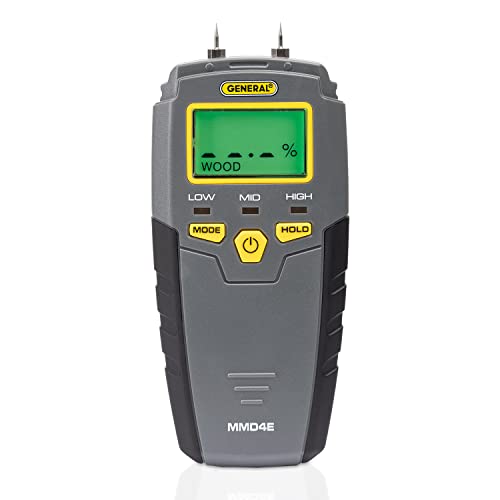
- Best known-brand option: General Tools MMD4E — Straightforward low, medium, and high alerts make it suitable for quick ready-or-not checks.
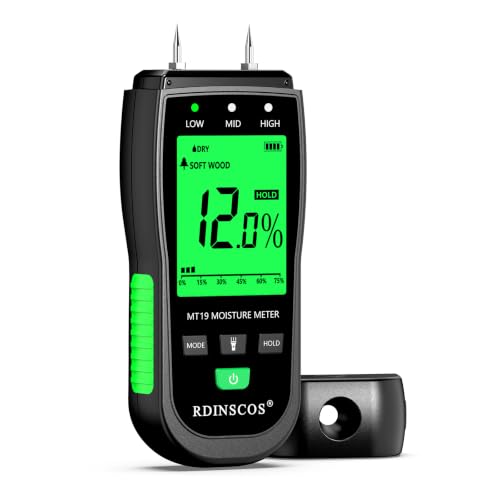
- Best rechargeable option: RDINSCOS Rechargeable Moisture Meter — A built-in rechargeable battery and USB-C charging avoid routine battery swaps.
- Best display: TopTes TS-630 — Its 2.25-inch LCD and tricolor backlight are useful when readings need to be seen quickly.
- Best replaceable-pin choice: RDINSCOS Replaceable Pins Moisture Meter — A pin design with replaceable pins suits users who want to maintain the contact points.
- Best pinless option: Klein Tools ET140 — It scans without making pin holes and detects moisture up to 3/4 inch deep.
Updated October 2026 – picks rechecked against current listings and manufacturer specifications.
What is the best wood moisture meter for firewood? A pin-type meter with species scales, such as the Mecurate Digital Pin Type Wood Moisture Meter, is the best wood moisture meter for firewood for most people because it reads the freshly split interior. The General Tools MMD4E is the simple pass/fail choice, and the Klein Tools ET140 or Wagner Orion 910 suit buyers who want pinless scanning.
Contents
Our Top Picks




How We Compared This Guide
This guide focuses on the job a firewood meter actually needs to perform: distinguishing wet, partially seasoned, and ready-to-burn wood. We compared the product descriptions and specifications available for each model, including measurement style, stated wood ranges, display features, power source, species settings, and depth limitations where those details were available.
We also considered common measurement issues associated with firewood meters. Pin meters require contact with the wood and are normally most useful on a freshly split face. Pinless meters avoid punctures but depend more heavily on suitable surface contact and stated scanning depth. Because the available product information is uneven between models, check the current listing and instruction manual for the exact scale names, included accessories, battery requirements, and operating limits before buying.
Firewood Moisture Meter Buying Guide
1. Choose Pin or Pinless Measurement
Pin meters use metal probes pressed into the wood. They are well suited to firewood because splitting a piece exposes the interior, where moisture readings are more useful than a reading taken only from weathered bark or a dry outer surface. The Mecurate, General Tools, RDINSCOS rechargeable, TopTes, and RDINSCOS replaceable-pin models use the pin format.
A pinless meter uses a scanning surface instead. The Klein Tools ET140 is the pinless choice in this group and is specified to detect moisture up to 3/4 inch deep. Its main advantage is speed without pin holes, particularly when sorting boards or finished surfaces. For firewood, however, the face being scanned should be reasonably flat and representative of the interior. A pinless reading taken on bark, a rounded split, or a very uneven surface may not answer the same question as a pin reading on a fresh split face.
2. Look for a Range That Covers Green and Seasoned Wood
A useful firewood meter should cover both very wet wood and the lower readings expected from seasoned fuel. The Mecurate is listed with a 6% to 60% wood range, while the General Tools MMD4E is listed from 5% to 50%. The available specifications for the other models use different descriptions, so confirm the full wood range rather than assuming that every meter has the same upper and lower limits.
A limited range can still be adequate for a simple burn-readiness check, but a broader range is more informative when tracking freshly split wood through the seasoning process. If the display reaches its maximum on green wood, the meter may tell you only that the piece is very wet—not how its moisture level changes over time.
3. Consider Wood Species Calibration
Wood species can affect electrical moisture readings. A meter with more than one wood scale can be useful when the firewood pile includes different species, provided the manual identifies which scale to use. The Mecurate lists eight calibrated wood scales, labeled A through H. That is an advantage for households burning a changing mixture of hardwoods and softwoods, but it adds a setup step.
Some users may prefer a simpler meter that does not require choosing among several scales. The trade-off is that a single general setting may be less appropriate for every species. Do not switch scales randomly to obtain a more favorable number; identify the correct setting from the meter’s instructions and use the same method when comparing pieces.
4. Understand the 20% Firewood Target
For ordinary firewood decisions, the practical question is whether the wood is at or below about 20% moisture content. This is a sorting target, not a promise that every reading will be identical. A piece can have different moisture levels near the bark, near the center, and across different ends.
Color bands and alerts can make this decision faster. The Mecurate uses a three-color indicator, and the General Tools MMD4E provides low, medium, and high alerts. These features are helpful when checking a stack quickly, but do not let an icon replace the number. A reading close to the target deserves more careful sampling than one taken from a single spot.
5. Measure the Correct Part of the Log
For the most useful firewood reading, split the piece and place the pins on the newly exposed interior face. Avoid relying on bark, an end grain surface alone, or wood that has been sitting in rain or snow. Surface conditions can distort the result and may not represent the moisture level inside the split.
Take readings from more than one piece in the load, especially when the stack contains different diameters, species, or storage locations. A single unusually dry or wet split is not a reliable description of the entire pile. Marking or separating questionable pieces can be more useful than treating every log as identical.
6. Use Consistent Pin Contact and Depth
Pin meters depend on firm electrical contact with the wood. Press both pins into the material at a consistent depth and keep the meter steady while the reading settles. Inconsistent pressure, shallow contact, or placing one pin in a crack can produce readings that are difficult to compare.
The General Tools MMD4E is listed with 0.3-inch stainless-steel pins. The RDINSCOS replaceable-pin model may appeal to users who want the option of replacing the contact points. Keep pins clean and protect them when the meter is stored. Never force the probes into knots or hard obstructions; choose another spot on the same split.
7. Match the Controls to Your Work Environment
Firewood is often checked outdoors, where low light, gloves, and cold conditions make a clear display valuable. The TopTes TS-630 has a 2.25-inch LCD and tricolor backlight. The Mecurate is listed with a large backlit display, while the General Tools model includes a backlit LCD and a hold function.
Automatic color indicators are convenient for rapid sorting, but a hold button can be useful when the display is difficult to view while holding a split. Before buying, check whether the controls can be operated with the gloves you normally wear and whether the display remains readable in your storage area.
8. Check Power, Verification, and Storage Features
Power design affects convenience more than measurement principle. The Mecurate uses two AAA batteries, the General Tools MMD4E uses a 9V battery, and the TopTes TS-630 uses three AAA batteries. The RDINSCOS rechargeable model uses a built-in battery and USB-C charging. A rechargeable meter can reduce disposable battery changes, but it needs to be charged before a long sorting session.
Calibration or self-check features are also worth considering. The Mecurate’s protective cap doubles as a self-check, and the General Tools model is listed with a cap that doubles as a calibration checker. Use those features according to the instructions, and store the meter protected from moisture. A meter is only useful when its readings are repeatable and the user applies the same measurement method each time.
Detailed product breakdowns
1. Mecurate Digital Pin Type Wood Moisture Meter
The Mecurate Digital Pin Type Wood Moisture Meter is the strongest all-around choice for firewood users who want more than a basic wet-or-dry indication. It is a pin-style meter designed for wood and building materials, with eight wood calibration scales, a backlit display and three colored indicators. Those features make it particularly suitable for checking split firewood at different stages of seasoning, especially when a woodpile contains several species.
For firewood, the important advantage is its stated wood-measurement range of 6% to 60%. That is broad enough to cover very dry fuel as well as wood that is still clearly too wet to burn efficiently. The meter uses two modes and eight wood scales, identified as A through H in the available product information. Buyers should consult the included instructions to match the selected scale with the species being measured. Choosing the closest available species group is important because pin meters estimate moisture from the electrical resistance between their probes, and wood species can affect that reading.
The three-color indicator provides a quick visual interpretation instead of requiring the user to study every decimal. The available specifications identify the wood indicator bands as low below 12%, medium from 12% to 15.9% and high at 16% or above. Those bands are useful for sorting, but they should not replace the normal firewood-checking method: split the piece, test the freshly exposed interior, and compare the numerical reading with the moisture target recommended for your stove or appliance. A high-band warning means the piece deserves further checking; it is not a substitute for testing several representative pieces.
The meter also has a backlit screen, a hold function and a protective cap that doubles as a self-check or calibration reference. The cap can be useful before a season of regular use because it gives the owner a way to confirm that the instrument is responding as expected. The available information also identifies an ambient-temperature display and two AAA batteries.
Strengths:
- Broad stated wood range of 6% to 60%.
- Eight wood scales are useful for owners who burn mixed species.
- Three colored indicators make quick sorting easier at the woodpile.
- Backlighting and a hold function support use in dim storage areas.
- The cap-based self-check provides an additional confidence check before relying on readings.
Trade-offs:
- The extra wood scales require the user to select the appropriate setting rather than simply switching the meter on.
- Pin depth, contact pressure and the location of the test can affect repeatability.
- The colored bands are broad categories, so buyers should still pay attention to the actual percentage shown.
- The stated power source is two AAA batteries, so buyers who prefer rechargeable tools will need to keep replacement batteries available.
Best for: Firewood burners who handle multiple species, want a wide reading range and value a fast color-coded indication alongside a numerical display.
Skip it if: You want a meter with no species-setting decisions, or if making probe marks in finished lumber is unacceptable. A pinless model is better for non-marking checks.
Check the Mecurate Digital Pin Type Wood Moisture Meter on Amazon
2. General Tools MMD4E Moisture Meter
The General Tools MMD4E is a straightforward pin moisture meter for wood, walls and water-leak detection. Its appeal for firewood is simplicity: it provides a numerical reading, low/medium/high alerts, a backlit LCD and a hold function without requiring the owner to manage a large number of operating modes. It is a practical choice for someone whose main question is whether a split is still wet enough to set aside.
The available specifications list a wood range of 5% to 50% and a resolution of 0.1%. The meter uses 0.3-inch, or 8-millimeter, stainless-steel pins, and spare pins are included. The available information describes a 9V battery as the power source. Buyers who expect to check large rounds or thick split faces should note the pin length: short probes may not reach far into a substantial piece, so the most useful comparison is generally made on the freshly split interior rather than through the bark or from the outside of a large round.
Low, medium and high visual and audible alerts make this model convenient when processing a pile. Instead of stopping to interpret every reading, the user can use the alert category to separate obviously wet wood from pieces that merit closer inspection. The hold feature is also useful when the display is difficult to see while the probes are pressed into a split. A cap that doubles as a calibration checker is listed among the features, giving owners a way to verify the meter before relying on it for seasonal decisions.
The principal limitation is that the available product information does not identify multiple wood species scales for this model. Buyers who regularly burn different hardwoods and softwoods should verify the manual’s calibration method and whether the displayed wood reading is intended as a general wood estimate rather than a species-specific correction. A meter can still be useful without multiple scales, but consistent testing matters more: use the same surface, test direction and probe placement when comparing pieces.
Strengths:
- Simple pin-based operation suited to routine firewood sorting.
- Stated wood range of 5% to 50% covers ordinary seasoning checks.
- Low, medium and high visual and audible alerts provide quick feedback.
- Backlit LCD and reading hold improve visibility in storage areas.
- Stainless-steel pins and included spare pins are useful for regular ownership.
- The cap serves as a calibration checker according to the available product information.
Trade-offs:
- The available data does not list multiple species-specific wood scales.
- The 0.3-inch pins may be limiting for thick pieces or owners who want to probe deeply.
- Pin meters leave small marks and require firm, consistent contact.
- The 9V battery format may be less convenient for buyers standardizing on rechargeable AA or AAA tools.
Best for: Wood burners who want a recognizable, uncomplicated meter with clear alert categories and do not need extensive species-selection controls.
Skip it if: You need a non-marking scanner, deeper material penetration or documented species-specific calibration for a varied hardwood collection. Verify those details before buying.
Check the General Tools MMD4E on Amazon
3. RDINSCOS Rechargeable Moisture Meter
The RDINSCOS Rechargeable Moisture Meter is aimed at buyers who prefer a built-in battery over disposable cells. It is a pin meter for wood, walls and hardwood, with the available product information identifying USB-C charging and separate softwood and hardwood modes. That combination makes it a potentially convenient option for repeated firewood checks, particularly when the meter is stored near a charging cable rather than in a toolbox with spare batteries.
The available specifications identify a softwood range extending to 56% and a hardwood range extending to 35%. Those different upper limits are important. A user testing green hardwood should select the hardwood mode and understand that the scale does not extend as high as the softwood setting. Buyers should check the manual for the exact operating procedure, species coverage and how the meter defines each mode before using it to compare different types of firewood.
Separate wood modes are more useful than a single generic setting when the owner knows which type of wood is being tested. They also introduce a possible source of error: selecting the wrong mode can make an otherwise careful reading misleading. The correct procedure is to identify the species or at least the wood category, split the piece to expose the interior, press the pins into the same general depth each time and record readings from several pieces rather than judging a pile from one sample.
Rechargeability is the model’s clearest convenience feature. USB-C is widely available, but buyers should verify whether a charging cable is included, how the meter indicates a low battery and whether the device can be used while charging. The available product information does not specify charge time, battery capacity, display size, pin length, accuracy or included accessories, so those details should be confirmed on the current listing or in the manufacturer’s documentation.
Strengths:
- Built-in rechargeable power avoids routine disposable-battery replacement.
- USB-C charging is convenient for owners who already use compatible cables.
- Separate softwood and hardwood modes acknowledge that wood types can produce different readings.
- The listed ranges extend to 56% for softwood and 35% for hardwood, providing useful coverage for seasoning checks.
- Pin-style testing focuses the reading on the surface selected by the user.
Trade-offs:
- The hardwood mode’s listed upper limit of 35% is lower than the softwood mode’s 56% limit.
- Using the correct mode is essential; a wrong setting can undermine comparisons.
- The available data does not specify accuracy, resolution, pin length or runtime.
- Rechargeable batteries eventually require charging and may be less convenient if the meter is stored away from a USB-C cable.
Best for: Firewood users who dislike changing batteries and mainly want a rechargeable pin meter with separate softwood and hardwood settings.
Skip it if: You need a wide, clearly documented range for very wet hardwood, species-by-species calibration or a tool that is ready immediately without checking its charge level.
Check the RDINSCOS Rechargeable Moisture Meter on Amazon
4. TopTes TS-630 Digital Moisture Meter
The TopTes TS-630 is a pin-style wood moisture meter distinguished by its large 2.25-inch LCD display and tricolor backlight. It is designed for checking firewood, drywall and other materials, so it can serve both as a fuel-seasoning tool and as a general household moisture detector. A large screen is especially helpful when the user is standing over a log, wearing gloves or working in a dim shed.
The available product information lists seven wood scales and a wood range reaching approximately 55% to 57%, depending on the selected scale. Buyers should verify the individual scale ranges and the species assignments in the current manual. The available data also notes that the mode labels may not correspond directly to every species a firewood owner encounters. That makes the meter more useful for comparing pieces consistently than for treating every displayed number as laboratory-grade moisture content.
The tricolor backlight gives an immediate indication of the general moisture condition. Color alerts can speed up sorting, but the owner should still examine the numerical reading and use a repeatable testing method. Firewood should be split before testing because bark and the outer surface can differ substantially from the interior. Test several pieces from different parts of the stack, especially when the pile contains wood split at different times.
The TS-630’s seven scales provide more flexibility than a single generic wood setting, but they also require some attention during setup. Users should identify the closest available wood category, document the selected setting and use the same setting when comparing pieces of the same species. If the listing does not clearly explain the scale assignments, buyers should review the manual or contact the seller before relying on the readings for a mixed-species pile.
The available data does not specify the battery type, accuracy, pin length, hold function or calibration-check procedure. Those are worthwhile details to verify because they affect ownership more than the color of the backlight. In particular, buyers who plan to use the meter on thick splits should confirm how far the pins extend and whether replacement pins are available.
Strengths:
- Large 2.25-inch LCD is easier to read than a compact display.
- Tricolor backlight supports quick wetness-level sorting.
- Seven wood scales offer more adjustment than a basic single-setting meter.
- Listed measurement coverage reaches approximately 55% to 57% depending on the scale.
- Suitable for firewood and household materials such as drywall according to the product description.
Trade-offs:
- The scale labels may not map neatly to every species, so the manual should be checked.
- The available data does not identify accuracy, battery type, probe length or calibration features.
- A large display does not eliminate the need for consistent probe depth and fresh-split testing.
- Color categories are convenient but should not be mistaken for a precise firewood-readiness standard.
Best for: Buyers who prioritize display readability and want several wood settings for routine firewood checks.
Skip it if: You want fully documented species calibration, a non-marking measurement method or a meter whose operating specifications are completely clear before purchase.
Check the TopTes TS-630 on Amazon
5. RDINSCOS Replaceable Pins Moisture Meter
The RDINSCOS Replaceable Pins Moisture Meter is a basic pin meter for buyers who want a simple way to check wood and the option to replace worn or damaged probes. Replaceable pins are a useful ownership feature for a tool that is repeatedly pressed into rough, split firewood. They can extend the practical life of the meter, provided replacement pins remain available and the user follows the manufacturer’s procedure for fitting them.
The product information identifies this model as a replaceable-pins moisture meter, but it does not provide a complete specification sheet in the available data. The wood range, accuracy, resolution, display type, battery format, calibration method, pin length and species settings should therefore be verified before purchase. The listing title indicates that the meter is intended for wood, but buyers should confirm whether it offers separate hardwood and softwood modes or a single general wood setting.
For firewood, a straightforward pin meter can be entirely adequate when used correctly. Split a sample to expose the interior, place the probes across the grain when the instructions recommend that orientation, push them to a consistent depth and test multiple pieces. The goal is not to produce a perfect number from one log; it is to identify patterns across the stack. Replaceable probes are especially relevant when the tool is used on bark-covered pieces, rough lumber or a large quantity of wood.
Because the available information is limited, buyers should pay close attention to what is included. Confirm whether spare pins are included or merely replaceable, whether the tool includes a protective cap, and whether the display gives a numerical percentage or only a category. Also check the maximum reading. A limited range may show that very wet wood has reached the top of the scale without distinguishing between freshly cut material and wood that has begun to dry.
Strengths:
- Replaceable pins are practical for repeated testing of rough firewood.
- Pin testing allows the owner to target the freshly split interior rather than relying on an exterior scan.
- The design is likely to suit buyers seeking a basic, dedicated wood-checking tool, subject to verification of the listing details.
- Replacement probes may reduce the need to discard the entire meter after pin damage.
Trade-offs:
- The available product information does not list the measurement range, accuracy or resolution.
- Battery type, pin length, display behavior and calibration features are also not specified here.
- Buyers must verify whether replacement pins are included, readily available and easy to install.
- Species modes and hardwood/softwood corrections are not confirmed by the listing.
Best for: Occasional or regular firewood users who want replaceable probes and are comfortable checking the complete specification before ordering.
Skip it if: You need documented accuracy, clearly identified species scales or a fully specified meter for making close decisions between nearly seasoned pieces.
Check the RDINSCOS Replaceable Pins Moisture Meter on Amazon
6. Klein Tools ET140 Pinless Moisture Meter
The Klein Tools ET140 is the non-marking option in this group. Unlike the pin meters, it uses a pinless sensor to detect moisture without driving probes into the wood. The available product information states that it detects up to 3/4 inch deep. That makes it attractive for quick scans, finished lumber and situations where leaving small probe marks is undesirable.
The listed wood ranges are 0% to 55% for softwood and 0% to 35% for hardwood. Buyers need to select the appropriate material category and should understand that the hardwood range ends lower than the softwood range. The available information also identifies accuracy of plus or minus 4%. That level of stated accuracy is useful context, but it does not mean every scan will be equally informative: surface condition, material thickness, contact with the wood and the location of the sensor can all affect a pinless reading.
A pinless meter is particularly useful for scanning the face of a board, checking a stack without making holes or quickly locating areas that may deserve closer inspection. For firewood, however, the method has an important limitation. The sensor reads to a specified depth from the surface, so it may not represent the moisture in the center of a thick split. A firewood owner should scan a freshly exposed, relatively flat face where possible and compare several pieces. Very irregular bark, gaps under the meter or a curved surface can reduce consistency.
The ET140’s major trade-off is therefore convenience versus targeted measurement. Pin meters make direct contact at two probe points and can be pressed into the fresh interior of a split. The pinless tool is faster and leaves no holes, but the owner must create suitable contact between the sensor and the wood. The available product information does not specify display size, battery type, hold function or whether the tool provides species-specific adjustment beyond the softwood and hardwood categories. Those details should be confirmed before purchase.
Strengths:
- Pinless operation does not leave probe marks in wood.
- Detects up to 3/4 inch deep according to the available product information.
- Listed softwood range of 0% to 55% covers many seasoning checks.
- Listed hardwood range of 0% to 35% supports routine hardwood screening.
- Useful for fast, non-destructive scanning of boards, stacks and relatively flat split faces.
Trade-offs:
- The tool may not represent moisture deeper than its stated detection depth in thick firewood.
- It needs good surface contact, which can be difficult on bark, curved faces and rough splits.
- The stated accuracy is plus or minus 4%, so close readings should not be treated as exact.
- The hardwood range tops out at 35%, lower than the softwood range.
- The available data does not specify display, battery, hold or detailed species-correction features.
Best for: Buyers who need rapid, non-marking scans and are willing to test flat exposed faces and several pieces from a stack.
Skip it if: Your main task is measuring the interior of thick, irregular splits or you want the most targeted possible probe contact. A pin meter may provide more useful information in those situations.
Check the Klein Tools ET140 on Amazon
7. Moisture Meter for Wood, Wood Moisture Meter Firewood Moisture Meter for Lumber
This moisture meter is marketed specifically for wood, firewood and lumber. That focus makes it relevant to wood burners who want a dedicated tool rather than a meter primarily presented for walls or general leak detection. However, the available product information does not provide a detailed feature list, so buyers should treat the product title as an indication of intended use rather than as proof of a particular range, accuracy or operating method.
The first detail to verify is whether the meter is pin-type or pinless. That distinction changes both the testing procedure and the kind of information the owner receives. A pin model can target the exposed interior of a freshly split log but leaves small marks. A pinless model is non-marking and quick, but its reading depends more heavily on surface contact and the depth reached by its sensor. The listing should also clarify whether the tool measures a numerical percentage or uses only wetness categories.
Buyers should next check the wood settings. Important questions include whether the meter supports separate hardwood and softwood modes, whether species groups are identified, and whether the range is high enough for freshly cut firewood. A narrow range can be adequate for checking seasoned pieces but less useful for tracking green wood as it dries. Also verify the stated accuracy and resolution, since a display with many decimal places does not necessarily provide equivalent real-world precision.
For any meter in this category, reliable firewood comparisons depend on technique. Test a freshly split face instead of bark, take readings from multiple logs and avoid basing the decision on the driest or wettest piece alone. If the tool has selectable modes, record the chosen setting with the reading. Buyers should also confirm the battery type, display visibility, automatic shutoff, protective cap, replacement pins if applicable and any calibration-check procedure.
Strengths:
- The product is expressly presented for wood, firewood and lumber.
- A dedicated wood meter may be simpler to operate than a multi-material detector, depending on the actual model configuration.
- It may suit buyers who want a basic tool for routine pile checks, subject to verification of the specifications.
- The intended application is closely aligned with measuring firewood and lumber rather than only detecting household leaks.
Trade-offs:
- The available data does not identify whether the meter is pin or pinless.
- Range, accuracy, resolution, battery type and display details are not provided.
- Wood-species modes and calibration procedures are not confirmed.
- Buyers cannot judge suitability for very wet or thick firewood without checking the current listing and manual.
Best for: Buyers looking for a wood-focused meter and willing to confirm the operating method and specifications before ordering.
Skip it if: You need a clearly documented range, accuracy figure, species calibration system or probe depth without doing additional product research.
Check the Moisture Meter for Wood and Firewood on Amazon
8. Klein Tools ET150 Pin Moisture Meter with Multi-Mode Detection
As an Amazon Associate we earn from qualifying purchases at no extra cost to you.

For buyers who want a trade-brand pin meter rather than a generic import. Klein Tools is better known for electrician and building-trade tools, and the ET150 is its pin-type model, sold alongside the pinless ET140 covered above.
- Pin-type measurement, so it reads a freshly split face directly
- Multi-mode detection for wood and building materials
- From the same maker as the ET140 pinless scanner
- Check the listing for exact range and battery type before ordering
Pros: reputable tool brand; pin design suits split logs; comfortable if you already own Klein tools. Cons: published firewood-specific guidance is thin, so follow the manual’s wood mode; fewer species scales than the Mecurate.
Skip it if you burn several species and want many calibrated wood scales.
9. LASELION 2-in-1 Pin & Pinless Moisture Meter MS03

For people who cannot decide between pin and pinless. The MS03 combines both methods in one body, so you can scan a surface quickly and then check the split interior with pins.
- 2-in-1 pin and pinless detection
- LCD display with hold function
- Built-in flashlight for dim wood sheds
- Auto power-off to save the battery
Pros: two measurement styles for roughly the price of a basic pin meter; flashlight helps in dark storage. Cons: from a lesser-known brand with limited documentation; use the pin mode for firewood, since pinless scanning on rounded splits is less reliable.
Skip it if you want a well-documented meter with clearly published species scales.
10. General Tools MMD7NP Pinless Digital Moisture Meter

For a second pinless option from the same maker as the MMD4E. The MMD7NP is described as non-invasive, so it leaves no holes in finished boards, which matters if you also work with lumber.
- Pinless, non-invasive scanning
- Digital display with humidity sensor, per the listing
- Same brand as the pin-type MMD4E
- Best on flat, dry surfaces
Pros: no probe marks; easy to scan lumber; known brand. Cons: pinless scanning struggles on bark and rounded splits; limited depth compared with pins on thick pieces.
Skip it if your goal is simple firewood sorting; a pin meter answers that question more directly.
11. AW Perkins Hearth Country Firewood Moisture Meter Kit
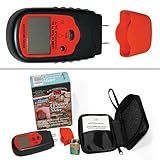
For wood burners who want a kit sold specifically for firewood and hearth use rather than a general building tool. The listing frames it as a firewood moisture meter kit, so it is aimed squarely at the woodpile.
- Sold as a firewood moisture meter kit
- Aimed at stove and fireplace users
- Review the listing for included accessories and battery requirements
Pros: purpose-built positioning for firewood; straightforward for beginners. Cons: little published technical detail, so confirm range and pin length before buying.
Skip it if you want multiple calibrated wood scales.
12. Wagner Orion 910 Pinless Wood Moisture Meter Kit

For anyone who treats moisture measurement as a professional job. Wagner Meters makes pinless meters for lumber work, and the Orion 910 is described as a deep-depth pinless model with on-site calibration. One review site picks it for firewood because pinless readings handle damp surfaces, but it costs far more than a pin meter.
- Pinless, deep-depth lumber measurement
- Non-damaging scanning with on-site calibration (standard calibrator)
- Kit format, premium tier
Pros: professional-grade, non-marking scanning; strong brand. Cons: the price is many times that of a pin meter, and for firewood a pin meter on a split face usually does the job.
Skip it if you only sort firewood a few times a year.
Moisture Meter Comparison
For firewood, the most important distinction is whether a meter uses pins or a pinless sensor. Pin meters contact the wood directly and are useful for checking a freshly split face, while pinless meters scan without leaving holes. Species settings, measurement range, display design, power source and depth are also worth considering. The table below includes the available information for the main products covered in the detailed breakdowns; confirm any missing specifications in the product listing before buying.
| Product | Best suited to | Meter type | Wood settings or range | Display or alerts | Power | Important consideration |
|---|---|---|---|---|---|---|
| Mecurate Digital Pin Type Wood Moisture Meter | Most wood burners | Pin; wood and building-material modes | 6% to 60%; eight wood scales | Backlit display; three-color indicator; hold function | 2 AAA batteries | Requires selecting the appropriate wood scale; cap includes a self-check |
| General Tools MMD4E | Simple ready-or-not checks | Pin; wood and building-material modes | 5% to 50% wood moisture equivalent; single wood scale | Backlit LCD; visual and audible low, medium and high alerts; hold function | 9V battery | Short 0.3-inch pins and no listed species correction |
| RDINSCOS Rechargeable Moisture Meter | Users who prefer rechargeable tools | Pin; wood, walls and hardwood modes | Softwood to 56%; hardwood to 35% | Check listing | Built-in rechargeable battery; USB-C charging | Hardwood mode has a lower listed maximum than softwood mode |
| TopTes TS-630 | Easy-to-read readings | Pin | Seven scales; up to approximately 55% to 57% | 2.25-inch LCD; tricolor backlight | 3 AAA batteries | Check the manual to match the meter’s mode labels with your firewood species |
| RDINSCOS Replaceable Pins Moisture Meter | Users wanting replaceable pins | Pin | Hardwood and softwood modes; range not fully listed | Check listing | 3 AAA batteries | Confirm the complete range, accuracy and included accessories before purchase |
| Klein Tools ET140 | Fast, non-marking sorting | Pinless | Softwood 0% to 55%; hardwood 0% to 35% | Check listing | 9V battery | Scans up to 3/4 inch deep; needs a reasonably flat surface and lists ±4% accuracy |
| Moisture Meter for Wood and Firewood | Buyers comparing basic firewood meters | Check listing | Check listing | Check listing | Check listing | Verify meter type, wood range, species modes and power source |
Best Pick by Need
Best overall for mixed firewood: Mecurate
The Mecurate is the most complete choice when a woodpile contains several species or when you want to follow wood from freshly split to ready to burn. Its listed 6% to 60% range covers a broad span, and its eight wood scales let you adjust the meter rather than treating every species alike. The three-color indicator and backlit screen also make the result easier to interpret in a shed or wood yard. The trade-off is that you must select the right scale and use consistent pin placement.
Best for simple pass/fail decisions: General Tools MMD4E
The General Tools MMD4E suits buyers who want a familiar pin-meter format with minimal interpretation. Its low, medium and high visual and audible alerts provide a quick indication while sorting splits. The hold function can help when the display is difficult to see at the exact moment of measurement. Its single wood scale is less flexible than the Mecurate’s multiple scales, and the short pins are better suited to surface checks than unusually thick splits.
Best rechargeable option: RDINSCOS Rechargeable
The rechargeable RDINSCOS is the logical choice for anyone who would rather charge a tool through USB-C than keep disposable batteries available. Its listed softwood and hardwood modes acknowledge that different wood types may require different settings. Check the hardwood range before buying if dense hardwood is your primary fuel, because the listed hardwood maximum is lower than the softwood maximum.
Best for a large, readable display: TopTes TS-630
The TopTes TS-630 stands out when screen visibility is a priority. Its 2.25-inch LCD and tricolor backlight are useful features for reading measurements while standing at a stack or working in changing light. It has seven scales and reaches approximately the mid-50-percent range, giving it enough listed range for many firewood checks. Read the instructions carefully before selecting a mode, since the mode labels may not correspond directly to the species names used in your woodpile.
Best for replaceable probe pins: RDINSCOS Replaceable Pins
A meter with replaceable pins can make sense for frequent users who expect the probes to receive hard use. This RDINSCOS model lists hardwood and softwood modes and is powered by three AAA batteries. However, the available information does not provide its complete range, accuracy or display details. Confirm those points, along with whether replacement pins are included, before choosing it over a more fully documented meter.
Best for no holes in the wood: Klein Tools ET140
The Klein Tools ET140 is the best match for quick, non-marking scans. Its pinless design can check wood without pressing metal probes into each split, and its listed scanning depth reaches up to 3/4 inch. The softwood and hardwood ranges are clearly identified, but the listed ±4% accuracy is less precise than the figures provided for some pin meters. Pinless scanning also works best when the sensor is placed against a reasonably flat surface, so irregular bark and curved rounds can make comparisons less straightforward.
Care and Setup Tips
Choose the right wood mode
If a meter offers separate hardwood, softwood or numbered species scales, use the setting that matches the wood being checked. Species selection matters because meters estimate moisture from electrical behavior, and different woods can produce different readings at similar moisture levels. When the manual does not clearly identify the correct mode, record the selected setting and use the same setting for comparisons rather than switching between modes.
Measure a freshly split face
Do not rely only on the outside of a split. Bark, weather exposure and surface drying can make the exterior differ from the interior. Split a representative piece and take readings on the newly exposed face. Check more than one piece from different parts of the stack, especially when the wood includes different species, sizes or storage conditions.
Keep pin depth consistent
Pin meters are most useful when the probes are inserted in a repeatable way. Press both pins into the wood to a similar depth and keep them aligned with the grain when the instructions call for that approach. Avoid comparing a shallow surface contact on one split with a deeper penetration on another.
Use several readings instead of one
A single split cannot represent an entire stack. Take readings from multiple pieces and consider the pattern. If most pieces are in the desired range but one is much higher, set that piece aside rather than judging the entire load from it. Consistent sampling is more informative than chasing a single unusually low or high number.
Check the meter before important measurements
Use the included cap, calibration checker or other verification feature if the meter includes one. The Mecurate and General Tools models described here include caps that double as a calibration check. Replace or recharge the power source when the display becomes unreliable, and check the product instructions for storage requirements.
Protect the probes and sensor
Keep pin tips clean and avoid forcing them into knots, stones or dirty surfaces. Replaceable pins are useful when probes become damaged, but they still need careful handling. For a pinless meter, keep the sensing area clean and place it flat against the wood whenever possible.
Interpret the number as a guide
Moisture meters are useful for sorting and comparing firewood, but the result depends on species, temperature, measurement location, pin depth and contact. A meter reading should support good seasoning and storage practices, not replace them. Keep wood covered from precipitation while allowing appropriate airflow, and use repeated readings to identify consistently dry pieces.
Frequently Asked Questions
What type of moisture meter is best for firewood?
A pin meter is a strong general choice because its probes contact the wood directly and can check a freshly split face. A pinless meter is preferable when avoiding holes matters or when many pieces must be scanned quickly. The better option depends on whether direct contact and species settings or speed and non-marking checks are more important to you.
What moisture reading should firewood reach?
Many firewood buyers use 20% as a practical target, but the reading should be interpreted consistently using the correct wood setting and a freshly split face. Do not judge a stack from one reading. Check several representative pieces and pay attention to whether the result is consistently near the target.
Should I measure the bark or the inside of a split?
Measure the inside of a freshly split piece when possible. The outside can dry faster than the center or be affected by rain and surface conditions. Interior readings generally provide a more useful picture of whether the split is ready to burn.
Are pinless meters accurate on irregular firewood?
Pinless meters work best against a reasonably flat surface. Bark, curves, gaps and uneven contact can affect the scan. The Klein Tools ET140 is listed for scanning up to 3/4 inch deep, but its surface requirements still matter when checking rough or rounded pieces.
Do I need a meter with multiple wood species settings?
Multiple settings are helpful if you burn different species or want more controlled comparisons. The Mecurate lists eight wood scales, while the TopTes lists seven. A single-scale meter can still be useful for consistent sorting, but you should confirm how its wood mode is intended to be used.
How many pieces should I check?
There is no single number that represents every stack. Check several pieces from different locations, sizes and species, with extra attention to the center of the pile and any wood that looks or feels different. The goal is to identify a consistent pattern rather than rely on one unusually dry or wet split.
Why do two meters show different readings?
Different meters may use different species scales, pin lengths, calibration assumptions and sensing methods. Readings can also change with pin depth, location, temperature and surface condition. For the most useful comparison, use the same piece, the same area and the correct setting for each meter, then focus on the general trend rather than expecting identical numbers.
Is a moisture meter also a water-leak detector?
Some products are designed for both wood and building materials, including walls, plaster or flooring. That does not mean every firewood meter can diagnose a leak. Check the listing for the materials and modes supported by the specific model before using it for walls or other construction materials.
Final Verdict
The Mecurate Digital Pin Type Wood Moisture Meter is the strongest all-around choice for firewood because the available specifications combine a broad 6% to 60% wood range, eight wood scales, a backlit display, a three-color indicator and a cap-based self-check. It is especially well suited to wood burners who handle more than one species and want a repeatable way to sort a stack.
Choose the General Tools MMD4E if straightforward low, medium and high alerts matter more than species flexibility. Choose the rechargeable RDINSCOS for USB-C charging, the TopTes TS-630 for its large display, the replaceable-pins RDINSCOS for probe serviceability, or the Klein Tools ET140 when you want fast, non-marking scans.
Whichever model you select, correct setup and sampling matter as much as the device itself. Use the appropriate wood mode, measure freshly split faces, keep contact consistent and compare several pieces. Those habits make a moisture meter a practical firewood-sorting tool rather than just another number on a display.
Is there a Milwaukee firewood moisture meter?
We did not find a Milwaukee model in current listings aimed at firewood. Milwaukee sells tools mainly for the building trades, so the closest trade-brand alternatives here are the Klein Tools ET150 pin meter and the ET140 pinless meter.
Which moisture meter works for hardwoods and softwoods?
Choose a meter with species or hardwood and softwood modes, such as the Mecurate with eight scales, the TopTes TS-630 with seven, or the RDINSCOS rechargeable. Select the closest setting before reading.
What do firewood moisture meter reviews say about cheap meters?
Budget pin meters are generally good enough to tell wet wood from seasoned wood. Their readings can vary between units, so check several pieces rather than trusting one number.