Best Band Saws for Resawing Boards into Thin Panels
What's inside
As an Amazon Associate I earn from qualifying purchases. This post may contain affiliate links at no extra cost to you.
Resawing is the band saw’s most useful job when you need thin panels, book-matched slabs, or veneer from boards too thick for a planer. It is also one of the hardest band saw operations. The blade must track straight, the frame must stay rigid under load, and the fence needs to support a board that may be 8, 10, or 12 inches tall.
The best saw is not necessarily the one with the largest throat or motor. For resawing, frame stiffness, usable cutting height, blade guides, and a good fence matter more than a long list of features. A cheaper saw can work well for occasional resawing, but it needs a careful setup and realistic limits.
As an Amazon Associate we earn from qualifying purchases at no extra cost to you.


Contents
What to look for in a resawing band saw
Start with cutting height. A saw rated for 6 inches of capacity is suitable for cutting narrow boards into two pieces, but it is not a serious veneer machine. For general furniture work, 10 to 12 inches of resaw height is a practical minimum. Larger saws with 14 to 16 inches of capacity are useful for thick slabs, although they take more floor space and cost considerably more.
Motor power is only part of the equation. A 1-1/2 hp saw is a sensible target for frequent resawing in hardwoods. A 1 hp machine can handle moderate boards if the blade is sharp and the feed rate is controlled. Smaller benchtop saws often have enough power for 4- to 6-inch boards, but they bog down when cutting dense material near their maximum height.
Look for a rigid welded or heavy cast frame, a table that locks without shifting, and blade guides that can be adjusted close to the work. Ceramic or bearing guides are both workable. The important issue is that they support the blade without rubbing unnecessarily or allowing it to twist.
A tall resaw fence is valuable, but the factory fence is not always the deciding factor. Many stock fences are too short, difficult to align, or prone to moving when pressure is applied. A straight auxiliary fence made from plywood or hardwood can improve a mediocre fence, provided the table and rail are rigid enough to support it.
For a closer look at suitable sizes, compare 14-inch resaw-capable band saws with smaller machines before deciding how often you will use the extra capacity.
Best band saw types for resawing
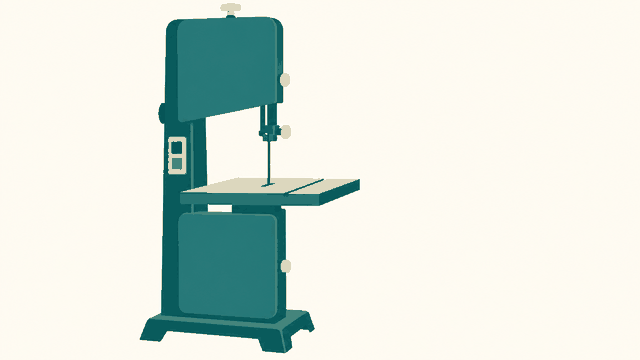
| Band saw type | Typical resaw capacity | Best use | Main compromise |
|---|---|---|---|
| Compact benchtop | 4 to 6 inches | Small boards, occasional work, limited shop space | Lower power, narrow tables, more vibration |
| 14-inch floor saw | 10 to 12 inches | Furniture parts, panels, regular hardwood resawing | May need a riser block or larger machine for thick stock |
| Heavy 14-inch saw with riser | 12 to 14 inches | Serious hobby use and wide boards | More setup sensitivity and reduced rigidity with some risers |
| 18-inch or larger floor saw | 14 to 16 inches or more | Slabs, veneer, production-style resawing | High price, large footprint, and greater electrical demands |
A 14-inch floor-standing saw is the best value for many woodworkers. It has enough capacity for most cabinet and furniture boards without the cost and bulk of an 18-inch machine. If your work mainly involves boards under 6 inches wide, the cheaper compact option is fine. Do not buy a large saw merely because its specification sheet looks impressive.
Blade width, tooth pattern, and fence choice
Blade selection has a bigger effect on resaw quality than a small difference in motor size. A 3/4-inch blade with a low tooth count—roughly 2 to 3 teeth per inch—is a strong general-purpose choice for boards up to about 10 inches. It clears sawdust efficiently and is less likely to clog than a fine-tooth blade.
A 1/2-inch blade is easier to tension on many mid-sized saws and can produce accurate cuts, especially in boards 6 inches or less. Wider blades resist wandering, but only if the saw can tension them properly. A wide blade on an underpowered or lightly built saw can perform worse than a narrower blade that the machine handles correctly.
Use a skip-tooth or hook-tooth resaw blade for softwood and most hardwood. A blade with too many teeth per inch creates fine dust, heats up, and may burn the cut. If the cut face will be glued or planed, a slightly rough surface is usually acceptable.
The fence should be tall enough to support the board and long enough to remain stable through the cut. Set it parallel to the blade only if the blade tracks parallel to the miter slot. Many band saws naturally cut with some drift, so align the fence to the blade’s actual cutting path rather than assuming the table slot is the reference.
How to set up the saw for a clean resaw
Install a sharp blade and tension it according to the manufacturer’s instructions, then check tracking with the saw unplugged. The blade should sit properly on the crown of the wheels, not ride against a flange. Set the upper guides just above the board—about 1/8 inch is close enough—to minimize exposed blade length.
Joint or plane one face and one edge of the board before cutting. A twisted board can force the blade sideways, pinch the kerf, or cause the workpiece to lift from the table. Mark the intended cut line on the top and front edge. Feed steadily, using both hands to keep the board against the fence while keeping fingers well away from the blade.
Do not force the feed rate when the motor slows. A practical starting point is a steady feed that produces continuous chips rather than powder and does not require heavy pushing. If the blade wanders, stop and diagnose the cause instead of steering aggressively. Common causes include a dull blade, insufficient tension, poor tracking, excessive feed pressure, or a board that is not flat.
Leave extra thickness when possible. If you need a finished panel measuring 1/4 inch, resaw it at roughly 5/16 inch and flatten it afterward. The blade kerf and minor waviness can easily consume 1/16 inch or more. For repeated veneer work, a tall band saw resaw fence is often a better upgrade than a more powerful motor.
Buying advice by budget and workload
For occasional resawing of small boards, choose a compact band saw with at least 4 inches of capacity, a usable table, and replacement blades that are easy to find. Expect slower cuts and more cleanup. This is the cheaper option that makes sense when resawing is an occasional task rather than the reason for buying the saw.
For regular furniture building, choose a rigid 14-inch floor saw with 1 to 1-1/2 hp, at least 10 inches of resaw height, a solid fence rail, and readily available 1/2- to 3/4-inch blades. This category offers the best balance of capacity, price, and shop space. A quality 14-inch floor-standing band saw is usually enough for boards used in cabinets, tables, and small casework.
Choose an 18-inch or larger machine when you routinely process thick slabs, need wide book-matched panels, or want to resaw for long periods without pushing the machine to its limit. These saws are worthwhile for demanding work, but they will not correct bad stock preparation or a poorly sharpened blade. For most home workshops, spending the difference on blades, dust collection, and a reliable fence produces more useful results.