Best Table Saws with Adjustable Scoring Blades for Veneered Panels
What's inside
As an Amazon Associate I earn from qualifying purchases. This post may contain affiliate links at no extra cost to you.
Contents
What Makes a Table Saw Suitable for Veneered Panels?
Veneered plywood, melamine-faced panels, and laminates are easy to cut badly. A standard table saw blade may leave a clean top surface but chip the veneer on the underside, especially when the panel is supported poorly or the blade is dull. A scoring blade solves that problem by making a shallow cut ahead of the main blade. It cuts the fragile surface fibers before the main blade reaches them.
The useful version is not simply a saw with a small second blade. For reliable results, the scoring blade needs independent height adjustment and lateral adjustment. Height controls how deeply it cuts; lateral adjustment centers its kerf with the main blade. Some machines also let you adjust the scoring blade while it is running, though most require the saw to be stopped.
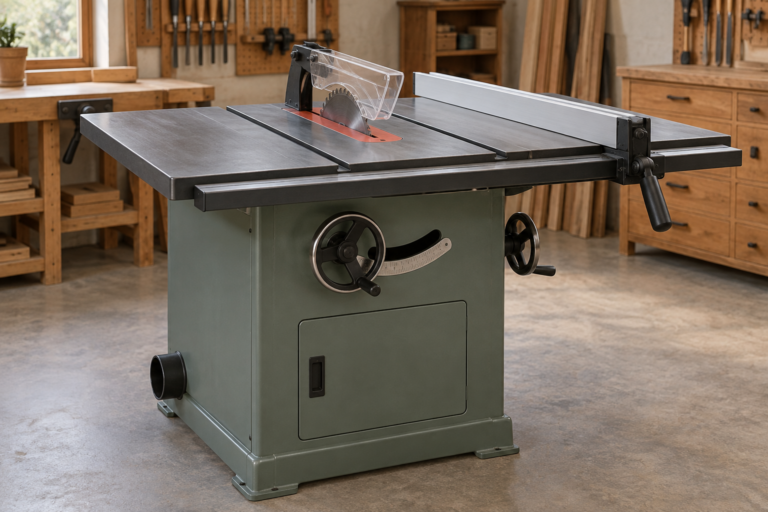
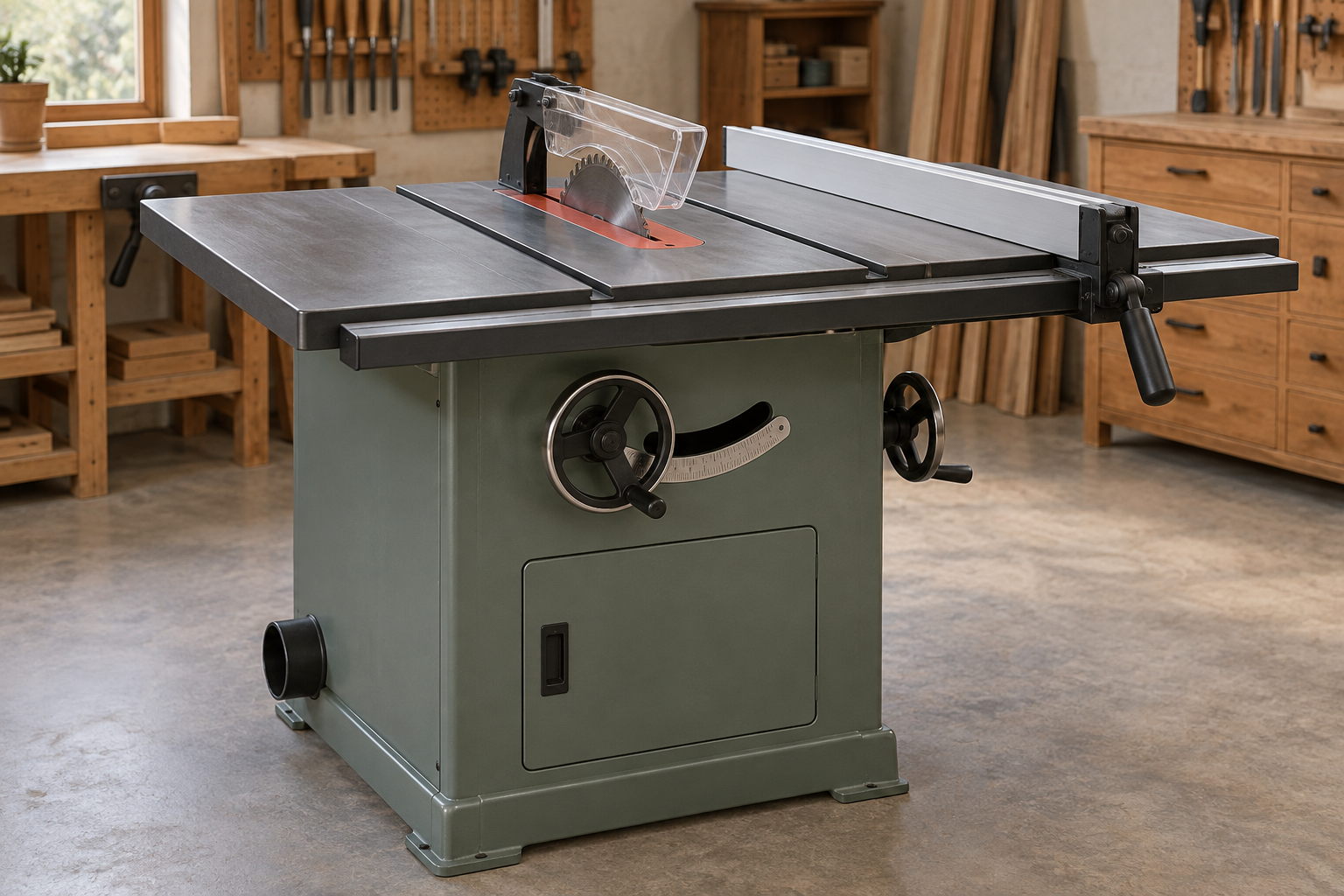
These machines are usually sliding table saws rather than conventional jobsite or contractor saws. The sliding table supports the full sheet and keeps the cut straight while the scoring unit handles the bottom face. For a cabinet shop processing plywood and melamine every week, a sliding table saw with a scoring blade is the right category to investigate.
Best Options by Workshop Type
| Workshop need | Best saw type | Why it works | Main compromise |
|---|---|---|---|
| Occasional veneered-panel work | Quality cabinet saw with appropriate blade and zero-clearance insert | Lower cost and smaller footprint | More setup, more handling, less consistent underside finish |
| Regular sheet-goods production | Sliding table saw with adjustable scoring unit | Clean cuts, supported panels, repeatable setup | Higher price and substantial floor space |
| High-volume cabinet work | Heavy sliding table saw with powered scoring and dust extraction | Fast production and stable alignment | Expensive, heavier, and often requires dedicated electrical service |
| Mixed solid wood and panel work | Sliding table saw with quick scoring disengagement | Handles both sheet goods and solid timber | More mechanisms to maintain and adjust |
A conventional cabinet saw can be perfectly adequate if you cut only a few panels. Use a high-quality 60- to 80-tooth plywood or melamine blade, keep the insert opening tight, and support the panel on both sides. For a small shop making one kitchen or furniture project at a time, spending several times more for a scoring saw may not pay back.
Scoring-Blade Adjustment Matters More Than Blade Count
The scoring blade should cut slightly deeper than the surface veneer but not so deep that it leaves a visible groove. A practical starting point is about 1 to 2 mm of scoring depth. On a 19 mm panel, that is enough to sever the bottom face without creating unnecessary resistance. Make a test cut in scrap because different materials and blades require different settings.
Lateral alignment is equally important. If the scoring kerf is wider than the main blade, the main blade should remove the scoring marks without leaving a step. If it is narrower or offset, a small ridge can remain on the finished edge. Adjustable scoring systems accept either a dedicated scoring blade or a two-piece blade set with shims. Two-piece systems are convenient because the kerf can be matched to the main blade, but they cost more and require careful cleaning and assembly.
Look for controls that are accessible and repeatable. A handwheel with a scale is preferable to an adjustment hidden inside the cabinet. The best machines let you disengage the scorer for solid wood cuts without removing it. Check the stated arbor diameter, maximum scoring-blade diameter, and available cutting depth; these vary considerably between machines.
Buying Factors That Affect Results
Sliding table size: A table that supports at least half of a 4-by-8-foot sheet is useful, but a longer travel and an outrigger support make full-sheet work safer. A small sliding table may be fine for cabinet parts already broken down with a track saw.
Fence accuracy: The rip fence must remain parallel to the blade and lock without movement. A scoring blade cannot compensate for a fence that drifts. For repeated parts, look for a fine-adjustment mechanism and a readable scale.
Dust collection: Veneer chips and melamine dust are fine and abrasive. A 4-inch port is common, but the port size alone means little if the lower cabinet leaks. Use a collector capable of roughly 800 to 1,200 cubic feet per minute at the machine, with short, unobstructed hose runs where possible.
Electrical requirements: Larger saws commonly use 220- to 240-volt power, and some need more than one circuit for the main motor and scorer. Confirm this before buying. An inexpensive saw that requires a new electrical run, forklift delivery, and assembly may not remain inexpensive.
Blade availability: Make sure replacement scoring blades are easy to obtain. A saw is less useful if its unusual scoring blade is expensive or perpetually out of stock. You can also compare melamine and scoring saw blades before choosing a machine.
How to Set Up a Clean Scoring Cut
Install a sharp main blade designed for the material, then align the scoring blade to its kerf. With the saw unplugged, rotate both blades by hand and verify that the teeth do not touch. Set the scorer about 1 mm deep, make a short test cut, and inspect the underside. Increase depth in small increments only if the veneer still chips.
Keep the scoring blade just proud enough to cut the surface. Too much height increases the chance of burning, noise, and a visible line on the finished edge. If the scoring blade is leaving a second step, adjust its lateral position or use a matching kerf set. Do not try to correct a misaligned scoring system by forcing the panel against the fence.
For buyers comparing machines, the industrial sliding table saw category is where adjustable scoring is most common. Choose the cheaper conventional saw when panel work is occasional and you have time for careful setup. Choose the scoring saw when chipped edges create rework, when full sheets are routine, or when repeatability matters more than purchase price.
Maintenance and Common Failures
Clean resin and dust from the scoring arbor, table tracks, and height mechanism regularly. A scoring blade packed with glue can run out of alignment even when it is sharp. Check the blade runout, fence parallelism, and sliding-table squareness at regular intervals. Typical failure modes include a scoring blade set too deep, a dull main blade pulling the veneer, and insufficient panel support causing vibration at the end of the cut.
Also inspect the riving knife and guards after changing blade sizes. The scoring system improves edge quality, but it does not replace safe feeding, proper dust extraction, or support for large panels. The most useful saw is the one that lets you make those adjustments quickly and repeatably.