Band Saw vs Planer for Processing Rough Curved Boards
What's inside
As an Amazon Associate I earn from qualifying purchases. This post may contain affiliate links at no extra cost to you.
Rough curved boards create two different problems: their outline is irregular, and their faces are usually twisted, cupped, or covered in uneven saw marks. A band saw and a planer address those problems in opposite ways. The band saw changes the board’s shape by cutting away material. The planer makes a supported face flat and brings the board to a consistent thickness.
For most projects, the best answer is not “band saw or planer.” It is using the band saw first when the board is too wide or uneven to support safely, then using a planer after one face has been made flat. If you can buy only one machine, the right choice depends on whether you need to preserve a natural edge or produce accurately sized stock.
As an Amazon Associate we earn from qualifying purchases at no extra cost to you.


Contents
What Each Machine Actually Does
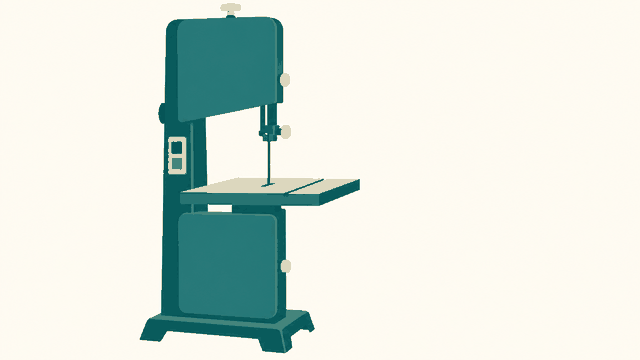
A band saw cuts along a line. With a suitable blade and a steady feed, it can remove a waste strip from a live edge, cut a curved profile, or resaw a thick board into thinner pieces. It does not make a face flat. A cut surface may show blade marks, and the board can still be twisted after the cut.
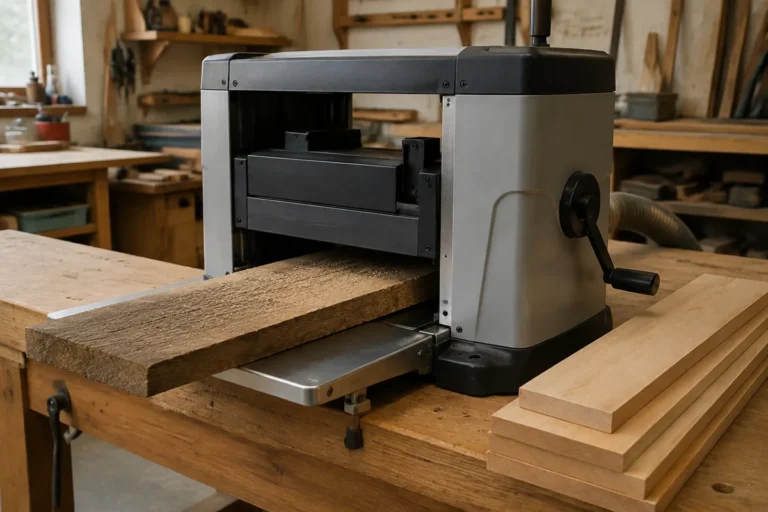
A planer cuts the top surface parallel to the surface riding on the bed. Once one face is truly flat, the planer can produce a parallel second face and repeatable thickness. It cannot correct a badly twisted board on its own: the cutter head follows the board’s existing position, so high spots are removed while low areas remain low. A short or unstable board can also rock as it enters the machine.
This distinction matters with curved boards. If “curved” means a naturally irregular edge but reasonably flat faces, plane the faces and leave the edge alone. If it means the entire board is bowed, twisted, or too wide to sit securely on the planer bed, flatten or divide it before planing.
When the Band Saw Is the Better First Machine
A band saw is the safer and more useful first step when you need to follow the board’s shape. It can trim a wandering edge, remove a bulging section, or split a 3-inch-thick slab into two thinner blanks. Compared with a table saw, it is much more forgiving of a nonstraight edge because the blade does not require a long, rigid fence reference.
Leave a small margin rather than cutting directly on the finished line. For rough stock, 1/8 to 1/4 inch of waste is practical. That leaves room for a jointer, planer, sanding, or hand-tool cleanup. Cutting exactly to the line often exposes tear-out or a drifted cut that cannot be corrected without making the board smaller.
Blade choice changes the result. A 3- to 4-teeth-per-inch hook-tooth blade removes rough stock quickly, while a narrower blade follows tighter curves. A wide blade tracks straighter for resawing, but it needs adequate tension and a saw with enough resaw capacity. Feed steadily without forcing the board; pushing harder than the blade can cut encourages drift, stalls, and overheated teeth.
The band saw is not automatically the cheaper solution. A useful floor model or large benchtop saw may cost more than a basic planer, and a poor saw with inadequate tension or a weak fence can make resawing frustrating. For cutting curved outlines and roughing slabs, however, a woodworking band saw offers capabilities a planer cannot replace.
When the Planer Is the Better Buy
Choose a planer first if your main goal is turning rough boards into shelves, cabinet parts, rails, or glue-up stock with consistent thickness. A planer is faster than hand planing and more predictable than sanding for removing saw marks. Many portable machines remove roughly 1/16 inch per pass comfortably, though taking 1/32 inch passes gives better control on difficult grain.
The board still needs a stable reference face. If it rocks, use a flat carrier sled, shim the board so it cannot move, and take light passes until one face is established. Once that face is flat, remove the sled and plane the opposite face. Do not send a severely twisted board through unsupported and expect the machine to fix it. It may produce a thinner board that is still twisted, or the board may shift and kick back at the infeed.
Planers also have predictable failure modes. Knives can leave snipe at the first and last few inches, especially if the board is not supported level with the bed. Grain reversal can cause tear-out, so feed difficult boards in the direction that produces the cleanest cut and reduce the depth of cut. Short boards are risky because they may not bridge the cutter head properly; check the manufacturer’s minimum length, commonly around 12 to 14 inches.
Band Saw vs. Planer
| Task | Band saw | Planer |
|---|---|---|
| Follow a natural curved edge | Excellent | Cannot do it |
| Make a face flat | No | Only with a stable flat reference or sled |
| Produce consistent thickness | No | Excellent after one face is flat |
| Resaw thick stock | Yes, within capacity | No |
| Remove rough-sawn marks | Leaves its own cut marks | Yes |
| Main risk with unstable stock | Blade drift or binding | Rocking, snipe, or kickback |
A Practical Workflow for Curved Rough Boards
Start by inspecting the board with winding sticks or a straightedge. Mark the usable outline, cracks, pith, and likely waste. If the board is wider than your planer or cannot sit flat, cut it into manageable pieces on the band saw first. Make the rough cuts with the board supported, keep your hands out of the blade path, and do not try to pivot a long board through a tight curve while the blade is buried in the cut.
Next, establish one flat face. A jointer is usually the fastest option for manageable boards, but a planer sled works when you do not own a jointer. Shim gaps with wedges or hot-melt-glued blocks, take shallow passes, and stop once the high points are removed across the board. Then plane the opposite face until it reaches the target thickness. Leave about 1/32 inch for a final pass if appearance matters.
Only after the faces are stable should you trim the final curved outline. This reduces wobble and makes the cut easier to control. If the board needs square edges for a glue-up, a jointer or table saw is more appropriate than trying to force a natural edge straight with a band saw.
Which Machine Should You Buy?
Buy a 13-inch wood planer if you mostly buy rough boards that are already close to straight and need thicknessed parts. It is the better value for furniture parts, repeated dimensions, and routine stock preparation. A basic portable planer is fine for occasional work if you can tolerate noise, dust collection demands, and some snipe.
Buy a band saw if your projects depend on live edges, curved components, resawing, or irregular slab shapes. If you mainly need occasional trimming, a smaller saw can be sufficient; if you expect to resaw boards thicker than 6 inches, pay attention to throat capacity, resaw height, motor power, blade guides, and tensioning rather than choosing on price alone.
If the budget allows both, the machines complement each other. The band saw handles shape and thickness reduction; the planer handles flatness and final sizing. If it does not, choose based on the operation you cannot perform with hand tools: a hand plane can flatten a few boards, but it cannot efficiently resaw a thick slab, while a band saw cannot substitute for repeatable thicknessing.