Table Saw vs Band Saw for Cutting Large Curved Panels
What's inside
As an Amazon Associate I earn from qualifying purchases. This post may contain affiliate links at no extra cost to you.
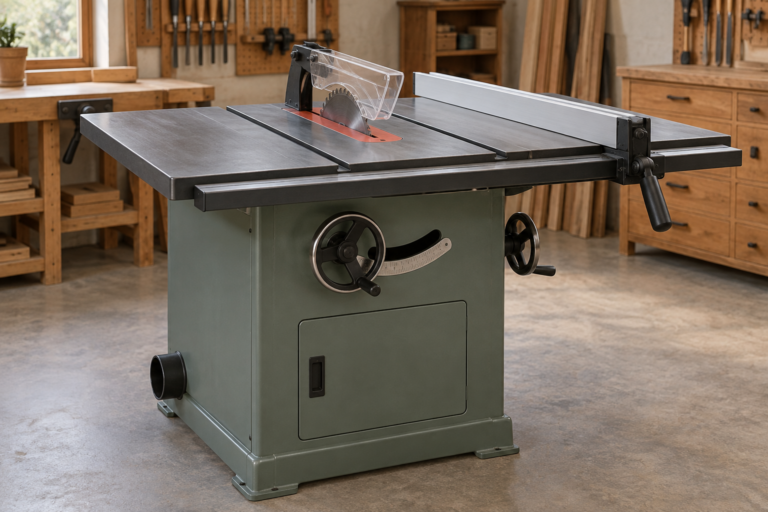
Large curved panels expose the basic difference between these machines: a table saw is built to guide stock past a straight, fixed blade, while a band saw is built to steer stock through a continuous blade. For cutting arcs, circles, and irregular profiles, the band saw is usually the practical choice. A table saw can still be useful for preparing the panel, making straight reference cuts, or cutting a curve with a suitable jig, but it is rarely the right primary machine for a large curved panel.
As an Amazon Associate we earn from qualifying purchases at no extra cost to you.


Contents
Which machine fits the cut?
A band saw handles a curved cut because the workpiece can rotate as it moves through the blade. The blade follows a line drawn on the panel, and the operator controls the feed direction. A table saw depends on the panel remaining against a fence or riding on a jig. That makes it excellent for straight cuts, but awkward and potentially dangerous for a freehand curve.
For a large tabletop edge, cabinet side, boat component, or architectural panel, start with a 14-inch woodworking band saw if curved cutting is a regular part of your work. A typical machine in this class offers roughly 12 to 14 inches of throat capacity and 6 inches or more of cutting height. Those numbers matter more than motor horsepower when the panel is wide and the curve has a deep belly.
| Factor | Table saw | Band saw |
|---|---|---|
| Best cut type | Long, straight, repeatable cuts | Curves, circles, irregular profiles |
| Large-panel handling | Excellent with adequate infeed and outfeed support | Limited by throat depth and table size |
| Curve accuracy | Good only with a dedicated jig | Good with a template, suitable blade, and steady feed |
| Edge quality | Very clean on straight cuts | Usually needs sanding or routing afterward |
| Main risk | Kickback or trapped work during improvised cuts | Blade drift, wandering cuts, and forcing the stock |
| Typical waste | Low on straight cuts | Depends on blade width and the accuracy of the layout |
Why large panels are difficult
The machine is only part of the problem. A 24-by-48-inch plywood panel is not especially thick, but it is large enough to catch on the table, rack during feeding, or run into the saw frame. If the curve approaches the edge of the band saw’s throat, the panel may not rotate far enough to follow the layout. On a table saw, a panel this size also needs stable support before and after the blade. Without it, the panel can lift, bind, or lever against the fence.
Measure the required curve before buying. A 12-inch throat does not provide a 12-inch radius in every practical setup; the panel must also clear the blade guides, frame, and operator’s hands. For very deep curves or oversized sheets, a jigsaw or handheld router may be more useful than either stationary saw. A band saw is not automatically the answer simply because the cut is curved.
Using a band saw for the curved panel
Make a full-size template from hardboard, MDF, or thin plywood. Transfer the curve to the workpiece, then mark the waste side clearly. If both sides of a panel must match, make one accurate master and use it to route or trace the second piece rather than relying on two freehand layouts.
Choose the blade for the tightest part of the curve. A 1/4-inch blade can follow a tighter radius than a 1/2-inch blade, but it removes material more slowly and is easier to deflect if pushed hard. A 3/8-inch blade is a useful compromise for many furniture curves. Use a narrower blade for tight curves and a wider blade for broad arcs where straight tracking matters more.
Set the upper guide just above the panel and check that the blade is properly tensioned and tracking. Feed at a steady rate without twisting the stock sideways. If the blade starts wandering, forcing the panel usually makes the cut worse. Back out only when the cut allows it; abruptly reversing a curved cut can kink or damage the blade. For thick material, make relief cuts into the waste area so the offcut does not pinch the blade as the curve closes in.
Expect a band-sawn edge to show tooth marks and possibly blade drift. Leave approximately 1/16 inch outside the finished line, then clean the edge with a flush-trim router, spindle sander, or sanding block. If the curve must be precise, the template-and-router method often produces a better final edge than trying to cut exactly on the line.
Where a table saw still works
A table saw is the cheaper option if the panel only needs straight cuts or if the curve will be cut with a separate tool. It is also useful for trimming a curved panel’s straight reference edges before routing. With a correctly built circle-cutting or pattern jig, a table saw can cut some arcs, but the setup must positively control the workpiece. Freehand steering a panel into a table-saw blade is not an acceptable substitute for a jig.
For a large panel, support it with an outfeed table, side supports, or a second person positioned well clear of the blade. Keep the fence out of the way when the cut or jig could trap the offcut. Never pull a panel backward through a spinning table-saw blade, and do not use a miter gauge and fence together unless the setup specifically prevents binding.
If your main work is cabinets, shelving, and sheet-goods breakdown, spend the money on a solid contractor table saw with a rolling stand and improve curve work with a router or jigsaw. That is often less expensive and more versatile than buying a band saw that is too small to accept the panels you actually cut.
Buying and workflow advice
Choose a band saw based on throat depth, table size, guide quality, and blade availability. A machine with 12 inches of throat and a 6-inch resaw height is more useful for furniture-sized curves than a compact benchtop saw with a powerful motor but limited working room. If panels exceed the table, add a level auxiliary support surface; it must not interfere with the blade guides or tilt adjustment.
For occasional curves, buy or use a corded woodworking jigsaw and finish against a template. For frequent curved panels, a band saw saves time and keeps the cut under better control. The table saw remains the better investment when most of your work is straight-line sheet processing. Match the machine to the dominant cut, not to the largest or most impressive specification.