Best Table Saws with Large Outfeed Support for Full Sheets
What's inside
As an Amazon Associate I earn from qualifying purchases. This post may contain affiliate links at no extra cost to you.
Breaking down a 4×8 sheet on a table saw is less about horsepower than support. A full sheet of 3/4-inch plywood weighs roughly 60 to 70 pounds, and even a lighter sheet can lever upward or sideways as it passes the blade. Without a long, flat outfeed surface, the cut can bind, the panel can fall, or the operator can lose control near the end of the cut.
The best setup combines a rigid table saw, a proper rip fence, and at least 4 feet of support behind the blade. For occasional sheet goods, a folding outfeed table may be enough. For a shop that regularly processes cabinets, doors, or furniture panels, a cabinet saw with a large fixed outfeed table is the safer and more productive choice.
Contents
What Makes a Good Full-Sheet Outfeed Setup
A useful outfeed surface should extend at least 36 inches behind the blade; 48 to 60 inches is more comfortable for a full 96-inch panel. It should be level with, or up to 1/32 inch lower than, the saw table. If it is higher, the workpiece can catch on the edge. If it is much lower, the sheet drops and may pivot into the blade.
Width matters too. A narrow stand may support the center of a board but leave a plywood corner hanging. Aim for a surface at least 24 inches wide, preferably the full width of the saw. Roller stands can help, but they are not a complete substitute for a flat table. Rollers can turn slightly, collect dust, or let a large sheet drift during a rip.
For repeated full-sheet work, consider a table saw outfeed table or build one from a torsion box. Locking casters are useful if the table must move, but the casters should lift completely off the floor when locked. Any rocking at the end of a cut transfers directly into the panel and can spoil a straight edge.
Best Saw Types for Large Outfeed Support
| Saw type | Typical outfeed solution | Best use | Main limitation |
|---|---|---|---|
| Cabinet table saw | Fixed 36- to 60-inch table or custom extension | Frequent full sheets and furniture work | Expensive, heavy, and needs dedicated floor space |
| Hybrid table saw | Fold-down or shop-built outfeed table | Serious home shops and intermittent sheet work | Less mass and usually less table area than a cabinet saw |
| Contractor-style saw | Folding rear extension or portable outfeed stand | Small shops and occasional plywood cuts | Can move or vibrate under a large panel |
| Benchtop saw | Separate support table or workbench | Light repairs and limited ripping | Small table, short fence, and poor full-sheet control |
Cabinet Saws for Production-Style Sheet Work
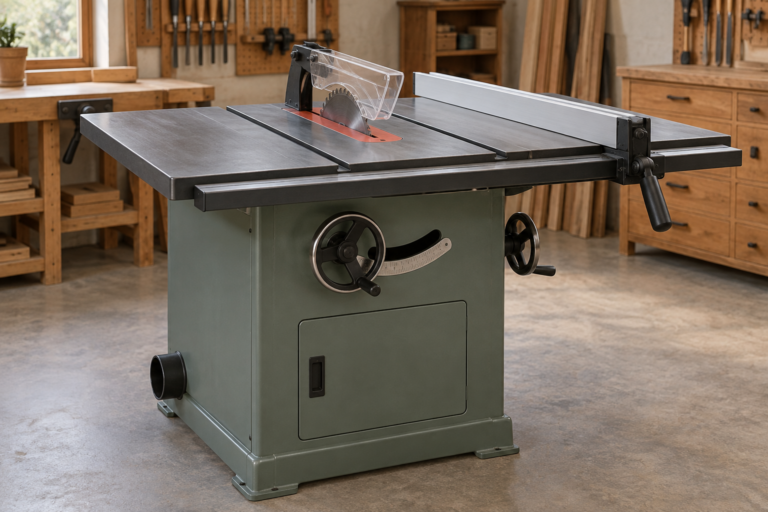
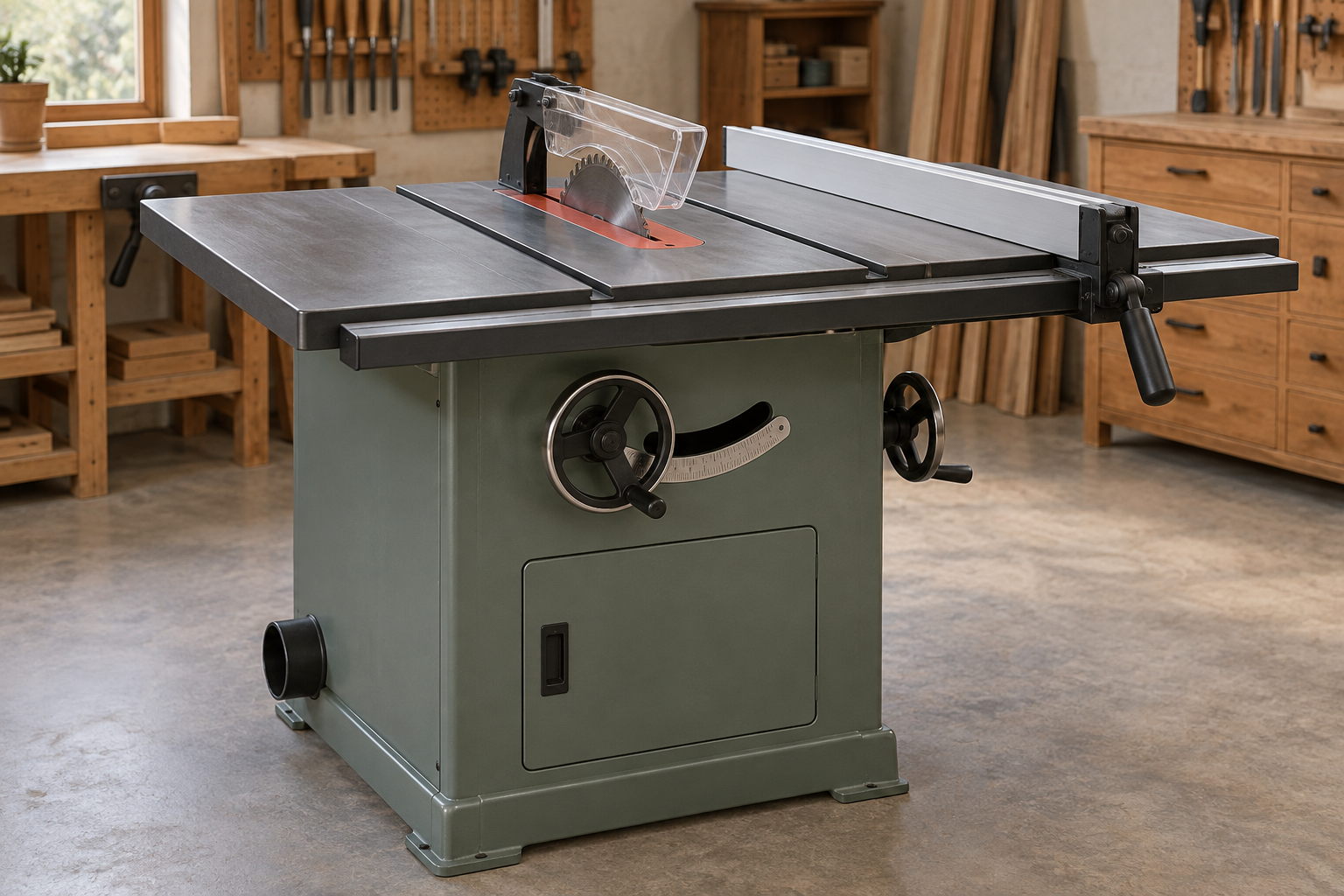
A cabinet saw is the strongest choice when the outfeed table will stay installed. Its heavy cast-iron top and enclosed base resist movement as a sheet is pushed through. Most have 3-hp motors and 10-inch blades, which provide enough capacity for thick hardwood and plywood without the saw bogging down during a long rip.
Look for a 50-inch rip fence system if you routinely cut full panels. The extra capacity refers to the distance to the right of the blade, not the outfeed length, but a long rail often gives you room to integrate a side table or assembly surface. Make sure the fence locks firmly at both ends. A fence that deflects 1/16 inch can create a tapered panel or pinch the offcut.
Cabinet saws are expensive, and the cheaper option is fine if you only break down a few sheets per month. In that case, use a track saw for the initial crosscut and rough rip, then use the table saw for accurate edge cuts. This prevents you from wrestling a 4×8 panel through a machine designed mainly for smaller stock.
For shops choosing this category, compare 3-hp cabinet table saws with 50-inch fences. Pay attention to dust collection, riving-knife adjustment, and whether the extension table is genuinely rigid rather than a thin sheet-metal shelf.
Hybrid Saws and Shop-Built Outfeed Tables
A hybrid saw is often the best value for a home woodworking shop. It has more mass and a better dust enclosure than a portable saw, while using a standard 120-volt circuit in many cases. A 1-1/2 to 2-hp motor is adequate for plywood, hardwood boards, and most cabinet work, although a deep rip in dense 8/4 stock will require a slower feed rate.
The usual compromise is the included outfeed support. It may be short, narrow, or slightly flexible. Replacing it with a 48-inch-deep torsion-box table can transform the saw. Leave access to the motor and blade-height controls, and keep the table removable if you need to tilt the blade or service the machine.
A practical homemade table uses two layers of 3/4-inch plywood with a grid of internal ribs. Add a replaceable hardboard skin so glue and scratches do not damage the main surface. Check it with a straightedge across the saw table and extension wing. A 1/16-inch step is enough to catch a thin panel, especially at the start or end of a cut.
Portable and Contractor Saw Options
A contractor-style saw can handle full sheets if the support is designed around it. Use a wide, folding table behind the saw and a separate side support on the left of the blade. The saw must be clamped or locked in position; otherwise, the panel can push the machine backward as the cut progresses.
This category makes sense when storage space or budget is tight. A portable table saw with an outfeed stand costs far less than a cabinet saw and can be adequate for occasional plywood. Expect more vibration, a smaller rip fence, and less convenient adjustment. Do not rely on a folding stand’s small rollers alone for a 96-inch sheet.
Safe Method for Cutting Full Sheets
Whenever possible, cut a full sheet into manageable pieces with a track saw, circular saw, or panel saw before making precision cuts at the table saw. Support the sheet on a sacrificial grid made from foam insulation or evenly spaced strips. This reduces both handling risk and the chance of damaging the finished face.
For a table-saw rip, set the fence carefully, confirm that the riving knife is aligned with the blade, and use a push stick or push block before your hands approach the blade. Keep the offcut from contacting the fence if it can close against the blade. Never stand directly behind the cut line; stand slightly to the side in case the panel kicks back.
Also check the complete path before switching on the saw. A wall, tool cabinet, or parked vehicle only 2 feet behind the outfeed table can force you to stop while the sheet is still partly supported. The right saw is important, but a clear 12-foot path, level support, and controlled feeding matter just as much.