How to Select Jointer Table Length for Long Furniture Boards
What's inside
As an Amazon Associate I earn from qualifying purchases. This post may contain affiliate links at no extra cost to you.
Contents
Why Table Length Matters
A jointer flattens one face and squares one edge, but it can only do that accurately when the board stays supported before and after the cutterhead. On a long furniture board, the table length is often more important than motor horsepower.
If the board is longer than the jointer’s usable support, its weight can pull the workpiece down or allow it to rise as you push. That changes the angle of the cut. The usual result is a board that looks flat near the middle but has a hollow, taper, or unwanted dip toward one or both ends.
For furniture work, think of the jointer as a reference-making machine, not a stock-removal machine. A longer table gives you a more stable reference during that first pass.
How to Measure Jointer Capacity
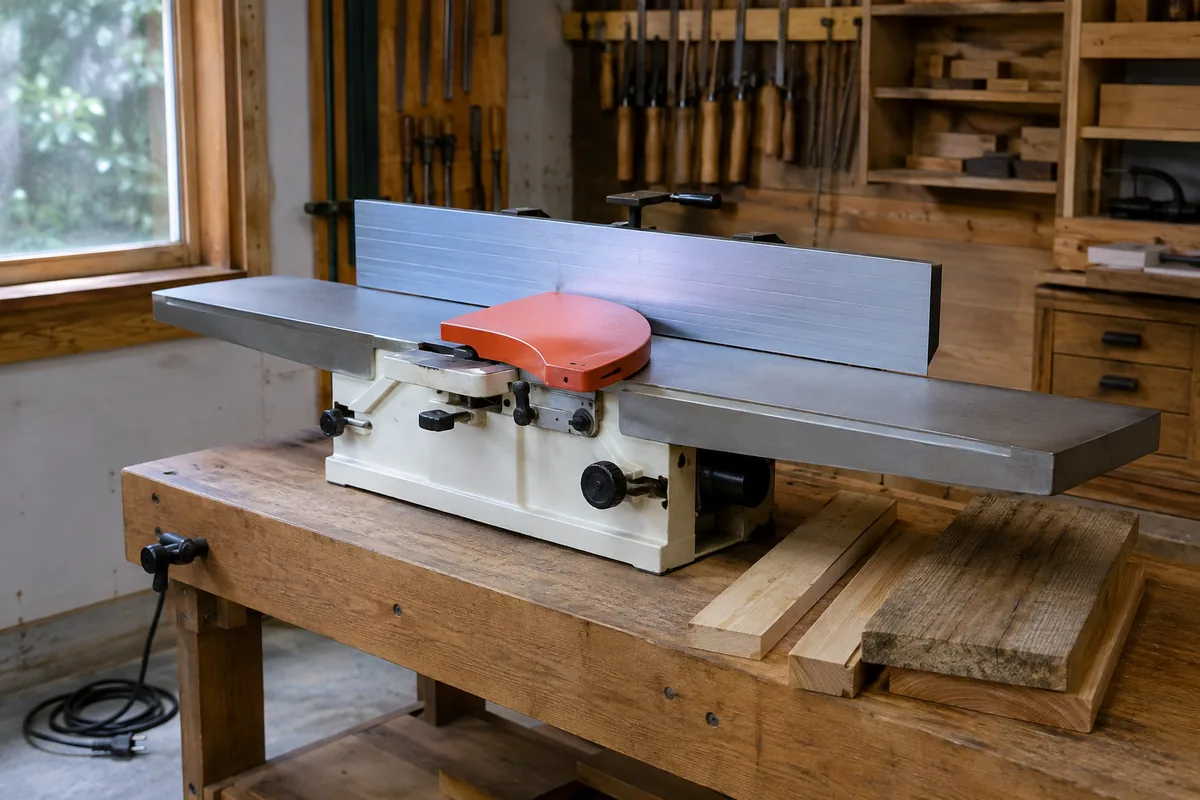
Jointer specifications normally list the total table length, but that number can be misleading. On a typical machine, the tables are divided into an infeed table and an outfeed table. The cutterhead occupies the gap between them. The usable support length is the combined surface area that contacts the board, not simply the overall footprint of the machine.
For example, a jointer advertised with 72 inches of table length might have approximately 30 inches of infeed and 42 inches of outfeed table. That is a useful amount of support, but it does not mean a 72-inch board is automatically easy to joint. Once the board extends well beyond the table, your hands and body position become part of the support system.
Measure the boards you actually buy, including the longest rough stock you expect to process. A 60-inch dining-table apron is a different problem from an 8-foot tabletop component. Also allow for cupping and bowing: a warped board makes less contact with the tables than a straight board of the same length.
Practical Length Guidelines
These are useful buying guidelines for reasonably straight hardwood boards. They assume careful technique and proper table alignment.
| Board length | Reasonable jointer table length | What to expect |
|---|---|---|
| Up to 4 feet | 36 to 48 inches | Most benchtop and compact floor jointers are manageable |
| 4 to 6 feet | 48 to 60 inches | Good general-purpose range for furniture parts |
| 6 to 8 feet | 60 to 72 inches | More stable, with less dependence on auxiliary support |
| Over 8 feet | 72 inches or more | Requires infeed and outfeed support, even on a long jointer |
These figures are not hard limits. A skilled woodworker can joint a 10-foot board on a 48-inch machine, but the setup must compensate for the short tables. Conversely, a careless operator can produce a bad edge on a 72-inch jointer.
Choose by the Longest Repeatable Part
Do not size the machine only for the occasional longest board. Base the decision on the longest parts you will joint regularly. If most of your cabinet rails and legs are 30 to 48 inches long, a 48-inch jointer may be the sensible purchase. If you frequently build dining tables, beds, or long shelving, the extra table length is easier to justify.
A 6-inch floor jointer with long tables is often a good middle ground for a small furniture shop. It offers more support than many benchtop machines without taking up the space or cost of a full 8-inch industrial jointer.
Remember that width and length solve different problems. A 6-inch jointer can flatten a narrow board very well, but it cannot flatten a 10-inch-wide tabletop panel in one pass. You can glue narrower boards into a panel and flatten the assembly with a planer or router sled, but that is a separate workflow.
Common Problems With Short Tables
The most common failure is a concave face. The operator presses down on the board’s leading end while it is on the infeed table, then presses down on the trailing end after it reaches the outfeed table. Those forces can keep the board from following its natural curve and remove more material from the ends.
Another failure is a tapered edge. If the board is allowed to rotate slightly as it crosses the cutterhead, the edge may be square at one end and noticeably out of square at the other. This becomes obvious when two long boards are placed edge to edge: they touch at one end but open into a wedge-shaped gap.
Short tables also make twisted boards difficult. A twist means that all four corners do not lie in one plane. The jointer can establish a flat face, but only if the operator prevents the high corners from rocking. Excessive pressure can force the board down temporarily, allowing the twist to return after the cut.
Supporting Long Boards Correctly
For boards longer than your table, use adjustable roller stands or dedicated infeed and outfeed supports. Set them slightly below the table surface—just enough that they catch the board without lifting it off the cast-iron tables. If a support is too high, it can change the cut angle and cause the same taper you were trying to avoid.
Roller stands are inexpensive, and they are often a better upgrade than replacing a serviceable jointer. A pair of adjustable woodworking roller stands can support long stock on either side of the machine. Ball-bearing supports or wide-top stands are preferable to narrow rollers when handling rough, twisted boards because they are less likely to snag an edge.
Support should be aligned with the jointer table, not merely placed near it. Check the setup with a straightedge before making a valuable cut. Keep the supports far enough from the cutterhead that your hands will never need to reach over an exposed section.
When a Shorter or Cheaper Jointer Is Fine
A benchtop jointer can be perfectly adequate for short cabinet parts, drawer components, small boxes, and furniture made from pre-cut stock. Its shorter tables and lighter construction become limitations mainly when boards are long, heavy, or badly warped.
A benchtop jointer is also a reasonable choice when storage and budget matter more than throughput. You can break down long boards first, use careful support, and flatten wide panels with another method. The trade-off is more setup time and a smaller margin for error.
If you regularly process 6- to 8-foot hardwood, a heavier floor-standing jointer with tables around 60 to 72 inches is usually the better investment. It will not eliminate the need for support, but it makes a consistent cut easier, especially on dense stock.
Check Alignment Before Blaming Length
Long tables cannot compensate for poor alignment. The outfeed table must be level with the cutterhead at the correct height, and the infeed table must lower evenly. A warped or misaligned fence can also create an edge that is not square.
Before shopping for a larger machine, verify that your current jointer is properly tuned and that your cutting technique is consistent. If you still cannot flatten your normal furniture parts without visible taper, then additional table length—or properly adjusted support—addresses the actual problem.