Best Planers with Low-Snipe Feed Systems
What's inside
As an Amazon Associate I earn from qualifying purchases. This post may contain affiliate links at no extra cost to you.
Contents
Best Planers with Low-Snipe Feed Systems
Surface planer snipe is the shallow dip or step cut into the first and last few inches of a board. It happens when the board lifts or drops as it enters or leaves the cutterhead, allowing the knives to remove more material at the ends. Most portable planers produce some snipe unless the operator supports the stock carefully.
The best low-snipe systems combine rigid infeed and outfeed tables, pressure rollers, a cutterhead lock, and enough bed length to keep the board flat. A helical or segmented cutterhead improves cut quality and noise, but it does not automatically eliminate snipe. Feed geometry and setup matter more.
Best choices at a glance
| Planer type | Low-snipe strengths | Main trade-off | Best for |
|---|---|---|---|
| Portable two-speed planer | Good tables, strong rollers, cutterhead lock on better models | Still needs careful stock support | Most home workshops |
| Benchtop helical planer | Smoother feeding and quieter cutting; some include locking heads | Higher cost and slower knife changes | Furniture parts and figured wood |
| Heavy cast-iron planer | Long bed and rigid pressure system reduce board movement | Expensive, heavy, and usually stationary | Frequent milling of long stock |
Best portable design for controlling snipe
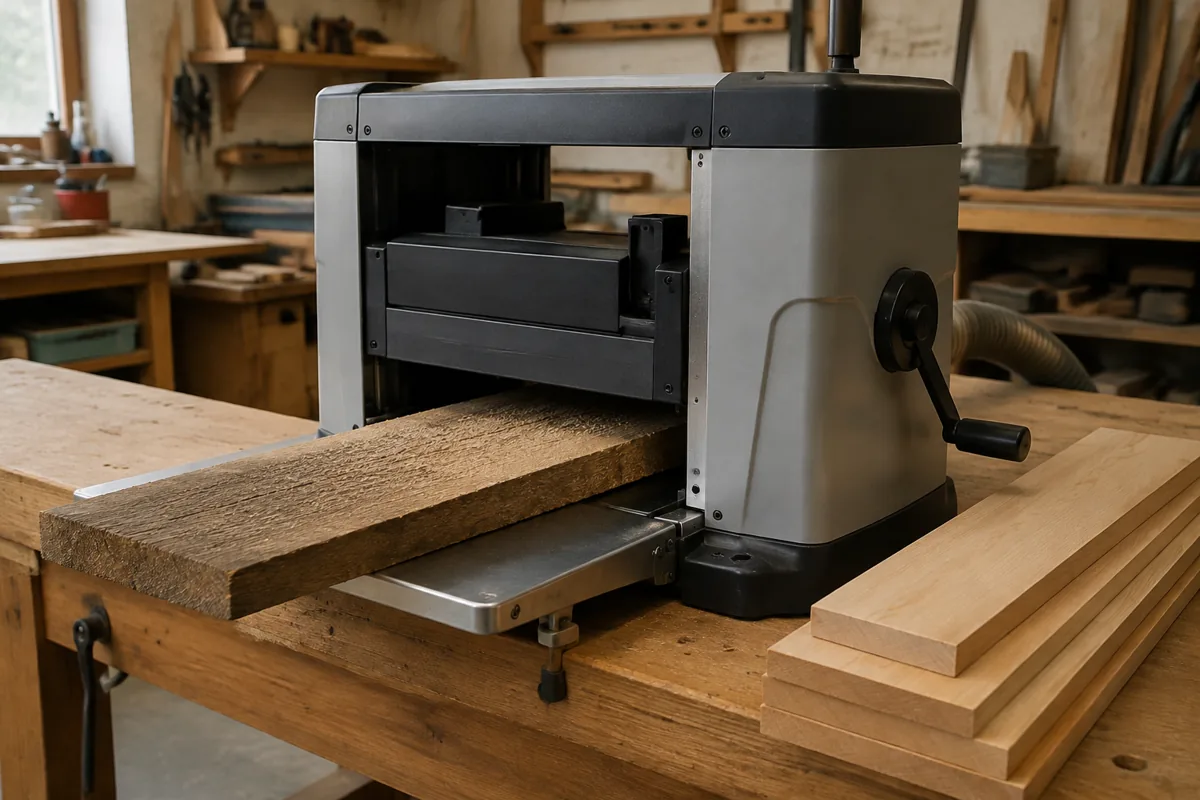
A two-knife or three-knife portable planer with long folding tables is usually the practical choice. Look for tables that extend at least 8 to 12 inches beyond the bed, a cutterhead lock, and adjustment screws that let you align the tables precisely. A machine with two feed speeds is useful: the faster setting removes material quickly, while the slower setting improves the finish on the final pass.
The DeWalt DW735 remains a strong example of this layout. Its four-column design, two feed speeds, and automatic cutterhead lock make it predictable for general work. It is not snipe-proof, and the disposable knives are a recurring cost, but it handles common hardwood and softwood stock well. A suitable portable thickness planer with cutterhead lock is the feature set to shop for, rather than a particular paint color or claimed “anti-snipe” label.
For boards longer than 4 feet, add roller stands or an outfeed support table. Set the support slightly below the planer bed, then raise it gradually until the board stays level without being pushed upward. Support that is too high can force the board into the cutterhead and create a different, often worse, snipe pattern.
When a helical or segmented cutterhead is worth paying for
Helical and segmented cutterheads use many small carbide inserts instead of long disposable knives. They reduce cutting noise, handle reversing grain better, and make small damaged areas easy to repair by rotating an insert. They also tend to cut with less shock, which helps the board stay stable under the feed rollers.
That benefit should not be confused with a dedicated anti-snipe mechanism. A poorly aligned table on a premium helical planer can still produce snipe. The cutterhead is worth considering when you work with figured maple, walnut, or other grain that tears out easily, or when the planer runs near occupied living space.
Models in the benchtop helical category often cost substantially more than knife-head machines. For occasional pine, construction lumber, or boards that will be trimmed to length afterward, the cheaper knife-head option is usually fine. Compare benchtop helical cutterhead planers by bed length, cutterhead lock, insert availability, and dust collection—not just the number of carbide cutters.
When a stationary planer makes sense
A cast-iron stationary planer has a longer, heavier bed and more rigid feed components than a portable machine. That mass reduces vibration and makes it easier to keep long boards flat. Some machines also use segmented pressure rollers, which maintain contact across boards with minor thickness changes.
The trade-off is size and cost. A stationary planer may weigh several hundred pounds, require a dedicated circuit, and need a dust collector capable of moving roughly 800 to 1,200 cubic feet per minute. It is a poor fit if you store tools in a garage and only mill a few boards each month. For a production shop or repeated work on 6- to 10-foot stock, the longer bed can justify the expense.
Setup steps that reduce snipe on any planer
Start with a flat, straight board. A twisted board can rock on the bed and imitate snipe even when the machine is adjusted correctly. Keep the first pass light—about 1/32 inch—and take heavier cuts only after the board has a stable reference face.
Align the infeed and outfeed tables with the planer bed. Place a straightedge across the bed and table surfaces; gaps or raised table ends should be corrected before testing. Feed the board with firm, level pressure until the first roller grips it. On exit, keep pressure on the board until the trailing end clears the last roller. Do not lift the board by its leading edge.
If the machine has a cutterhead lock, engage it after setting the thickness. The lock prevents the head from creeping upward during a cut, which can cause inconsistent thickness and contribute to end marks. Also leave 2 to 4 inches of sacrificial length on valuable boards, then crosscut the affected ends after planing.
Buying checklist
Prioritize a cutterhead lock, rigid four-column lift, long support tables, replaceable feed rollers, and readily available knives or inserts. Check the maximum width—12-1/2 inches is common for portable machines—and the minimum stock thickness, often around 1/8 inch but dependent on the machine and safe feeding.
Dust collection is not optional. Chips packed around the rollers can mark the board and interfere with feeding. A planer roller stand and outfeed support is often a better low-snipe investment than upgrading from a decent knife head to an expensive cutterhead. Spend first on accurate setup and reliable support; buy the helical version when its quieter, lower-tear-out cutting will save real time.