Best Jointers for Milling Reclaimed Lumber
What's inside
As an Amazon Associate I earn from qualifying purchases. This post may contain affiliate links at no extra cost to you.
Contents
What reclaimed lumber demands
Reclaimed boards can hide nails, grit, paint, and old glue beneath a clean-looking surface. A jointer’s job is to make one face flat and one edge square; it is not a safe way to remove embedded metal or a substitute for inspecting the stock. A nail can chip knives or carbide inserts, while grit dulls edges quickly. Check both faces and edges with a metal detector, then remove fasteners and loose dirt before milling.
Board shape matters, too. A jointer can flatten a board with a gentle bow or cup, but it cannot safely correct every twist, and a short bed can be frustrating with long, warped stock. Start with boards that are wider and longer than the finished pieces, but not so unstable or twisted that they rock on the tables. For severely twisted lumber, a planer sled or other flattening setup may be needed before a thickness planer can produce a parallel face.
As an Amazon Associate we earn from qualifying purchases at no extra cost to you.



Choosing a jointer
For occasional furniture parts, a 6-inch benchtop jointer is the least expensive, space-saving option. Its narrow capacity limits the face width you can flatten, and short infeed and outfeed tables offer less support for long boards. It can still be a sensible buy if your reclaimed stock is mostly narrow and you have a sturdy bench, careful work habits, and time to take light passes.
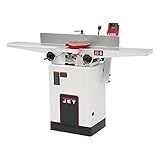
A 6-inch floor-standing jointer usually has longer tables and a heavier base, making it easier to control boards and maintain a steady cut. A 8-inch machine handles wider boards and often has longer tables, but costs more and takes up more space. For a small shop milling mostly trim, cabinet parts, or narrow boards, the wider capacity may not pay for itself. For wide tabletop stock, it can save time, though a 8-inch jointer will not flatten a board wider than its cutterhead in one pass.
Compare the 6-inch benchtop jointers with 6-inch floor-standing jointers by table length, fence rigidity, dust collection, and cutterhead type—not just motor horsepower. A straight-knife cutterhead is common and keeps initial cost down, but knives need careful setting and can leave scallop marks. A helical or spiral-style head with replaceable carbide inserts costs more up front; individual inserts can be rotated or replaced when damaged, which is useful when processing uncertain reclaimed stock. Neither type makes metal-contaminated lumber safe to cut.
Which type fits the job?
| Jointer type | Best fit | Main trade-off |
|---|---|---|
| 6-inch benchtop | Narrow boards, light use, limited floor space | Short tables and limited face width |
| 6-inch floor-standing | Regular small-shop use and longer boards | More space and cost than a benchtop model |
| 8-inch floor-standing | Wider stock and frequent furniture work | Higher purchase price, weight, and space needs |
Before buying, check whether the machine can be connected to the dust collector you actually own. Jointers make a lot of chips, and clogged ports or poor collection can turn a milling session into cleanup. Also check that the fence adjusts square and locks without shifting. A fence that moves when locked can leave a beveled edge even when the cutterhead tables are aligned.
Prepare before cutting
Measure the stock and mark defects. Use a metal detector on the full board, including the edges; old nails can be cut short and hidden below the surface. Remove loose paint and dirt with a scraper or brush, and avoid milling wood with embedded grit that you cannot remove. If the board has unknown coatings, take appropriate precautions against dust exposure and use effective extraction and respiratory protection.
Set the jointer for shallow cuts. Around 1/32 inch per pass is a reasonable starting point for rough reclaimed lumber; take less if the wood is hard, unstable, or the machine strains. Do not try to remove a deep cup in one pass. That wastes usable thickness and increases the chance of tear-out or a poor finish. Keep hands on the board’s safe areas, use push blocks where appropriate, and follow the machine manual for minimum stock dimensions and guard use. Never joint end grain on a standard jointer.
A reliable milling sequence
Choose the face that rocks least and place it on the infeed table. Feed with the grain where possible; against-the-grain cuts can tear fibers, especially on figured or weathered wood. Take repeated passes until the board has a continuous flat face, checking for gaps under a straightedge. Then place that face against the fence and joint one edge square to it. Use that flat face and straight edge as references at the planer and table saw.
Keep pressure over the infeed table before the cutterhead and shift it to the outfeed table after the board’s leading end has passed over the knives. Pressing down hard on a bowed board can flatten it temporarily; the board springs back after cutting and remains out of flat. Use steady feed pressure instead. If a board is twisted enough that it will not sit securely, stop rather than forcing it across the cutterhead.
When a jointer is not enough
A jointer creates a flat reference face, but a thickness planer is usually needed to make the opposite face parallel. A table saw can rip the jointed edge straight, but it cannot flatten a twisted face by itself. If your lumber is too wide for the jointer, a router sled can be a practical alternative for occasional wide panels, though it is slower and requires a flat, stable setup. Buying a wider jointer makes sense when wide stock is routine—not merely because a rare board might exceed a 6-inch capacity.
For most reclaimed-wood shops, the best choice is the machine that matches the usual board width, offers enough table support, and can be serviced with available knives or inserts. A benchtop unit is fine for narrow stock and occasional use; spending more for a longer-table floor model is worthwhile when board control and regular production matter. Set aside budget and time for inspection, sharpening, and dust collection: those determine how smoothly reclaimed lumber moves through the shop as much as the jointer itself does.