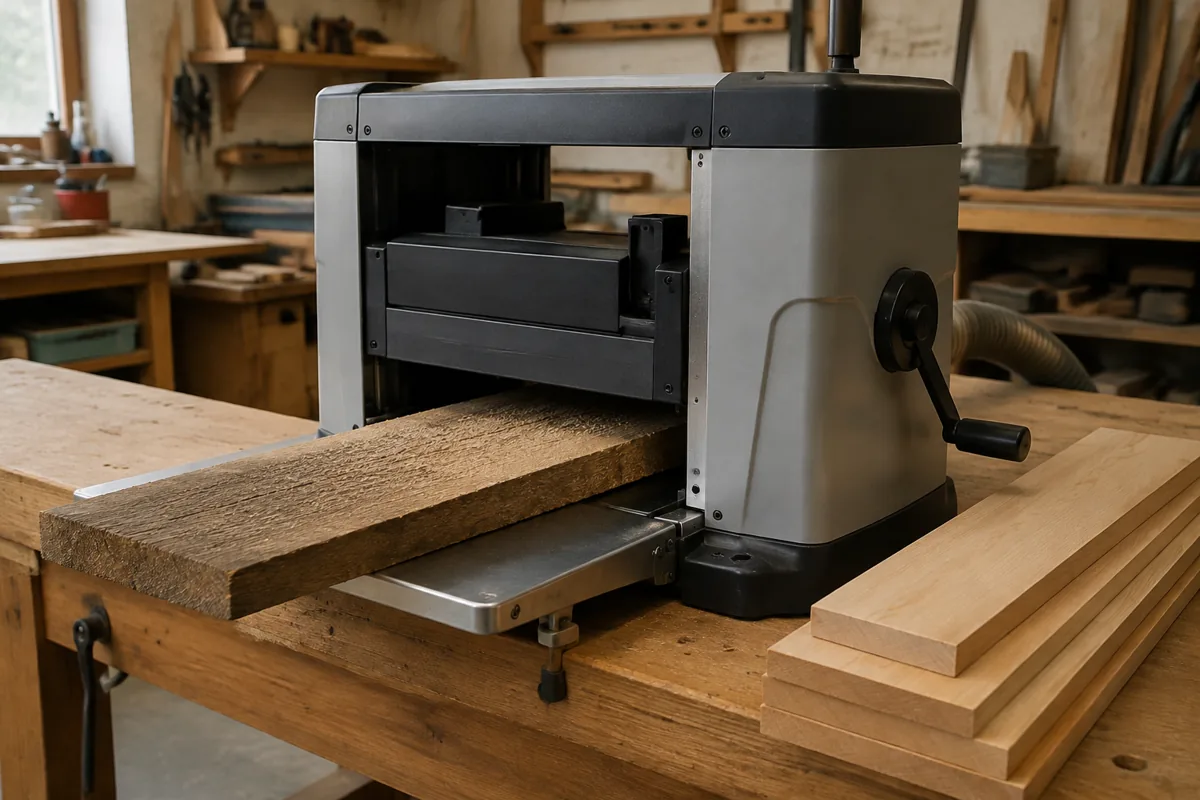
How to Feed Short Boards Through a Stationary Planer Safely
What's inside
As an Amazon Associate I earn from qualifying purchases. This post may contain affiliate links at no extra cost to you.
Short boards are among the easiest pieces to damage in a stationary planer. The board can lift as it enters, stop under the cutterhead, tip between the feed rollers, or be thrown backward if the rollers lose control. A planer is not automatically safe just because the stock is small. In many cases, the safest choice is to wait until the board is long enough, or use a different machine.
Contents
Check the Planer Manual First
Every planer has a published minimum stock length. On many portable thickness planers, that minimum is roughly 12 to 14 inches, but some machines require more. Treat the number in the manual as a hard limit, not a suggestion. It accounts for the distance between the infeed and outfeed rollers, cutterhead position, and how much material must remain supported after the board leaves the first roller.
Also check the minimum thickness, maximum cutting depth, and permitted stock width. If the manual does not list a minimum length, contact the manufacturer before testing a short piece. Never assume that a board which fits on the bed is safe to feed.
Measure the actual board, including any irregular or tapered ends. A 14-inch board with a badly chipped corner may have less usable support than a straight 12-inch board. Remove nails, screws, staples, bark, and loose knots before the stock reaches the cutterhead.
Why Short Stock Is Risky
Planer rollers need to hold the workpiece flat while the cutterhead removes material. When a short board is between the rollers, it is controlled at both ends. As it exits the outfeed roller, it may no longer have enough length to remain captured. The trailing end can rise into the cutterhead, producing a deep gouge or sudden kickback.
The opposite transition happens at the infeed side. A board that is too short can drop into the gap before the infeed roller grips it. This commonly creates a wedge-shaped cut at the leading end, often called snipe. Excessive depth of cut makes both failures more likely. A shallow pass does not make an undersized board acceptable, but it reduces the force involved when a board starts to lift.
| Situation | Best choice | Main trade-off |
|---|---|---|
| Board meets the manual’s minimum length | Plane it normally with shallow passes | May still show snipe at the ends |
| Board is slightly shorter than the stated minimum | Do not feed it directly; use a manufacturer-approved method or another tool | More setup or extra jointing work |
| Several short pieces need identical thickness | Use a suitable carrier or gang setup only if the manual allows it | Setup takes time and a loose piece can become a projectile |
| Very short blocks or end grain pieces | Use a router sled, sander, hand plane, or buy longer stock | May be slower, but avoids a serious planer failure |
Safe Direct Feeding
If the board meets the minimum length, inspect it for twist and rocking. A twisted board may not sit flat on the bed, and the cutterhead can press it down unevenly. Stand to one side of the feed path, not directly behind the board. Keep your hands outside the area between the board and the rollers; do not push stock into the cutterhead with your fingers or a scrap stick.
Set the cutter for a light cut. Around 1/32 inch is a sensible starting point for ordinary hardwood, with less for wide, difficult, or figured stock. Let the machine establish the feed rate. Do not pull the board through, and do not push down on the leading or trailing end. Downward pressure can hide a lifting problem until your hand is close to the cutterhead.
Support long stock at the same height as the planer bed. Use sturdy infeed and outfeed tables or roller stands that do not swivel into the workpiece. Poorly adjusted supports can make a board dive at entry or climb at exit, even when its length is adequate. If you are buying supports, adjustable roller stands are useful, but they must be locked and aligned rather than used as a substitute for the planer’s own table.
Carrier Boards and Gang Feeding
A carrier board can extend the effective length of a short workpiece, but it is not a universal fix. Some planers and manufacturers permit a rigid carrier or sled; others warn against feeding anything that can separate, shift, or contact the cutterhead. Follow the manual exactly.
Do not simply place a small board on a long board and hope friction holds it. If the short piece moves, it can be pulled into the cutterhead, thrown backward, or leave a damaged groove in the carrier. Double-sided tape, hot glue, or wedges may also fail under vibration, especially with dusty or oily wood. A permitted setup must keep the workpiece completely below the cutterhead, flat on the carrier, and unable to slide sideways or lift.
Gang feeding several short pieces is only safe when the pieces are compatible with the planer and cannot collide or shift. They should be similar in thickness and held in a controlled arrangement. Never feed loose blocks end to end as if they formed one long board. The gap between them can let a roller drop or cause one piece to rotate.
If you need a purpose-built solution, compare the instructions for thickness planer sleds and carrier boards with your machine manual before buying. A carrier is worthwhile when you regularly process short parts and the planer manufacturer supports the method. It is not worth improvising for one small board.
Better Alternatives for Very Short Boards
For pieces below the stated minimum, a drum or oscillating spindle sander is often safer for small thickness adjustments. A router sled can flatten a short board when you need one face referenced, though it requires careful clamping and multiple passes. A hand plane works well for a small amount of material removal, and a cabinet scraper can remove final marks without risking the board in a machine.
If the project allows it, plane a longer blank first and cut it into short parts afterward. This is usually the cheapest and fastest solution. You lose some material to the cut, but you gain predictable support and avoid building a carrier. When buying stock, a longer board may cost slightly more, yet it is often cheaper than replacing a damaged cutterhead or injured hand.
Stop If Something Goes Wrong
Turn the planer off and wait for the cutterhead to stop before investigating a stalled board, unusual knocking, or a lifted edge. Disconnect power before reaching inside. Do not reverse or pull a jammed board while the machine is running.
After a failure, inspect the rollers, knives, bed, and board for embedded metal or loose fragments. A repeated wedge-shaped cut usually points to inadequate support, excessive depth of cut, or stock shorter than the machine can control. Fix the cause rather than taking a deeper pass or standing closer to the opening.
