How to Prevent Board Skew When Feeding Stock Through a Planer
What's inside
As an Amazon Associate I earn from qualifying purchases. This post may contain affiliate links at no extra cost to you.
Contents
Why boards skew in a planer
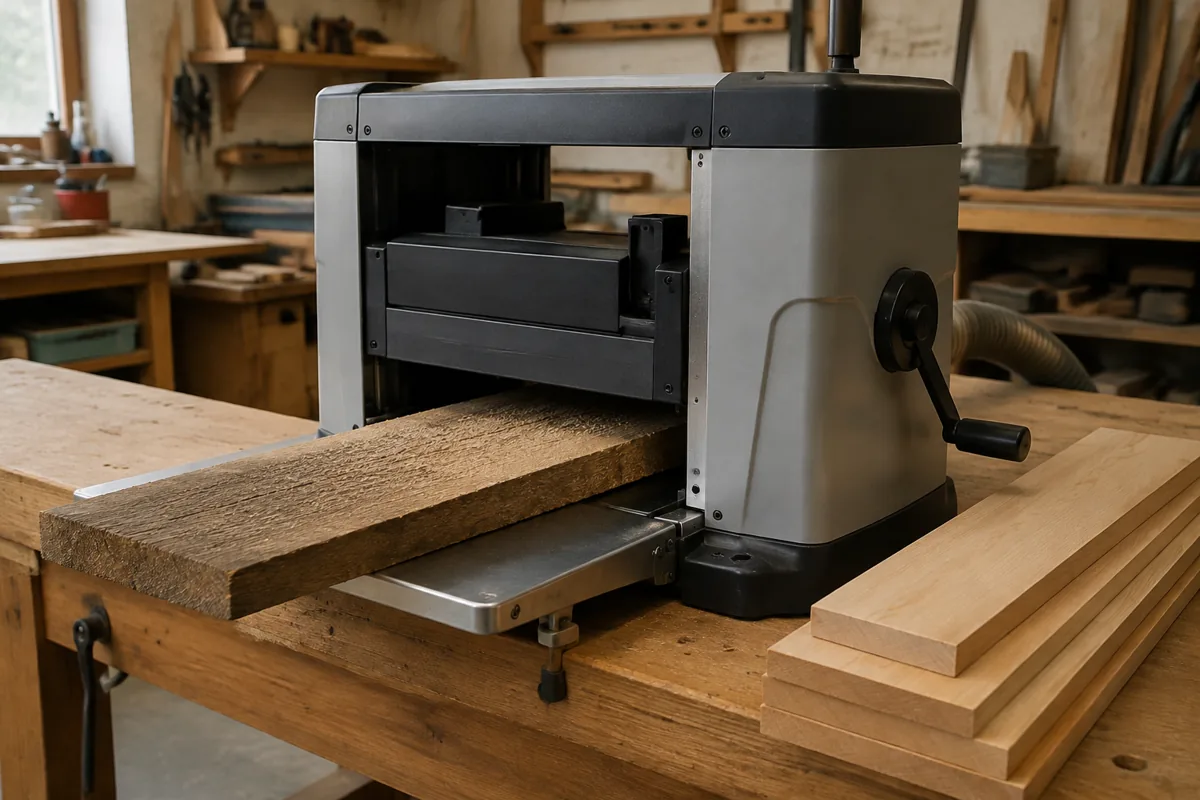
A thickness planer feeds stock between powered rollers and a cutterhead. If the board enters at an angle, one side may reach the cutter first; the board can then track diagonally, leave uneven edges, or come out with a tapered thickness. A planer can also preserve a twist or bow already present in the board. It is not a substitute for a jointer or a flat reference surface.
Start with sound stock and a stable setup. Remove loose bark, grit, and metal, and check for severe cup, bow, or twist. Sight along the board and place it on a flat bench: if it rocks, the planer alone will not reliably flatten it. For twisted or cupped stock, flatten one face with a jointer, a planer sled, or another controlled method before thicknessing. A board with a flat face has a dependable reference against the planer bed.
Align the board and support it
Set the board on the planer bed with its long axis parallel to the feed direction. Keep both hands clear of the infeed rollers and cutterhead area. Guide the stock from the sides rather than pushing down hard; downward pressure can force a bowed board flat temporarily, only for it to spring back after the cut.
Support long or heavy boards at both ends. The support surfaces should be close to the height of the planer bed, level with it, and aligned with the feed path. A roller stand that sits too high or too low can lift or drop the board as it enters, steering it sideways or causing snipe. Check alignment by placing a straightedge across the planer bed and support surface. If the board is long enough to sag, add support rather than asking a helper to lift the far end; lifting changes the board angle during the cut.
Keep the infeed and outfeed paths clear. A wall, stand, or stack of lumber that forces you to twist the board while feeding it is an invitation to skew. If space is tight, reposition the planer before starting.
Take shallow, even passes
Set the depth of cut conservatively. For common portable thickness planers, removing about 1/32 inch per pass is a reasonable starting point for hard wood, wide stock, or a board with uncertain grain. A light cut around 1/16 inch may be suitable for narrower, stable stock, but the machine’s manual sets the limit. Do not exceed the rated maximum cut just because the board is thin; width, species, grain direction, and cutter condition all affect the load.
Listen to the motor and watch the feed. A slowing motor, slipping feed, chatter, or a sudden change in sound means the cut is too aggressive, the knives are dull, or the stock is presenting a problem. Stop and investigate rather than forcing the board through. A shallow pass may take longer, but it reduces the chance of stalled stock, tear-out, and uneven feeding. Alternate faces between passes when appropriate, and check thickness at several points with calipers or a reliable thickness gauge.
Reduce snipe and side drift
Snipe is a deeper cut near the leading or trailing end. It often happens when only one set of rollers grips the board, letting it tip slightly as it enters or exits. Use properly aligned infeed and outfeed supports, and follow the manual’s instructions for table extensions and roller adjustments. On some portable planers, raising the ends of the extension tables slightly is recommended; on others, that can worsen alignment. Do not guess at an adjustment.
To reduce the effect of snipe, feed a sacrificial lead board before your workpiece and a sacrificial trailing board after it, with the pieces butted end to end if the manual permits. This can move the deeper cut onto the scrap, but it is not a cure for poor table setup. If a board consistently drifts toward one side, check that the board is entering square, the support stands are not steering it, and the cutterhead and feed rollers are clean and in good condition. Disconnect power before inspecting or adjusting the machine.
Choose the right fix for the cause
| Problem | Likely cause | Practical response |
|---|---|---|
| Board enters at an angle | Misaligned approach or side pressure | Square the stock to the feed path; reposition supports. |
| Board rocks on the bed | Twist, cup, or bow in the reference face | Flatten one face first, or use a secured planer sled. |
| One end is thinner | Snipe, sagging support, or uneven feed | Align supports, inspect table setup, and try sacrificial boards. |
| Feed slows or chatters | Cut too deep, dull knives, or unsuitable stock | Stop, reduce the cut, and inspect the cutterhead. |
A planer sled is useful when you need to thickness a twisted board without a jointer. It holds the board steady on a flat base while shims fill gaps; secure the stock so it cannot shift, and take light cuts. For occasional work, a shop-made sled from straight sheet material is often enough. If you regularly process wide, twisted stock, a dedicated planer sled may be more convenient, but it still needs a flat base and secure workholding.
Roller stands are a lower-cost fix for long boards, provided they are stable and adjustable to the machine’s bed height. A basic pair of adjustable roller stands is fine for occasional use; check that the rollers turn freely and the legs do not shift under load. For frequent heavy stock, wider or more rigid supports are worth considering. More expensive stands will not correct a twisted board or a poorly aligned feed path.
Safe feeding checks before each cut
Read the planer manual for minimum stock length, thickness, and width. Keep hands away from the opening, and never reach into a moving machine to catch or steer stock. Do not plane a board with loose knots, embedded fasteners, or a defect likely to break free. Use eye and hearing protection, connect dust collection, and stand clear of the board’s exit path.
Before feeding the next piece, inspect the last one for diagonal marks, uneven thickness, and end snipe. If the marks point to a setup problem, correct it before continuing; repeated passes will not reliably fix a board that is being fed crooked. When stock is straight, supports are aligned, and cuts are modest, the planer should carry the board through without side pressure or mid-pass correction.