Open-Stand Planer vs Enclosed Planer for Dust Management
What's inside
As an Amazon Associate I earn from qualifying purchases. This post may contain affiliate links at no extra cost to you.
Contents
Open-Stand Planer vs Enclosed Planer for Dust Management
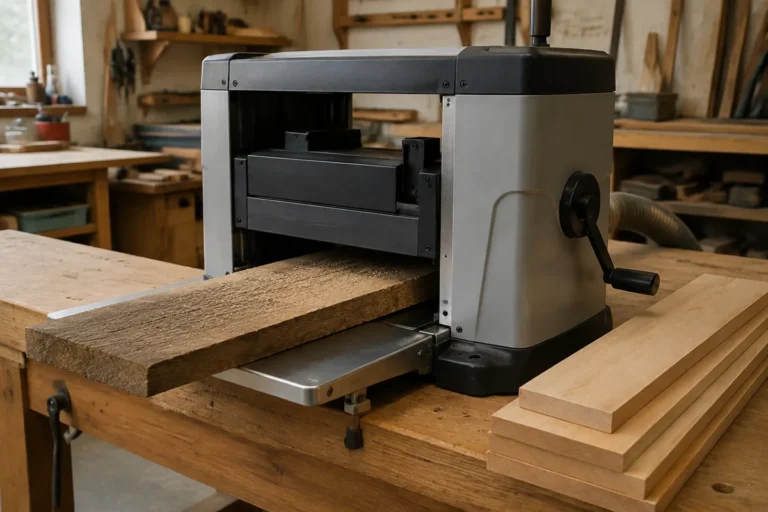
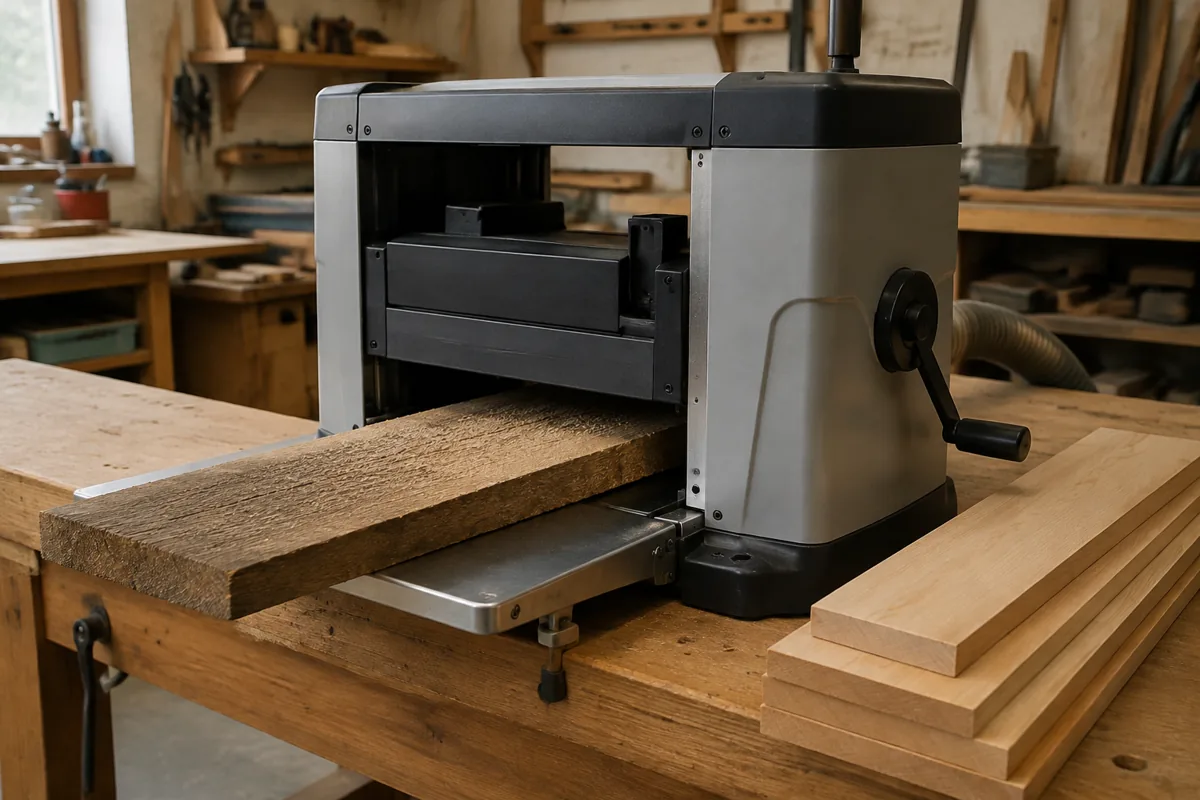
For dust control, the difference between an open-stand planer and an enclosed planer is smaller than many buyers expect. The planer’s cutterhead creates the chips; the dust collector has to capture and move them. A cabinet or enclosed base can improve containment, but it does not replace a properly sized collector, a clear hose, and a well-designed chip-ejection path.
The real buying question is where you want the chips to go when collection is imperfect. An open-stand planer spills them into the shop around the machine. An enclosed planer keeps more of that mess inside the base, but it can also make cleaning, hose routing, and access more difficult.
How planers create dust and chips
A thickness planer produces a mix of long shavings, broken chips, and fine dust. At light cuts in straight-grained softwood, the waste may come out as long curls. With figured hardwood, deep cuts, dull knives, or tear-out, the waste becomes shorter and more turbulent. Fine particles are the health concern, while the larger shavings are the problem that clogs hoses and fills collection bins.
Most stationary planers use a four-inch dust port. That does not mean any four-inch shop vacuum is suitable. A typical shop vacuum may advertise high airflow with no hose attached, but its small hose and restrictive filter reduce useful airflow significantly. A planer generally works better with a dust collector that can maintain roughly 400 cubic feet per minute at the machine, with the exact requirement varying by port design and hose length.
A four-inch hose run should be as short and straight as practical. A long flexible hose, several sharp bends, or a reducer can lower airflow enough that chips begin falling from the cutterhead area. If you routinely plane wide boards or take cuts around 1/8 inch deep, collection capacity matters more than it does for occasional light passes.
Dust-management comparison
| Factor | Open-stand planer | Enclosed planer |
|---|---|---|
| Containment without a collector | Chips spread around the machine | More chips remain inside the base |
| Dust-port access | Usually easy to reach | May require reaching inside or moving panels |
| Cleaning | Fast to sweep or blow out | Less floor mess, but interior cleanout can be awkward |
| Hose routing | Flexible and visible | Can be neater, but may have tight bends |
| Footprint and storage | Often lighter and easier to move | Usually heavier and more stable |
| Best use | Small shops with an existing collector and occasional use | Frequent use where containment and a tidy layout matter |
When an open-stand planer is enough
An open-stand model is the sensible choice for many home workshops. If the planer has a usable four-inch port and you already own a decent 1.5 HP dust collector, the machine itself does not need a cabinet to collect chips effectively.
Open stands are easier to inspect when something goes wrong. A disconnected hose, blocked impeller, or packed dust chute is visible immediately. You can also reach the lower rollers, drive belt, and mounting hardware without removing a base panel. That matters because planers generate enough vibration to loosen fittings and shift hoses over time.
The main failure mode is simple: the collector cannot keep up, and chips fall through the open stand onto the floor. This is inconvenient but not usually a machine problem. Place a low-sided catch tray or a piece of plywood beneath the planer, and sweep it between boards. Do not use compressed air to scatter accumulated fine dust around the shop; vacuum it instead.
Choose an open stand when the machine sits near a wall, you move it often, or you need the lowest purchase price. It is also a good fit if you plane only a few boards at a time and do not mind collecting a small pile of shavings afterward.
When an enclosed planer is worth the extra cost
An enclosed base is useful when the planer runs frequently, sits in a shared garage, or must remain tidy between projects. The cabinet catches chips that escape around the dust hood and keeps them from spreading under shelving and benches. It can also reduce drafts that blow loose shavings across the floor.
Do not assume an enclosure makes the machine dustproof. The cutterhead opening, feed and outfeed openings, access doors, and hose connection still leak. If the collector is undersized, the cabinet simply becomes a larger place for chips to accumulate. Some enclosed designs also have internal ledges where shavings pack tightly, especially when a hose is partly blocked.
Stability is another legitimate advantage. A heavy enclosed base is less likely to walk during aggressive feeding or when a long board catches at the outfeed. That is useful, but a solid open stand bolted to the floor or equipped with locking casters can provide similar stability.
Before buying, inspect how the dust port is reached. A port that requires removing a rear panel may be frustrating if you change between a four-inch dust hose and clamps regularly. Look for a smooth, short discharge path and enough clearance to remove packed chips without dismantling half the machine.
Improve collection on either design
Use rigid four-inch pipe for the main run when possible, then connect the planer with a short length of flexible hose. Seal loose joints with foil HVAC tape rather than ordinary cloth duct tape, which eventually dries out and peels. Keep the collector filter clean; a loaded filter can reduce airflow enough to turn good collection into floor cleanup.
Check the hose after every few boards during the first use. If chips collect around the cutterhead, stop and find the restriction. Common causes include a collapsed hose, a nearly full bag, a blocked dust hood, or a collector whose inlet is accidentally reduced below four inches. Never reach into the chute while the planer is connected to power.
For a small shop, a cyclone dust separator can keep planer shavings out of the collector filter. Use a separator rated for chips and connect it with the largest practical hose. It adds resistance, so it is not a cure for an already weak collector, but it can extend filter life and reduce maintenance.
The practical buying decision
Buy the open-stand planer if price, access, and mobility matter most and you already have adequate dust collection. The cheaper option is entirely acceptable when the machine is used occasionally and a small amount of floor cleanup is acceptable.
Choose an enclosed planer when you run long production sessions, need a cleaner shared workspace, or value a heavier, more stable setup. Spend the remaining budget on a better collector, shorter duct run, and a filter monitor before paying extra for decorative cabinet panels. For dust management, airflow and maintenance consistently matter more than whether the planer sits on an open frame or inside a box.