How to Control Planer Noise in an Enclosed Woodshop
What's inside
As an Amazon Associate I earn from qualifying purchases. This post may contain affiliate links at no extra cost to you.
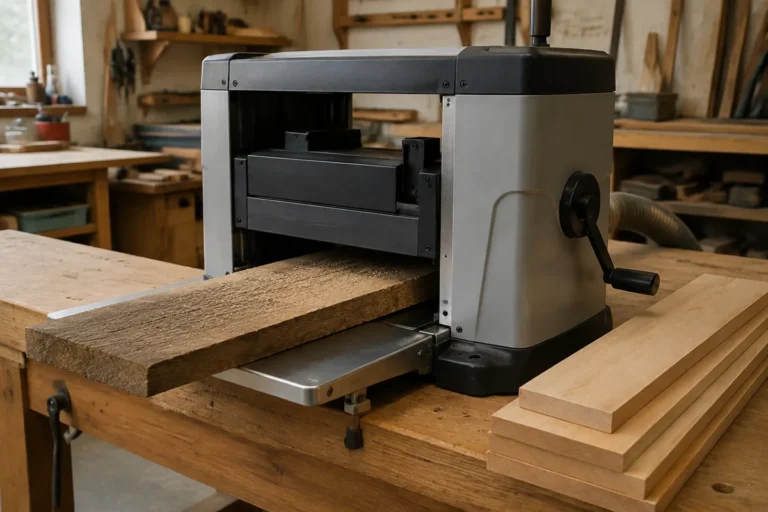
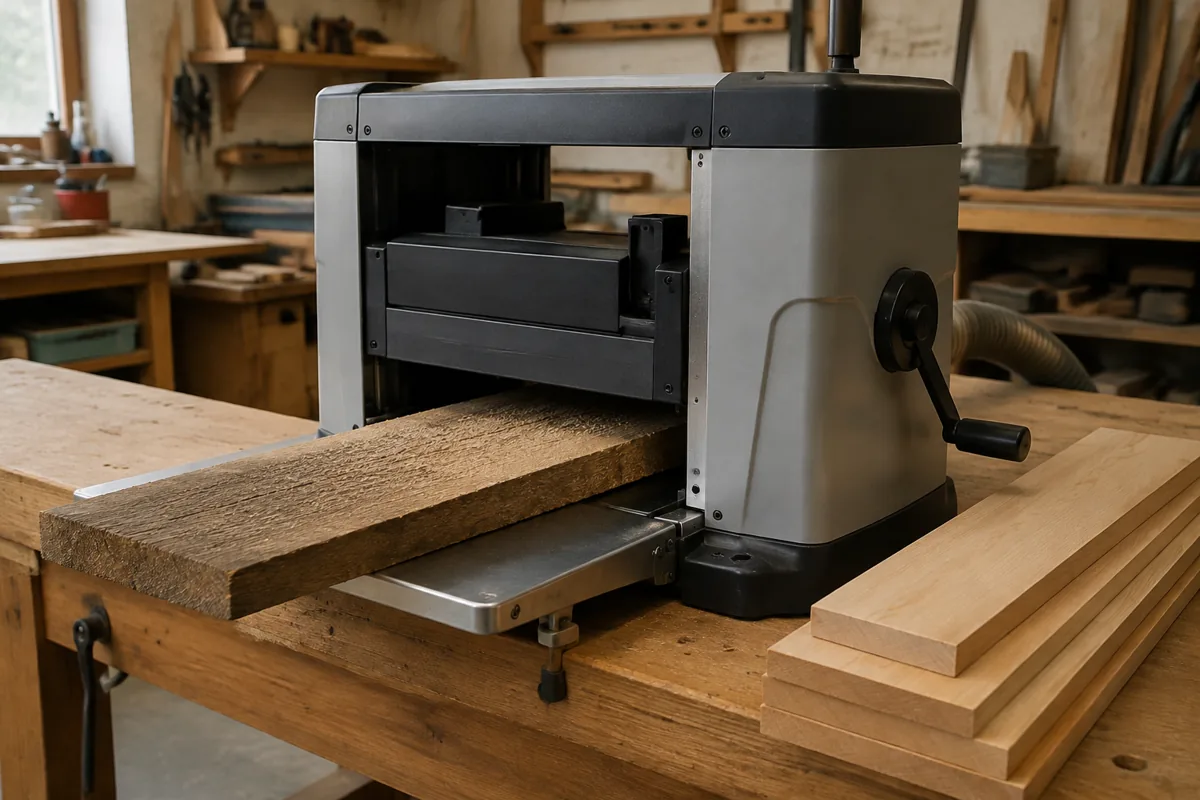
A planer is one of the loudest machines in a small woodshop. The cutterhead produces a sharp, high-frequency roar, while the motor, belts, dust collector, and boards rattling through the machine add lower-frequency noise and vibration. In an enclosed room, hard walls reflect all of it back at you.
You cannot make a thickness planer quiet, but you can reduce the sound reaching your ears, your family, and neighboring rooms. The best results come from combining quieter machine operation, vibration control, enclosure treatment, and hearing protection. Treating only the walls rarely solves the problem.
Contents
Measure the problem before buying materials
Use a sound-level app as a rough guide, or a basic handheld meter if you want repeatable readings. Measure at the operator’s position, near the shop door, and in the room above or beside the shop. Take readings with the planer off, running empty, and cutting typical stock.
A portable planer commonly produces roughly 90 to 105 dBA at the operator’s position, depending on the machine, cutterhead, wood, and room. A difference of 3 dB represents a noticeable change in sound energy, but a 10 dB reduction is approximately perceived as half as loud. If the planer is still above 85 dBA at your normal working position, wear hearing protection every time.
Do not rely on an app to prove that a room is safe. Phones vary widely at high sound levels, and peak noise from a board entering the cutterhead may not be captured accurately.
Reduce noise at the planer
Sharp knives or inserts reduce cutting force and often reduce the harshness of the cut. A dull cutterhead makes the motor work harder and increases vibration. Replace disposable knives when the finish worsens, the machine labors, or the sound changes noticeably. On helical and spiral heads, rotate or replace damaged inserts instead of continuing with one chipped cutter.
Keep the planer level and tighten loose covers, handles, guards, and dust ports. A loose sheet-metal cover can turn into a loud resonator. Check that the cutterhead, motor, and feed rollers are properly aligned. Damaged bearings can produce a growling sound that no acoustic panel will fix.
Anti-vibration feet help when the planer sits on a stand or cart. They are most useful on concrete or other hard floors where vibration travels easily. They are not a substitute for a rigid stand: overly soft feet can let the machine shift during a cut, which is a safety problem.
If you are buying a new machine, a helical or spiral cutterhead is usually a worthwhile noise reduction compared with straight knives. It is not silent, and the motor and feed mechanism remain loud, but the cutting sound is often less sharp. A slower feed rate can also change the sound, though it may increase cutting time and is not a cure for a badly maintained machine. Browse helical planer cutterheads only after confirming compatibility with your planer.
Control vibration and airborne noise
Put the planer on a heavy, stable base. A light plywood stand can act like a drum. A better stand uses a rigid frame, a thick top, and enough mass to resist movement. Leave clearance around the motor and dust outlet; enclosing a running motor too tightly can cause overheating.
For the room, use absorption rather than thin foam alone. Fiberglass or mineral-wool panels 2 to 4 inches thick, covered with breathable fabric, absorb a much broader range of sound than thin decorative foam. Place panels on opposing walls and near the ceiling reflection path, but do not cover every surface. A partly reflective room helps you see and work safely, while a completely bare room is painfully reverberant.
Acoustic panels reduce reflected sound inside the shop. They do not reliably stop noise passing through a door, wall, or ceiling. For that, mass and airtightness matter more. Seal gaps around the door, add a perimeter gasket, and use a threshold seal. A hollow-core door is a major weak point; a solid-core replacement is usually more effective than adding foam to the wall.
Use an enclosure only with ventilation
A partial enclosure around the planer can reduce direct noise, but it must not restrict cooling, board movement, dust collection, or access to the emergency stop. Build it from heavy panels such as MDF or plywood, and line the inside with acoustic insulation protected by perforated hardboard or fabric. Do not leave exposed fibrous insulation where dust can accumulate.
Keep the infeed and outfeed openings as small as practical, but allow long boards to pass without catching. Add removable access panels for knife changes and cleaning. A maze-like opening can reduce sound leakage better than one large opening, but it also increases the chance of a board striking the enclosure.
Never run a planer in a sealed box. The motor needs cooling air, and the dust collector needs a clear path. A baffled ventilation path can reduce noise while allowing airflow. Check the motor temperature during a normal session, and stop if the enclosure becomes hot or the overload trips. Dust buildup around the motor is both a cooling problem and a fire risk.
Compare the practical options
| Method | Typical cost | Best use | Main limitation |
|---|---|---|---|
| Hearing protection | Low | Protecting the operator immediately | Does not reduce noise outside the shop |
| Door seals and solid-core door | Low to medium | Stopping sound through a doorway | Weak walls and ceilings may still transmit noise |
| Mineral-wool wall panels | Medium | Reducing echo and reflected noise | Limited effect on sound passing through walls |
| Heavy planer stand with isolation feet | Low to medium | Reducing rattles and floor vibration | Does little to remove cutterhead noise |
| Ventilated partial enclosure | Medium to high | Reducing direct sound near the machine | Can cause overheating or access problems if poorly designed |
Protect your hearing and plan your workflow
Wear properly fitted earplugs, earmuffs, or both. For planer work, ordinary passive earmuffs are usually a better value than electronic noise-canceling headphones. Active noise cancellation is designed mainly for steady low-frequency sound and may do little against the cutterhead’s sharp noise. Shop-tested woodworking hearing protection earmuffs are inexpensive compared with permanent hearing loss.
Keep planer sessions short when possible. Prepare multiple boards, set up dust collection, and make one efficient run instead of repeatedly starting the machine. Do not work with the planer while another person is in the room without hearing protection. Children and pets should stay out of the shop during operation.
A dust collector with a properly sized hose can reduce some turbulence and rattling, but it will not make the planer quiet. If the collector is louder than the planer, place it in a separate ventilated enclosure or outside the shop, using an appropriate duct and fire-safe arrangement. Never block the collector’s airflow to reduce noise; poor airflow can leave combustible dust behind and overload the system.
Choose the cheapest effective improvement first
For most enclosed shops, start with hearing protection, sharp cutters, tightened machine hardware, and door seals. These fixes are inexpensive and address the immediate risks. Add a rigid stand and isolation feet if the floor or machine rattles.
If the room still has a painful echo, install thick mineral-wool panels. If the complaint is noise in an adjacent room, spend the budget on airtight doors, added wall mass, and ceiling or floor construction rather than decorative foam. A new helical cutterhead makes sense when your existing head is worn or you also want better finish quality; buying one solely for silence is usually poor value.