How to Resaw Short Hardwood Boards Without Blade Pinching
What's inside
As an Amazon Associate I earn from qualifying purchases. This post may contain affiliate links at no extra cost to you.
Resawing a short hardwood board is less about forcing a thick cut and more about controlling a workpiece that wants to twist, lift, or close the kerf. A pinched blade can stall a saw, burn the wood, throw the board backward, or damage the blade. The safest setup depends on the board’s length, thickness, straightness, and the machine you own.
Contents
Choose the Right Saw
A band saw is normally the better machine for resawing. The blade cuts continuously, the workpiece can be guided with a fence, and there is no exposed rear section of a circular blade trying to lift the board. A table saw can resaw narrow boards, but it demands more support and leaves less room for error, especially with short stock.
| Machine | Best use | Main pinching risk | Useful minimum length |
|---|---|---|---|
| Band saw | Boards roughly 1 to 6 inches thick, depending on capacity | Board twisting into the blade or drifting away from the fence | About 12 inches, or the manufacturer’s stated minimum |
| Table saw | Thin, straight boards that can be held in a stable sled | Kerf closing behind the blade and lifting into the teeth | Usually 18 inches or more for comfortable control |
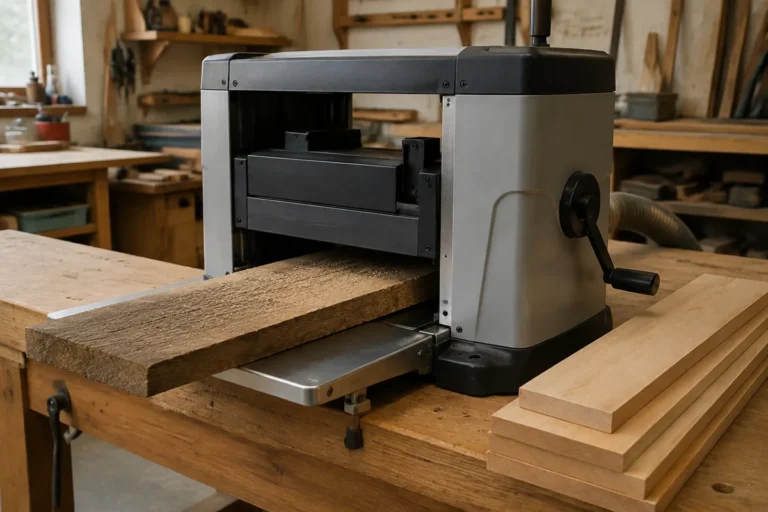
| Planer and bandsaw combination | Splitting a board, then bringing both faces parallel | Less a cutting issue than poor support during the saw cut | Depends on the band saw and planer |
If you regularly resaw short hardwood, a properly adjusted 14-inch band saw with resaw capacity is generally a better purchase than trying to make a small table saw do every job. The cheaper option is fine for occasional boards that are straight, long enough to support, and not especially thick.
Inspect and Prepare the Board
Remove dirt, staples, and loose bark before cutting. A hidden nail can ruin a blade and cause the board to shift. Sight down both edges and faces. If the board has a pronounced bow, cup, or twist, do not use the least stable face as the reference surface.
Joint one face and one edge if possible. The reference face should sit flat on the table, and the reference edge should remain consistently against the fence. If the board rocks, the blade will follow the movement and the kerf can close around it.
Short stock also needs a sensible length limit. A board shorter than the distance between the blade and the nearest stable support is difficult to control. Check the saw’s manual rather than relying on a universal number. On a table saw, never use a short board if your hands must pass close to the blade or if the board cannot be held down and against a guide at the same time.
Band Saw Setup That Prevents Pinching
Use a sharp, wide blade intended for resawing. A blade around 1/2 inch wide with three to four teeth per inch is a common starting point for a medium-size band saw. Wider blades track better, but they need adequate tension and wheel alignment. A narrow blade may turn more easily, but it is more likely to wander in a thick cut.
Set the upper guides just above the board. The thrust bearing should sit close behind the blade without touching during free running. The side guides should be close enough to support the blade but not rub it. Verify that the blade tracks near the center of the wheel and that the table is square to the blade.
Set the fence parallel to the blade’s actual drift, not automatically parallel to the miter slot. Make a test cut in scrap, then adjust the fence until the board feeds without being pushed sideways. For a short board, a tall, smooth fence is more useful than a complicated featherboard that can obstruct your hands.
Feed steadily. Do not stop halfway through a thick cut unless you must. Stopping can leave a hot, narrow kerf that closes as the wood relaxes. If the feed rate suddenly increases or the blade begins squealing, stop the machine and wait for the blade to stop before investigating.
Using a Table Saw More Safely
Table-saw resawing is limited by the blade’s maximum exposed height. You may need two cuts, flipping the board between them. Mark the intended cut line on both ends and keep the first kerf aligned with the second cut. A thin-kerf blade reduces waste, but it also has less steel and can deflect more easily in hardwood.
Use a stable resaw sled or tall auxiliary fence so the board cannot tip. The sled should keep the board’s reference face against the table and provide positive lateral guidance. A standard push stick is often inadequate for a short, tall board; use a push block or handle that keeps your hands well away from the blade while maintaining downward pressure.
Do not rely on a riving knife alone to cure a closing kerf. A riving knife helps prevent the rear teeth from trapping the workpiece, but internal stress can still pinch the blade before the knife. A splitter or riving knife must be aligned with the blade, and the blade must be sharp and correctly installed.
A table saw resaw sled is worthwhile if you do this often. For one or two short boards, making a simple sled from straight plywood may be more practical than buying an elaborate fixture.
Control Internal Stress and Kerf Closure
Some hardwoods contain built-in tension. The board may open on one side of the cut or clamp the blade shut as soon as the kerf reaches the center. Watch the cut closely during the first few inches. If the kerf opens, stop and insert a thin wooden wedge behind the blade only when the machine is fully stopped. Never reach near a moving blade to install one.
For stressed material, make a shallow relief cut first, or cut the board into narrower pieces before resawing. This sacrifices some width but reduces the force acting on the blade. You can also leave an extra 1/8 inch to 1/4 inch of thickness and flatten the resawn faces later with a thickness planer. That trade-off is usually preferable to forcing a blade through a closing cut.
Know When to Stop
Stop if the blade wanders more than about 1/8 inch from the intended line, the motor labors continuously, the cut produces heavy burning, or the board requires increasing sideways pressure. These symptoms point to a dull blade, poor tension, fence drift, internal stress, or an unsuitable workpiece.
When the board is too short for confident control, screw it to a longer sacrificial carrier board and cut the assembly only if the fastening method is completely clear of the blade path. Otherwise, save the piece for a hand-saw operation or have a shop resaw it. A smaller yield is cheaper than a damaged blade—or an avoidable injury.