Best Table Saws for Cutting Oversized Solid-Wood Panels
What's inside
As an Amazon Associate I earn from qualifying purchases. This post may contain affiliate links at no extra cost to you.
Contents
Best Table Saws for Cutting Oversized Solid-Wood Panels
Oversized solid-wood panels are a difficult job for any table saw. A 4-by-8-foot glued-up panel can weigh more than 100 pounds, and its surface may be wider than the saw table, longer than the outfeed support, and flexible enough to sag into the blade. The saw itself is only part of the solution. You also need reliable support, a stable fence, adequate rip capacity, and a way to control the panel without pushing it into the blade.
For repeated work, a full-size cabinet saw is the strongest choice. For occasional panel cutting, a good hybrid saw can work if you add substantial infeed and outfeed support. If the panel is too large for one person to handle safely, a track saw and guide rail kit is often the better first cut, even if the final sizing happens at the table saw.
As an Amazon Associate we earn from qualifying purchases at no extra cost to you.


What matters most in a table saw
Support comes first. A standard 27- to 30-inch-deep saw table is not enough for a wide panel. The workpiece should remain flat as it approaches the blade and continue flat until it is completely past the blade. For a 48-inch-wide panel, plan on at least 4 feet of side support and 3 to 4 feet of outfeed support. Roller stands can help, but broad, smooth support surfaces are less likely to catch an edge or twist the panel.
Rip capacity is not the same as usable capacity. A saw advertised with 50 inches of right-side rip capacity may have a long extension table, but that does not guarantee the fence stays parallel under pressure. A heavy T-square fence is preferable to a light rail and thin extrusion. Check that the fence locks consistently at both ends and does not move when you lean a panel against it.
Power matters when the cut is deep or the stock is dense. A true 3-horsepower cabinet saw is more comfortable in thick hardwood than a 1-3/4-horsepower hybrid saw, particularly with an 8-inch dado stack or a full-kerf combination blade. For ordinary 3/4-inch panels, a sharp 10-inch blade and a sound 1-3/4-horsepower motor are usually adequate. The cheaper option is fine if your work is occasional and your dust collection is modest.
Which saw type fits the job?
| Saw type | Best use | Strengths | Limitations |
|---|---|---|---|
| Cabinet saw | Frequent oversized panels and hardwood | Rigid table, strong fence, low vibration, excellent dust collection | Heavy, expensive, usually needs a dedicated circuit |
| Hybrid saw | Serious hobby shop and occasional large panels | Good accuracy, enclosed base, lower cost and power demands | Less reserve power and often less robust extension hardware |
| Contractor saw | Portable or budget-conscious work | Lower purchase price, easier to move | More vibration, weaker stands, limited large-panel support |
| Sliding table saw | Crosscutting and controlled panel sizing | Excellent support and repeatability, safer handling of broad stock | Large footprint and substantially higher cost |
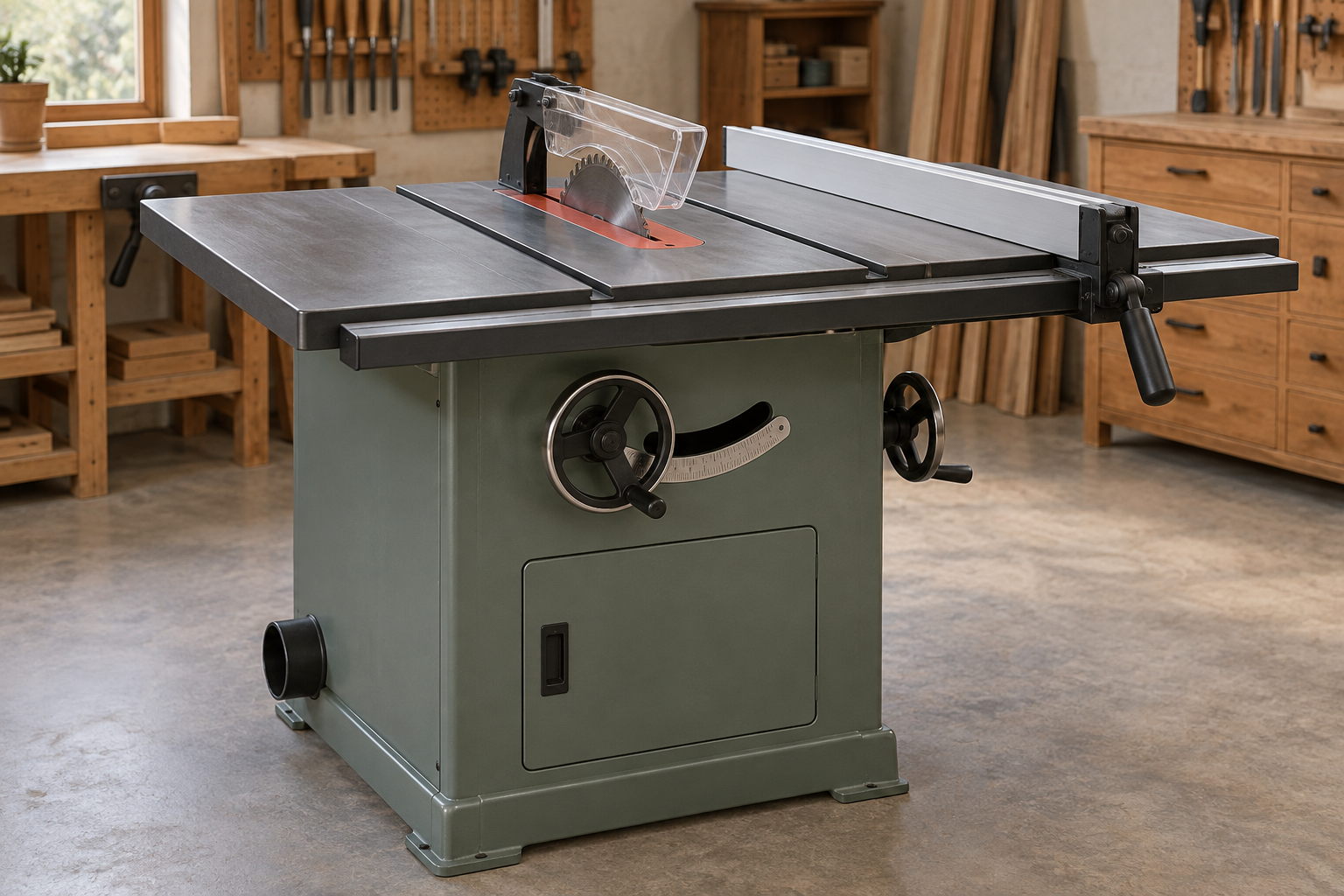
A cabinet saw is the best general recommendation when the machine will stay in one place. Look for a cast-iron table, a substantial extension wing, a 52-inch fence option, and a riving knife that remains in place for through-cuts. A 3-horsepower cabinet table saw with a 52-inch fence gives you useful capacity without relying entirely on improvised supports.
A hybrid saw is the sensible middle ground. It usually has enough power for 3/4-inch oak, maple, walnut, and ash, provided the blade is sharp and the cut is fed steadily. Expect more stalling in 8/4 material and less forgiveness if the panel contacts a small or flexible extension table. If you choose this category, budget for a rigid outfeed table and a better side-support system rather than spending every dollar on the saw.
Sliding table saws deserve attention if most of your work involves crosscutting large panels. Their sliding carriage supports the work and keeps your hands away from the blade, but many machines have less right-side rip capacity than a cabinet saw. They are not automatically better for ripping a 48-inch-wide solid-wood panel. They are better for controlled crosscuts and panel breakdown.
How to cut a large solid-wood panel safely
Break down the panel before asking the table saw to make a precision cut. A rough cut 1/2 to 1 inch outside the final line can remove the handling problem. Use a track saw, circular saw with a straightedge, or a temporary cutting table. A 48-inch or longer track-saw guide rail is useful for trimming a panel to a manageable width. Leave enough material for jointing or a final table-saw pass.
Before cutting, inspect the panel for bow, cup, twist, and internal stress. Solid wood can pinch the blade after a rip cut opens or closes. Use a riving knife and a sharp rip or combination blade. A 10-inch blade with 24 to 30 teeth removes stock quickly; a 40- to 50-tooth combination blade leaves a cleaner edge but feeds more slowly. Do not remove the guard simply because the panel is large.
Place an assistant at the outfeed side only to support the material, not to pull it. The operator must control the feed and stay out of the kickback path. Never stand directly behind the blade. If the panel begins to bind, stop feeding, switch off the saw, and wait for the blade to stop before investigating. Trying to force a closing cut is a common route to kickback.
A practical buying checklist
Prioritize a rigid fence, a flat table, a riving knife, reliable blade-height adjustment, and enough room for proper support. Dust collection is not just housekeeping: chips trapped between the panel and table can change the cut and interfere with the fence. A saw with a 4-inch dust port connected to a real collector is preferable to a cabinet full of loose debris.
Also check the electrical requirements. A 3-horsepower saw may need a 240-volt circuit, while many hybrid saws run on 120 volts. Verify the required amperage before delivery. Finally, measure the shop. A 52-inch fence, side table, and 4-foot outfeed surface can consume more than 12 feet of width and 8 feet of depth. If you cannot support the panel properly, the most powerful saw is still the wrong purchase.