Best Planers for Matching Thickness Across Wide Panel Stock
What's inside
As an Amazon Associate I earn from qualifying purchases. This post may contain affiliate links at no extra cost to you.
Contents
What wide panel stock needs
A planer can make both faces of a board parallel, but its maximum width sets a hard limit on what it can handle in one pass. That matters with wide panels: a benchtop planer that accepts 12- or 13-inch stock cannot flatten a glued-up top that is 20 inches wide. Turning the panel and planing each side separately is not a reliable workaround; the two tracks may differ in height, leaving a ridge or hollow where they meet.
For panels wider than the machine’s capacity, the practical choices are a wide-capacity stationary planer or a router sled. A jointer helps flatten one face before thickness planing, but its bed width also limits the stock it can handle. Decide whether you need to process whole panels, or can mill narrower boards first and glue them up afterward. That decision often matters more than cutterhead style.
Planer types and trade-offs
| Type | Typical capacity | Best fit | Main trade-off |
|---|---|---|---|
| Benchtop planer | About 12–13 inches wide | Boards and narrow glue-ups | Cannot take a wider panel in one pass; light machines can be awkward to support long stock |
| Floor-standing planer | Often 15–20 inches or more | Regular milling of wider panels and thick stock | High purchase price, weight, and space requirements |
| Router sled | Limited mainly by sled and work surface | Flattening panels wider than a shop planer | Slower; requires a stable, accurately set-up sled and substantial cleanup |
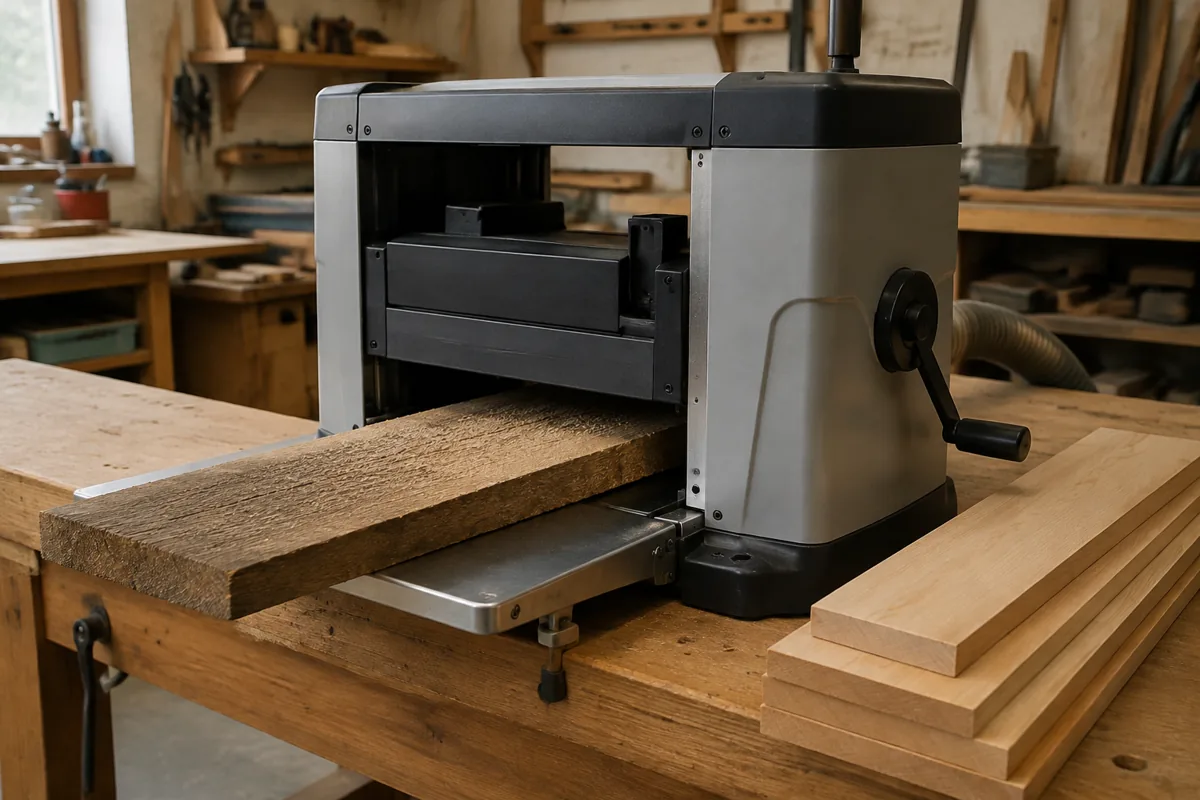
A wide-capacity stationary planer is the direct solution when you need to bring wide stock to consistent thickness regularly. Check the actual cutting width, maximum stock thickness, minimum stock length, and available feed speeds—not just the machine’s headline capacity. A 15-inch planer will not accept a 16-inch panel, and a machine’s opening height does not mean it can safely feed a very short workpiece.
Choosing a cutterhead
Conventional straight knives cost less to replace and can leave a good surface when sharp and correctly set. Their weakness shows up with figured grain: a cut that meets reversing grain at the wrong angle can tear out chunks below the finished surface. Dull knives also tend to leave more visible ridges and require more sanding.
Helical or segmented cutterheads use small replaceable inserts, often arranged at an angle to the feed direction. They generally run more quietly and can reduce tear-out and the severity of knife marks. They are not a cure for every grain problem, and inserts still need maintenance. The head may cost more up front, so it makes sense for frequent use, figured hardwood, or a shop where reducing noise and knife changes matters. For ordinary, straight-grained stock and occasional projects, a sharp straight-knife machine can be the better-value purchase.
Before buying, check whether inserts can be rotated individually and whether replacements are easy to source. Also confirm that the planer’s feed system and table support suit your stock. A good cutterhead cannot compensate for a long panel sagging at the infeed or outfeed.
Avoid snipe, ridges, and waves
Snipe is a deeper cut near the leading or trailing end of a board. It usually happens as the rollers take or release the workpiece and the board tips slightly. On a panel, a small dip can be hard to remove without losing thickness across the whole face. Support long stock level with the planer table, and follow the manufacturer’s guidance on roller pressure and table extensions. Feed the work steadily; pushing or pulling on an overhanging panel can change its angle under the cutterhead.
Take light finishing cuts rather than trying to remove a large amount at once. A pass of roughly 1/32 inch is a sensible starting point for a wide, heavy panel, especially in hard wood; the safe cut depends on species, width, motor, and machine. Listen for bogging and inspect the surface after each pass. Excessive depth can overload the motor, produce scalloped marks, or cause the feed rollers to slip. Keep hands clear of the opening and never reach into a running planer.
When the panel is wider than the planer
For an oversized panel, flatten one face with a router sled, then use that face as the reference for a suitable planer if the panel can be reduced to fit. A sled needs a rigid, level base wider than the workpiece, with the panel secured so it cannot rock. Take shallow router passes and verify flatness with winding sticks or a straightedge. The result often needs sanding or a light cleanup cut because router bit tracks can remain.
Another option is to thickness the individual boards before glue-up, provided the joints and assembly keep the finished panel flat enough for the project. This is often simpler than buying a large machine for one occasional job. For a suitable router-sled flattening system, compare the supported work area and rail stiffness, not just the advertised panel width.
A practical buying checklist
Measure the widest panel you actually expect to process, including any overhang from clamps or uneven edges, and leave a margin rather than buying to the exact limit. Confirm electrical requirements, dust-port size, machine weight, and how you will move and support stock. Planers make a large volume of chips; a dust extractor or chip collector with adequate capacity is more useful than relying on a small shop vacuum alone.
If you mill boards for furniture and only occasionally face a panel wider than 13 inches, a benchtop planer paired with a router sled may be enough. If wide panels are routine, a floor-standing machine with capacity beyond your usual stock width saves setup time and avoids improvised two-track cuts. The best choice is the machine that fits the real panel size and workload—not the one with the biggest number in its listing.