Kreg Shelf Pin Jig Review: Is It the Best Cabinet Jig?
What's inside
As an Amazon Associate I earn from qualifying purchases. This post may contain affiliate links at no extra cost to you.
Contents
Kreg Shelf Pin Jig Review: Is It the Best Cabinet Jig?
The Kreg KMA3225 shelf pin jig is the best cabinet jig for most woodworkers building adjustable shelves — it drills consistent 5mm or 1/4″ holes at a true 32mm spacing, indexes off a fence for repeatable results across multiple panels, and costs a fraction of a dedicated boring machine. It’s not perfect for every situation, but for bookcases, kitchen cabinets, and built-ins, it solves the single hardest problem in shelf construction: getting pin holes to line up so shelves sit level.
What the KMA3225 Actually Is
The Kreg KMA3225 (sometimes listed as the Kreg shelf pin jig kit) is a compact drilling jig built around a hardened steel drill guide and an indexing fence. Instead of marking every hole location by hand — the classic source of crooked shelves — you clamp the jig to your panel, drill through the guide bushing, then drop an indexing pin into a finished hole to reposition the jig for the next set. The result is a continuous column of evenly spaced holes that stays square to the panel edge.
As an Amazon Associate we earn from qualifying purchases at no extra cost to you.

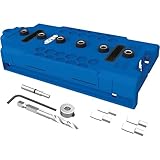
It follows the 32mm system spacing standard used in European cabinetry, which matters because most shelf pins, standards, and hardware are designed around it. The kit typically includes a bit sized for 5mm pins; a 1/4″ version suits shops already stocked with imperial pin hardware.
How It Performs on the Criteria That Matter
Hole Spacing Accuracy
The jig bores holes on exact 32mm centers, and the hardened guide keeps the bit from walking — the main failure mode when free-handing with a template. Consistency matters more than raw precision here: if every hole in every column is off by the same tiny amount, the shelf still sits level because all four pins share the error. Where the KMA3225 earns its keep is keeping the two sides of the cabinet identical, which is what determines whether your shelf rocks.
Indexing and Repeatability
The indexing pin method is the heart of the tool. Drill one set of holes, insert the pin, slide the jig down until the pin seats, clamp, drill again. Repeat down the panel. This produces a continuous column with no accumulated spacing error — each new set references a drilled hole rather than a pencil mark. The practical limit is your clamping discipline: if the jig shifts mid-cycle, every subsequent hole inherits the offset.
Material Support and Panel Handling
The jig works on plywood, melamine, MDF, and solid wood. On melamine — common in shop-built cabinets — the brad-point bit reduces tear-out around each hole, which matters because chipped melamine around a pin hole is nearly impossible to hide. For narrow panels under about 3″ wide, the fence has less edge to register against; cutting cabinet sides wider and ripping to final width after drilling is a more reliable workflow.
Ease of Use
Setup is genuinely fast: set the fence for your desired hole setback (typically 1-1/2″ to 2″ from the panel edge), clamp, and drill. A depth-stop collar on the bit prevents blowing through 3/4″ stock — set it for roughly 1/2″ depth, well short of the opposite face. Most users get consistent results within the first panel; the learning curve is mostly about clamp placement and remembering to verify the index pin is fully seated.
Key Specs at a Glance
| Feature | Kreg KMA3225 Shelf Pin Jig |
|---|---|
| Hole spacing | 32mm (Euro system) |
| Bit sizes supported | 5mm and 1/4″ (kit-dependent) |
| Guide material | Hardened steel bushing |
| Indexing method | Drop-in pin registers off drilled holes |
| Compatible stock | Plywood, MDF, melamine, solid wood (typically 1/2″–1″ panels) |
| Typical drilling depth | ~1/2″ (depth-stop controlled) |
| Street price range | Budget-to-mid-range; roughly $40–$70 depending on kit configuration |
| Alternative options | Self-centering dowel jigs, CNC, dedicated line boring machines ($1,000+) |
Which Shelf Pin Jig Fits Your Situation
| Your Situation | Best Choice | Why |
|---|---|---|
| Building one bookcase or a pair of cabinets | KMA3225 or a basic pegboard template | Jig pays for itself in saved time vs. layout marks |
| Hobbyist, several cabinet projects per year | KMA3225 | Repeatable accuracy without a big investment |
| Working mostly with 1/4″ pin hardware on hand | KMA3225 with 1/4″ bit | Matches existing pins; no 5mm hardware needed |
| Production shop, dozens of panels weekly | Line boring machine | Drills a full column per cycle; KMA3225 becomes the bottleneck |
| Already own a CNC | CNC boring program | Perfect spacing at production speed |
Ownership Realities: What to Expect Over Time
The component that wears first is the drill bit, not the jig. Brad-point bits dull faster in melamine and MDF than in plywood; expect to replace or resharpen after a few large cabinet projects. The hardened guide bushing itself holds up well — the classic killer of drill guides is soft steel that wallows out, and this one resists that.
Common mistakes worth knowing before your first panel:
- Drilling through the panel. Always use the depth stop, and test on scrap in your actual stock thickness. Through-holes on the visible face of a cabinet side are the number-one beginner failure.
- Forgetting to mirror the setback. Drill left and right sides with matching front/back setbacks, or pins won’t align front-to-back.
- Letting chips pack the guide. Clear sawdust between holes; packed debris changes drilling depth slightly and can score the bushing.
- Skipping the dry layout. Decide your shelf heights and stop-hole positions before drilling continuous columns — holes you don’t need are ugly and weak.
- Clamping over the index hole. Clamp position matters; a clamp that covers the next indexing hole forces mid-column repositioning.
The Verdict
For hobbyists and serious DIYers, the Kreg KMA3225 is the best shelf pin jig value in 2026 — accurate 32mm spacing, reliable indexing, and a price point that makes sense for anyone building more than one adjustable-shelf project. Production shops should skip straight to a line boring machine, and CNC owners don’t need it at all. But in the space between a pencil and a pegboard template on one side and industrial machinery on the other, this jig is the tool most cabinet builders should buy first.
FAQ
Does the Kreg shelf pin jig work with both 5mm and 1/4″ pins?
Yes — the jig body accepts either bit size. The KMA3225 kit commonly ships with a 5mm bit; 1/4″ bits are sold separately or bundled in other configurations. Match the bit to the pin hardware you plan to use.
Can I use it on panels that are already assembled into a cabinet?
It’s designed for flat panels before assembly. Drilling inside an assembled carcass is possible in wide-open cases but awkward — the fence needs a straight panel edge to register. Drill cabinet sides before glue-up whenever possible.
How many holes should I drill in each column?
Drill only the range where shelves might realistically sit — typically the middle two-thirds of a bookcase. Full-height columns look busy, weaken the panel slightly, and take drilling time you didn’t need to spend.
Is the Kreg jig accurate enough for frameless kitchen cabinets?
Yes. The 32mm spacing is exactly the Euro system used in frameless construction. Just verify your hinge and drawer-slide hole locations don’t conflict with your pin columns before drilling.